
How Clothing Donations Work for Nonprofits
What shelters and clothing closets actually take, why new socks and underwear top the list, and the IRS good used condition rule.

Nick Issaris |
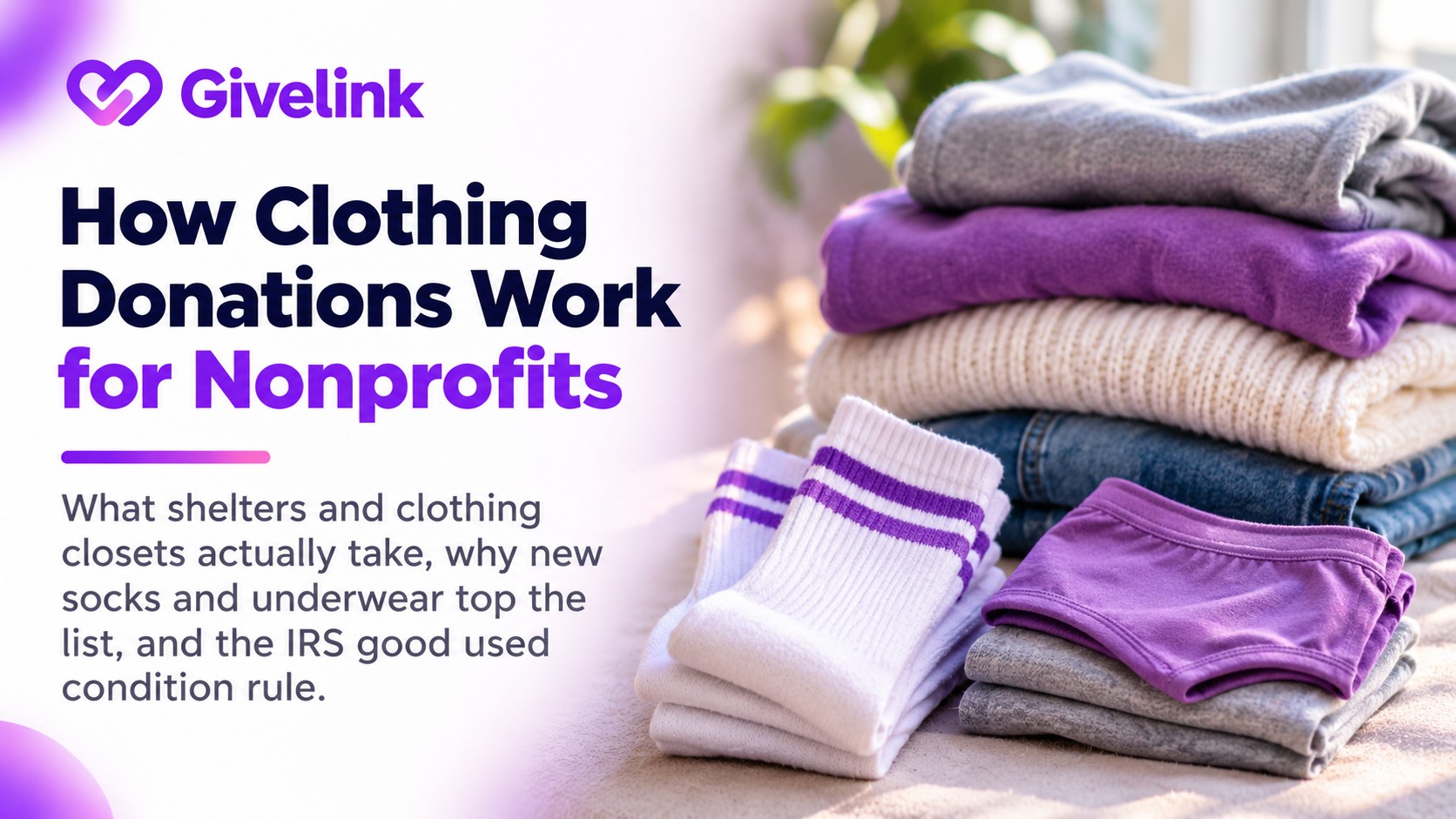
How Clothing Donations Work for Nonprofits
Donated clothing either goes directly to people, through shelters, clothing closets and school programs, or gets sold through a thrift operation to fund the mission. Either way, used clothing has to be sorted before it's useful, and the items direct-service programs ask for most, new socks and new underwear, are the ones donors rarely bring.
That gap between what arrives and what's needed is the whole story of clothing donations. Understanding it helps you write a better ask, set a clearer policy and spend less volunteer time on bags you can't use.
Direct use vs resale
Nonprofits use donated clothing in 2 basic ways.
Direct use. A shelter, clothing closet, refugee resettlement program or school gives clothing to the people it serves, usually for free. Quality and fit matter a lot here. Every item has to be something a person would choose to wear.
Resale. A thrift store sells donated clothing and uses the revenue for programs. Here, volume matters more than fit, and items that don't sell can be passed on to textile recyclers or other channels.
Some organizations do both: the best items go to clients, and the rest goes to a thrift partner. Knowing which model you're running shapes everything else, from what you accept to how you describe it on a receipt.
What shelters and clothing closets actually take
When you look at real shelter wish lists, the same items show up again and again, and most of them are new.
- Seattle's Union Gospel Mission lists new, unopened underwear and new socks alongside men's pants.
- A national guide for domestic violence shelters lists new socks, underwear and pajamas as everyday essentials and says most shelters need new items, to protect survivors' dignity and safety.
Underwear and socks are the clearest case. For hygiene reasons, almost no direct-service program accepts them used. They also wear out fast, which means the need never really ends.
Items that are often welcome, if they're clean and in good shape:
- Seasonal outerwear, especially coats, hats and gloves in winter
- Work and interview clothing, including slip-resistant shoes for kitchen and warehouse jobs
- Children's clothing in sizes that match the families you serve
- Plus sizes and larger men's sizes, which many closets run short on
Items most programs decline:
- Anything stained, torn, missing buttons or with broken zippers
- Out-of-season clothing you have nowhere to store
- Formalwear, costumes and novelty items, unless you run a program that uses them
- Used underwear, socks and swimwear
- Children's jackets and sweatshirts with hood or neck drawstrings
That last one isn't just a preference. The CPSC treats hood and neck drawstrings on children's upper outerwear in sizes 2T to 12 as a strangulation hazard and a substantial product hazard. If one comes in, remove the drawstring completely or don't pass the item on.
The sorting burden nobody budgets for
A bag of donated clothing looks like a gift. For a small team, it's also a task list: open it, sort by type, size and season, check condition, set aside what can't be used, store the rest and find a home for the rejects.
That work falls on staff and volunteers who could be doing something else. It also takes space, which many shelters and pantries don't have. And items you can't use don't disappear on their own. Someone has to haul them to a thrift partner or a textile recycler.
None of this means you should stop accepting clothing. It means your acceptance policy should be specific enough that most of what arrives is usable. "Gently used clothing" invites everything. "New men's underwear, sizes L to 3XL, and new crew socks" gets you exactly what you need.
How clothing gets from the donor to the person you serve
For a direct-service program, the path usually looks like this:
- Ask. You publish a specific list: item, size range, new or used.
- Drop-off or delivery. Donors bring items during set hours or send them directly.
- Sort and check. Volunteers check condition, sort by size and pull anything that doesn't meet your policy.
- Receipt. The donor gets an acknowledgment describing what they gave.
- Store. Items go on shelves by size and season.
- Distribute. Clients choose items in a closet setting, or staff hand out what's needed at intake.
- Pass on the rest. Unusable items go to a thrift or recycling partner.
The more specific step 1 is, the lighter steps 3 and 7 become.
The IRS good used condition rule
This rule affects your donors more than you, but they'll ask about it, so it helps to know it.
IRS Publication 526 says donors can't take a deduction for clothing or household items unless the items are in good used condition or better. There's a single narrow exception: a single item that isn't in good used condition can be deducted at more than $500 only with a qualified appraisal and Form 8283, Section B.
Publication 526 also sets expectations on value. It says the fair market value of used clothing is usually far less than what the donor paid, and that the value to claim is what buyers actually pay in used clothing stores, like consignment or thrift shops. Its own example: a coat bought for $300 3 years earlier, where similar coats sell for $50 in a thrift store, has a fair market value of $50.
How to receipt a clothing donation
Clothing is a noncash contribution. Your receipt should describe what was donated and leave the value to the donor. IRS Publication 1771 says a written acknowledgment includes "a description (but not the fair market value)" of donated property, plus whether you gave the donor anything in return.
A simple version: "Thank you for your donation of 2 bags of adult clothing and 12 pairs of new socks, received on November 20. No goods or services were provided in exchange for your contribution."
A few practical points:
- Describe, don't value. Don't write a dollar amount, even if the donor asks for one.
- Don't certify condition you didn't check. If bags go into a sorting area unopened, describe them as bags of clothing. Whether the items meet the good used condition rule is the donor's call to make and support.
- Under $250, a receipt still matters. Publication 526 says donors generally need a receipt showing your name and address, the date and location of the gift and a description of the property.
For the full rules, see our guide to in-kind donation receipt requirements, and for donor-facing questions, are in-kind donations tax deductible?
Common mistakes with clothing donations
- A vague ask. "Clothing donations welcome" brings in whatever people are clearing out, not what your clients need.
- Accepting used underwear and socks. Almost no program can use them. Say "new only" in writing.
- No storage plan. Winter coats donated in April need somewhere to live until November.
- Writing a value on the receipt. Describe the items. The donor values them.
- Passing on recalled or hazardous items. Check children's outerwear for drawstrings and check the CPSC recalls page for anything that looks questionable.
- No exit for rejects. Line up a thrift or textile recycling partner before the bags pile up.
Running a clothing drive that doesn't bury you
If you run a drive, run it around a short list. A workplace or school drive for "new socks and underwear, adult sizes M to 3XL" is easy for donors to shop for and easy for you to sort. Our guide on how to run a workplace donation drive covers timing, collection and thank-yous.
For new items, you can also skip the drop-off entirely. On Givelink, nonprofits list the exact items they need, like a 6-pack of crew socks in a specific size, donors fund them, and the items ship new to your door. That works especially well for the things you can't accept used.
FAQ
Do shelters accept used clothing?
Many do, but it depends on the program. Most direct-service shelters want clean, seasonal items in good shape, and many ask for new items only, especially underwear and socks. Check the shelter's posted wish list or call before dropping anything off.
Why do shelters ask for new underwear and socks?
Hygiene and dignity. Used underwear and socks can't be reasonably cleaned and passed on, and they wear out quickly, so the need is constant. That's why they appear on so many shelter wish lists as new-only items.
Should our receipt say the clothing was in good condition?
Only if you actually checked. Your receipt should describe the items and leave the value to the donor. The IRS good used condition rule is something the donor has to meet and support.
What do we do with clothing we can't use?
Have a plan before it arrives. Common options are passing items to a thrift partner or a textile recycler. Tell donors up front what you accept so less of it ends up there.
Next step
Rewrite your clothing ask this week. Replace "gently used clothing" with a short, specific list: item, size range and whether it must be new. Post it where donors look first, on your website and wish list, and share it with any drive organizers before their next collection.
See also



What is Givelink?
Learn from the founders:
Run a nonprofit? Get what you need.
Set your nonprofit up yourself in about 15 minutes. It's free, there's no contract, and you don't need to talk to anyone first.