
blog
Are In-Kind Donations Tax Deductible? (2026 Rules + Free Receipt Generator)
Whether in-kind donations are tax deductible, what documentation the IRS requires at each value threshold, and exactly what a compliant nonprofit acknowledgment must say. Free receipt template.

Givelink Team |
Are In-Kind Donations Tax Deductible?
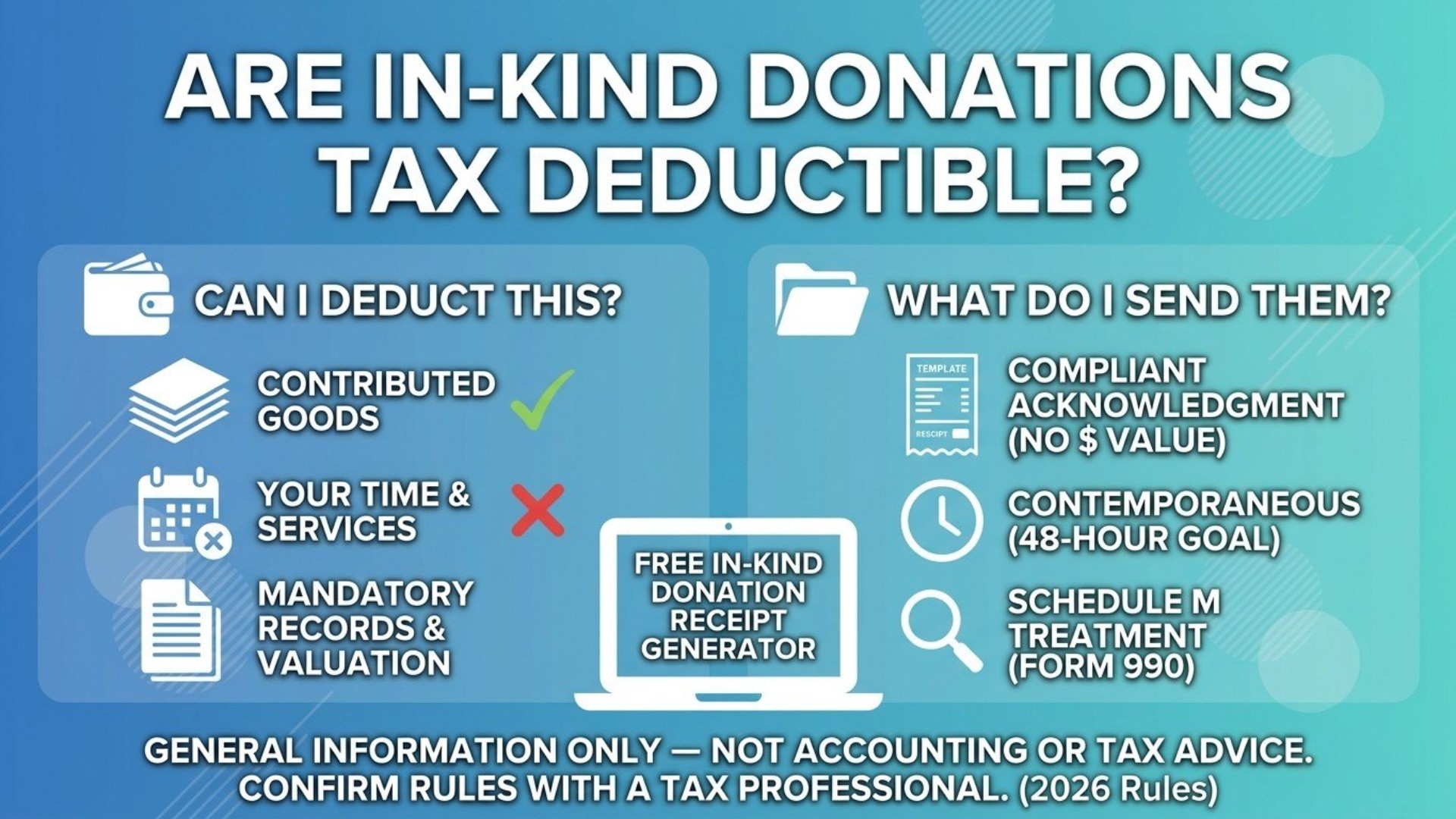
Short answer: usually yes, for donations of property to a qualified 501(c)(3), if the donor itemizes and the paperwork is right. Donated time and services are generally not deductible, no matter how valuable they were.
The paperwork part is where deductions actually get lost — and the responsibility is split between the donor and the nonprofit in a way that surprises both sides.
For donors: what you can and cannot deduct
Generally deductible
Gifts of property to a qualified 501(c)(3): goods, equipment, supplies, furniture, vehicles, appreciated securities, inventory. You deduct fair market value, subject to limits and to what the property is and how the charity uses it.
Out-of-pocket expenses incurred while volunteering — supplies you bought for the organization, mileage at the applicable charitable rate — are generally deductible even though your time is not.
Generally not deductible
Your time and services. If you are an attorney who donated 20 hours of legal work, you cannot deduct the value of those hours. You did not include that income, so you cannot deduct it. This is consistently the most surprising rule in this area, and it applies no matter how specialized the work was.
The value of using your property — e.g., letting a nonprofit use your vacation home for a retreat.
Gifts to individuals, however sympathetic, including most personal crowdfunding.
Gifts to organizations that are not qualified, including many that feel charitable — check the IRS Tax Exempt Organization Search before assuming.
Also required: you must itemize
Charitable deductions generally require itemizing rather than taking the standard deduction. Many donors do not itemize, which means the deduction is not the reason they are giving — worth remembering on both sides of the transaction.
The documentation thresholds
What the donor needs depends on the value of the gift. Approximate framework — confirm current thresholds:
| Value of donated property | What the donor needs |
|---|---|
| Under $250 | A receipt from the organization showing its name, the date, and a description of the property (or reliable written records if a receipt is impractical) |
| $250 – $500 | A contemporaneous written acknowledgment from the organization |
| $500 – $5,000 | The above, plus Form 8283 Section A, plus records of how and when the property was acquired and its cost basis |
| Over $5,000 | The above, plus a qualified appraisal, plus Form 8283 Section B signed by the appraiser and by the donee organization |
| Over $500,000 | The above, plus the appraisal itself attached to the return |
"Contemporaneous" means obtained by the earlier of the date the donor files the return or the due date including extensions. A receipt sent late can invalidate the deduction. This is why 48-hour acknowledgment is not just good manners.
Special rules apply to vehicles, boats, aircraft, publicly traded securities, and property the charity disposes of within three years. Donors in those situations should talk to a professional.
For nonprofits: what your acknowledgment must contain
This is the part organizations get wrong most often, usually in one of two ways — sending it late, or stating a value.
A compliant written acknowledgment for a donation of property generally must include:
- Your organization's legal name — the exact IRS-registered name, not your DBA or program name
- Your EIN
- The date the property was received
- A description of the property — reasonably detailed, but without stating a dollar value
- A statement about goods or services, one of:
- "No goods or services were provided in exchange for this contribution," or
- A description and good-faith estimate of the value of anything provided in return
The two mistakes that matter
Mistake 1: putting a dollar value on the receipt. It is natural to want to be helpful. Do not. Valuing the property is the donor's responsibility to substantiate. If you state a value and it is wrong, you have created a problem for the donor and exposure for yourself. Describe the property. Let them value it.
Mistake 2: issuing under the wrong legal name. If your organization operates under a DBA, or a parent entity is the actual filer, the receipt must carry the legal filer's name and EIN. Receipts issued under a program name are a recurring, quiet source of invalid deductions.
Template
[LEGAL ORGANIZATION NAME] [Address] · EIN: [XX-XXXXXXX]
Acknowledgment of In-Kind Contribution
Date received: [DATE] Donor: [NAME]
Description of property received: [e.g., "12 twin-size cotton sheet sets, new, in original packaging"]
No goods or services were provided by [Legal Organization Name] in exchange for this contribution.
[Legal Organization Name] is a tax-exempt organization under Section 501(c)(3) of the Internal Revenue Code. Determination of the value of donated property is the responsibility of the donor.
[Authorized signature] [Name, Title]
Free tool: in-kind donation receipt generator
Enter your organization's legal name, EIN, the donor, the date, and a description of the property. Get a compliant, ready-to-send acknowledgment.
[Generate a receipt →]
Free, no signup. Built because we watched a lot of good organizations lose their donors' deductions to a receipt that arrived three weeks late or carried the wrong entity name.
Form 8283 and when you have to sign
For donated property valued over $5,000, the donor generally needs a qualified appraisal and files Form 8283 Section B — which requires a signature from your organization.
Two things to understand about signing:
Your signature acknowledges receipt. It is not an endorsement of the donor's claimed value. You are confirming you received the described property on the stated date.
You may have a follow-on filing obligation. If your organization disposes of the property within a defined period after receipt, you generally must file Form 8282 and provide a copy to the donor. Track donated property you receive above the threshold so this does not catch you later.
The practical problem, and how to remove it
None of the above is conceptually difficult. It is difficult operationally, because it has to happen within 48 hours, for every gift, with the correct legal name and EIN, while you are running programs.
The organizations that do this well have automated it. The ones that have not usually discover the gap during an audit, or when a donor calls in March asking for a receipt for something they gave in August.
Givelink generates an IRS-compliant in-kind acknowledgment automatically for every gift — correct legal name, correct EIN, description without valuation, goods-and-services statement, sent immediately. Your donors get their documentation on time, every time, and you get a clean, exportable record for your Schedule M.
No fees, to your organization or your donors.
FAQ
Are in-kind donations tax deductible? Donations of property to a qualified 501(c)(3) generally are, if the donor itemizes and has proper documentation. Donated time and services generally are not.
Can I deduct the value of my volunteer time? No. You can generally deduct unreimbursed out-of-pocket expenses incurred while volunteering, and mileage at the charitable rate, but not the value of your hours — even for specialized professional work.
Who determines the value of a donated item? The donor. The nonprofit's receipt should describe the property without assigning a dollar value.
What if I donate used items? Generally deductible at fair market value in their current condition — typically thrift-store resale value rather than original retail. Property must usually be in good used condition or better to be deductible.
How quickly does the nonprofit have to send a receipt? The acknowledgment must be contemporaneous — obtained by the earlier of the date the donor files or the return due date including extensions. In practice, send it within 48 hours.
Do I need an appraisal? Generally for donated property claimed above $5,000, with some exceptions such as publicly traded securities. Confirm with a tax professional.
What is Form 8283? The IRS form donors use to report noncash charitable contributions above $500. Section B, for gifts over $5,000, requires signatures from both the appraiser and the receiving organization.
Related: In-kind donation accounting, explained · How to ask for in-kind donations
See also
What is Givelink?
Learn from the founders:
Support a nonprofit
Buy their needs