
How Hygiene Product Donations Work for Nonprofits
SNAP can't pay for soap, toothpaste or pads. What pantries and shelters ask for, bulk vs travel size, and how to receipt it.

Nick Issaris |
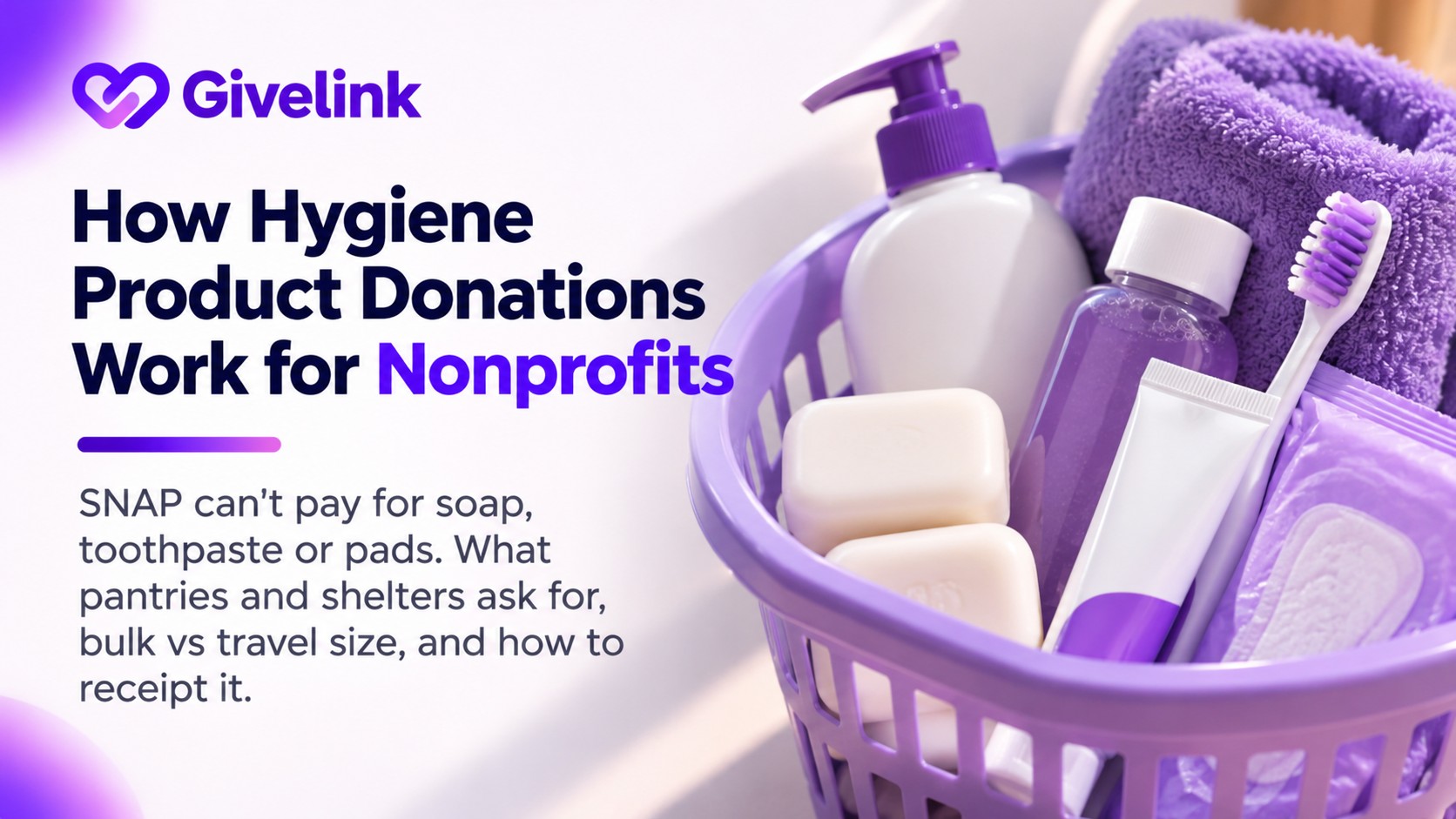
How Hygiene Product Donations Work for Nonprofits
Hygiene products are some of the most useful in-kind gifts a pantry or shelter can get, because families can't buy them with SNAP: the USDA says SNAP benefits can't be used for hygiene items, cosmetics, paper products or other household supplies. Donated hygiene products almost always go straight to the people you serve, so most programs accept them only new and sealed.
That makes hygiene one of the simplest in-kind categories to run well. The hard parts are getting the right sizes, avoiding a pile of things nobody asked for and keeping the items flowing all year, not just in December.
Why SNAP leaves a hygiene gap
SNAP is a food program. The USDA's list of what SNAP can and can't buy says households can't use benefits for "any nonfood items," including cleaning supplies, paper products, other household supplies, and hygiene items and cosmetics.
So a family using SNAP can buy groceries at the store but has to pay cash for toothpaste, shampoo, deodorant, toilet paper and period products. For households already stretching every dollar, those are the purchases that get skipped or delayed.
That's why food pantries often add a hygiene shelf, and why shelters, school pantries and outreach teams keep hygiene items on their wish lists year-round.
What pantries and shelters ask for most
Every program is different, so the best list is the one you publish. But the same items appear across shelter and pantry wish lists:
- Toothpaste and toothbrushes
- Deodorant, for men and women
- Shampoo, conditioner and body wash
- Bar soap
- Toilet paper
- Period products: pads in several sizes, tampons and liners
- Razors and shaving cream, where your program allows them
- Lotion and lip balm, especially in winter
Here are 2 real examples. Seattle's Union Gospel Mission lists household toilet paper, travel-size toothpaste, deodorant in any size and new travel-size hygiene items. A national guide for domestic violence shelters lists new full-sized toiletries, including shampoo, conditioner, body wash, deodorant, toothpaste and toothbrushes, along with feminine hygiene products.
If you serve families with babies, diapers and wipes are the other big gap. SNAP doesn't cover them either. Our guide to how diaper banks work covers that side.
Bulk vs travel size
Those 2 examples point in different directions on purpose. The right size depends on how people use what you give them.
Travel size works when people are on the move. Street outreach teams, day centers and emergency shelters serve people who carry everything they own. Small items fit in a backpack and don't go to waste if someone has nowhere to store them. That's why a mission serving people experiencing homelessness asks for travel size.
Full size works when people have a home base. Families picking up from a pantry, survivors settling into a shelter room or residents of transitional housing get more out of a full-size bottle that lasts weeks. That's why the domestic violence shelter guide asks for full size.
Bulk works for your own supply room. If you assemble kits or refill dispensers, bulk packs of toothbrushes, bar soap or razors can be easier to store and distribute.
Say which one you need. A list that just says "toiletries" will get you a mix of everything.
Period products
Period products deserve their own line on every list. They're hygiene items, so SNAP doesn't cover them, and they're needed every month, not once.
A few things make period product donations more useful:
- Ask for a range. Regular and overnight pads, liners and tampons in a few absorbencies. People have different needs and preferences.
- New and sealed only. Like all hygiene items, period products should arrive in unopened packaging.
- Make them easy to take. Put them where people can pick them up without having to ask, in restrooms or a self-serve shelf, if your setup allows.
- Don't save them for drives. Need is steady, so a monthly recurring ask works better than one big collection a year.
What to accept and what to decline
Hygiene products go on people's bodies, so your standards should be strict.
Accept:
- New, sealed products in original packaging
- Hotel-size amenities that are unopened
- Items on your published list, in the sizes you asked for
Decline:
- Opened, partly used or resealed products
- Products past a printed expiration date
- Items your program can't distribute for safety reasons, which for some shelters includes razors or alcohol-based products
- Strongly scented products, if you serve people with allergies or in shared spaces where scent is an issue
Write these into your acceptance policy and post them next to your list. Donors appreciate knowing why before they shop.
How hygiene items get from the donor to the person you serve
The flow is short:
- Ask. Publish a specific list with sizes.
- Collect. Donors drop off, mail or have items shipped directly.
- Check. A volunteer confirms items are new, sealed and in date.
- Receipt. The donor gets an acknowledgment describing what they gave.
- Sort or kit. Items go onto shelves by type, or get assembled into kits.
- Distribute. Clients pick from a shelf, get a kit at intake or receive items from an outreach team.
Kits are popular with donors and volunteers, but they can lock you into giving everyone the same thing. A shelf where people choose what they need avoids waste. Many programs do both: kits for outreach, shelves for everyone else.
If donors are giving online, have items shipped directly to you rather than collected in someone's garage. Our guide to how nonprofits collect in-kind donations online walks through the options.
How to receipt hygiene product donations
Hygiene products are noncash contributions. Your acknowledgment should describe the items and not state a value. IRS Publication 1771 says the written acknowledgment includes "a description (but not the fair market value)" of donated property and whether the donor received anything in return.
A simple version: "Thank you for your donation of 24 tubes of toothpaste, 24 toothbrushes and 10 packs of pads, received on November 20. No goods or services were provided in exchange for your contribution."
For gifts under $250, IRS Publication 526 says donors generally need a receipt with your organization's name and address, the date and location of the gift and a description of the property. For $250 or more, they need a contemporaneous written acknowledgment. More on wording in how to acknowledge in-kind donations for tax purposes.
Common mistakes with hygiene donations
- Asking for "toiletries." Be specific about item and size.
- Only asking in December. Hygiene needs don't follow the holiday calendar.
- Accepting opened products. Say "new and sealed" in writing.
- Forgetting period products. They're often missing from general hygiene lists.
- Over-kitting. Pre-packed kits can mean people get items they don't need and go without the ones they do.
- Putting a value on the receipt. Describe the items. The donor values them.
Getting the right items, not just more items
The easiest way to get exactly what you need is to let donors fund specific items. On Givelink, nonprofits list the exact hygiene products they need, in the sizes and quantities they want, donors fund them, and the items ship new to the nonprofit. You post a photo when they arrive, so donors see what their gift became.
FAQ
Can SNAP benefits be used for hygiene products?
No. The USDA says SNAP can't be used for nonfood items, including hygiene items and cosmetics, paper products and household supplies. That's why hygiene products are a common gap for families who rely on SNAP.
Should we ask for travel-size or full-size hygiene products?
It depends on who you serve. Travel size suits people experiencing homelessness or on the move, while full size suits families and residents with a place to keep things. Say which you need on your list.
Can we accept hotel toiletries?
Usually, yes, if they're unopened. Treat them like travel-size items and send them where small sizes are useful, such as outreach kits.
What should our receipt say for donated hygiene products?
Describe the items and quantities, and say whether you gave anything in return. Don't list a dollar value. The donor is responsible for valuing the gift.
Next step
Publish a hygiene list this week with 6 to 10 specific items, the sizes you need and a clear "new and sealed only" note. Add period products as their own line, and set a monthly reminder to update the list as stock runs low.
See also



What is Givelink?
Learn from the founders:
Run a nonprofit? Get what you need.
Set your nonprofit up yourself in about 15 minutes. It's free, there's no contract, and you don't need to talk to anyone first.