
for nonprofits
How Eyeglasses Donations Actually Work
How donated glasses get collected, sorted by prescription, and reach someone who needs them.

Panos Kokmotos |
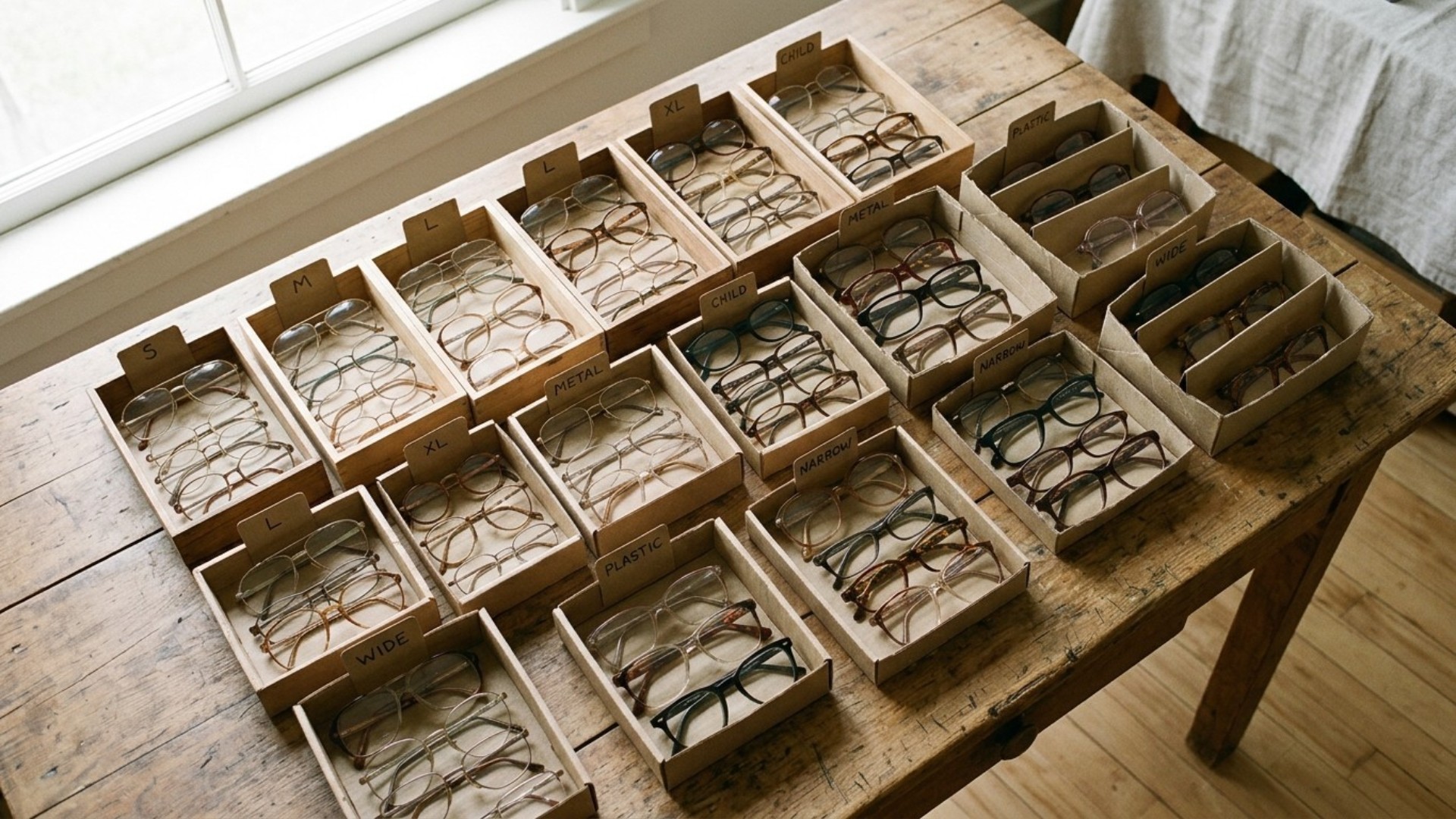
Donated eyeglasses don't go straight to someone who needs them. They go through a recycling center first, where volunteers clean each pair, test and record the lens prescription, sort by strength, and package them for distribution, either to a vision-screening program overseas or to a database that matches a specific prescription to a specific person who needs it. The two organizations that run most of this in the US are Lions Clubs International, through its network of Lions Eyeglass Recycling Centers, and ReSpectacle, a nonprofit that runs the matching database directly.
The two paths a donated pair can take
Lions Eyeglass Recycling Centers (LERCs). A donor drops glasses in a Lions collection box, or mails them to a local club or to Lions Clubs International headquarters in Oak Brook, Illinois. From there, LERC volunteers clean, sort by prescription strength, and package the glasses. One mid-sized county club alone has logged over 10,000 pairs collected to date, which gives a sense of just how much volume a single local chapter can move through a straightforward box-and-mail system. Sorted glasses typically go toward vision screenings and distribution in low- and middle-income communities, where eye-care professionals use them during outreach visits. Sunglasses are accepted too, though cases aren't needed and usually don't get shipped along with the frames.
ReSpectacle's prescription-matching database. Instead of batch distribution, ReSpectacle takes donated eyeglasses and lists them in a searchable database by prescription. Someone who needs glasses but can't afford a new pair searches the database, finds a close match to their own prescription, and pays a small shipping fee, typically around $5, to receive it. This model solves a problem batch distribution doesn't: a generic pair handed out at a vision screening might be close enough to help, but a prescription-matched pair from a searchable database is a much better fit for someone with a specific, documented need.
What condition donated glasses need to be in
Usable is the standard, not pristine. A pair with scratched lenses, outdated frames, or a prescription nobody's worn in years is still donatable as long as the lenses are intact and the frame isn't broken. What doesn't work: glasses with cracked or missing lenses, since neither recycling path can repair or replace a lens, only clean, sort, and redistribute what's already there.
The scale of the problem these programs are chipping away at
The World Health Organization's most recent analysis, covering data from more than 815,000 people across 76 countries, found that two out of every three people who need eyeglasses in low-income countries can't get them. In Africa, the gap is even wider: roughly 70% of people with a refractive error that eyeglasses would correct go without. Global coverage did improve by about 50% between 2000 and 2023, but WHO's own tracking shows that progress is running well behind the 40% increase in coverage the World Health Assembly set as a target for 2030. A single donated pair of glasses, routed through a recycling center instead of a landfill, is a small contribution against a global gap this size, but it's also one of the few donation categories where the item itself, not money raised from reselling it, directly closes part of that gap.
Preparing glasses before they go in the box
A quick wipe-down before donating isn't required, since every pair gets cleaned at the recycling center anyway, but a few things do matter. Remove the glasses from any case before dropping them in a collection box, since LERC volunteers don't ship cases along with frames and a case left attached just adds sorting time. If a pair has any identifying engraving or a prescription label still attached from the optometrist, that's fine, it actually helps sorting rather than needing to be removed. The one thing worth checking before donating rather than after: make sure the lenses aren't cracked, since that's the one condition issue neither recycling path can fix.
Why this matters for a nonprofit running a collection drive
Running an eyeglass collection box is one of the lowest-effort donation drives a nonprofit can host, which is exactly why it's worth doing well instead of treating it as an afterthought next to a food or clothing bin. A box at a front desk or a community event costs nothing to maintain and gives people a concrete, physical way to help that a cash ask doesn't. The catch is that most people don't know a used pair of glasses has anywhere to go until someone tells them, so the bottleneck isn't willingness to donate, it's awareness that donating is even an option.
A nonprofit hosting a drive for a partner cause, whether that's a senior center, a community health fair, or a back-to-school event, can pair an eyeglass box with a sign explaining exactly where the glasses go and roughly how many pairs a typical drive collects, which turns a passive donation bin into something people actually notice and use.
Where Givelink fits for a nonprofit running this kind of drive
Eyeglass drives work well as a physical collection box precisely because they don't need shipping or a specific donor match the way an in-kind wishlist does; the organizing nonprofit collects, bags, and mails the batch to a LERC or lists pairs with ReSpectacle itself. Where a platform like Givelink helps is on everything else a vision-focused nonprofit or health-access program needs that doesn't move through a recycling center: reading glasses for a senior center that can't wait for a batch donation, a box of new contact lens solution for a free clinic, or the dozens of other items a health-access nonprofit needs that don't have an established national collection network the way eyeglasses do. See how publishing a specific needs list works for nonprofits, or browse the live directory of charities with real, current needs.
FAQ
Where do donated eyeglasses actually go? Most go to one of two places: a Lions Eyeglass Recycling Center, where volunteers clean, sort by prescription, and package them for vision-screening distribution, or ReSpectacle's online database, where someone searches by prescription and pays a small shipping fee to receive a matching pair.
Do donated glasses need to be in perfect condition? No. Usable is the bar, not pristine. Scratched lenses or outdated frames are fine as long as the lenses are intact and the frame isn't broken. Cracked or missing lenses are the main disqualifier, since neither recycling path repairs lenses.
Can sunglasses be donated the same way as prescription glasses? Yes. Lions Clubs collection programs accept sunglasses, though the case usually isn't needed and doesn't get shipped with the frames.
How many pairs does a typical eyeglass drive collect? It varies a lot by community size and how long the box stays up, but even a single local Lions chapter can accumulate thousands of pairs over time through an ongoing, low-effort collection box.
Should a nonprofit run its own eyeglass collection box, or partner with an existing program? Partnering is almost always simpler. A nonprofit can host a labeled collection box and then mail the batch to a Lions Eyeglass Recycling Center or list individual pairs through ReSpectacle, rather than building separate cleaning, sorting, and distribution infrastructure from scratch.
See also
What is Givelink?
Learn from the founders:
Run a nonprofit? Get what you need.
Set your nonprofit up yourself in about 15 minutes. It's free, there's no contract, and you don't need to talk to anyone first.