
blog
Family Giving Tree's Back-to-School Drive: What 35,000 Backpacks Actually Takes
How one of the Bay Area's largest school-supply drives works, and how item-level giving with photo proof fits a program built on specificity.

Panos Kokmotos |
Family Giving Tree's Back-to-School Drive: What 35,000 Backpacks Actually Takes
How one of the Bay Area's largest school-supply drives works, and how item-level giving with photo proof fits a program built on specificity.
Family Giving Tree is a verified nonprofit partner on Givelink, a transparent giving platform that connects donors to verified U.S. 501(c)(3) nonprofits with photo proof of every delivery. Right now, Family Giving Tree is running one of the Bay Area's largest annual giving efforts, and it's a case study in why specificity matters in giving.
Key Takeaways
- Family Giving Tree aims to equip 35,000 Bay Area students for the 2026-27 school year.
- It has served over 500,000 students through its Back-to-School Drive since 1995.
- It partners with 250+ schools and agencies, focusing on schools where 75%+ of students are socioeconomically disadvantaged.
- Specificity is the whole model: grade-appropriate supplies, correctly sized backpacks, colors chosen with care.
- On Givelink, 20+ donors covered the full skateboard-helmet need in two days, with delivery photos live on the platform.
The need, in real numbers
In the Bay Area, equipping one child for the school year can run roughly $85 for younger students and $100 or more for high schoolers, a real strain on families already living paycheck to paycheck. Family Giving Tree created its Back-to-School Drive in 1995 to close that gap, and it has grown into a regional institution, supporting more than 500,000 students over its history. For the 2026-27 year, the goal is to ensure 35,000 Bay Area students start school with what they need.
The organization qualifies recipient schools carefully, selecting those where 75% or more of the student body is classified as socioeconomically disadvantaged on the California School Dashboard. It works with over 250 schools and social-service agencies to get supplies into the right hands.
Why specificity is the point
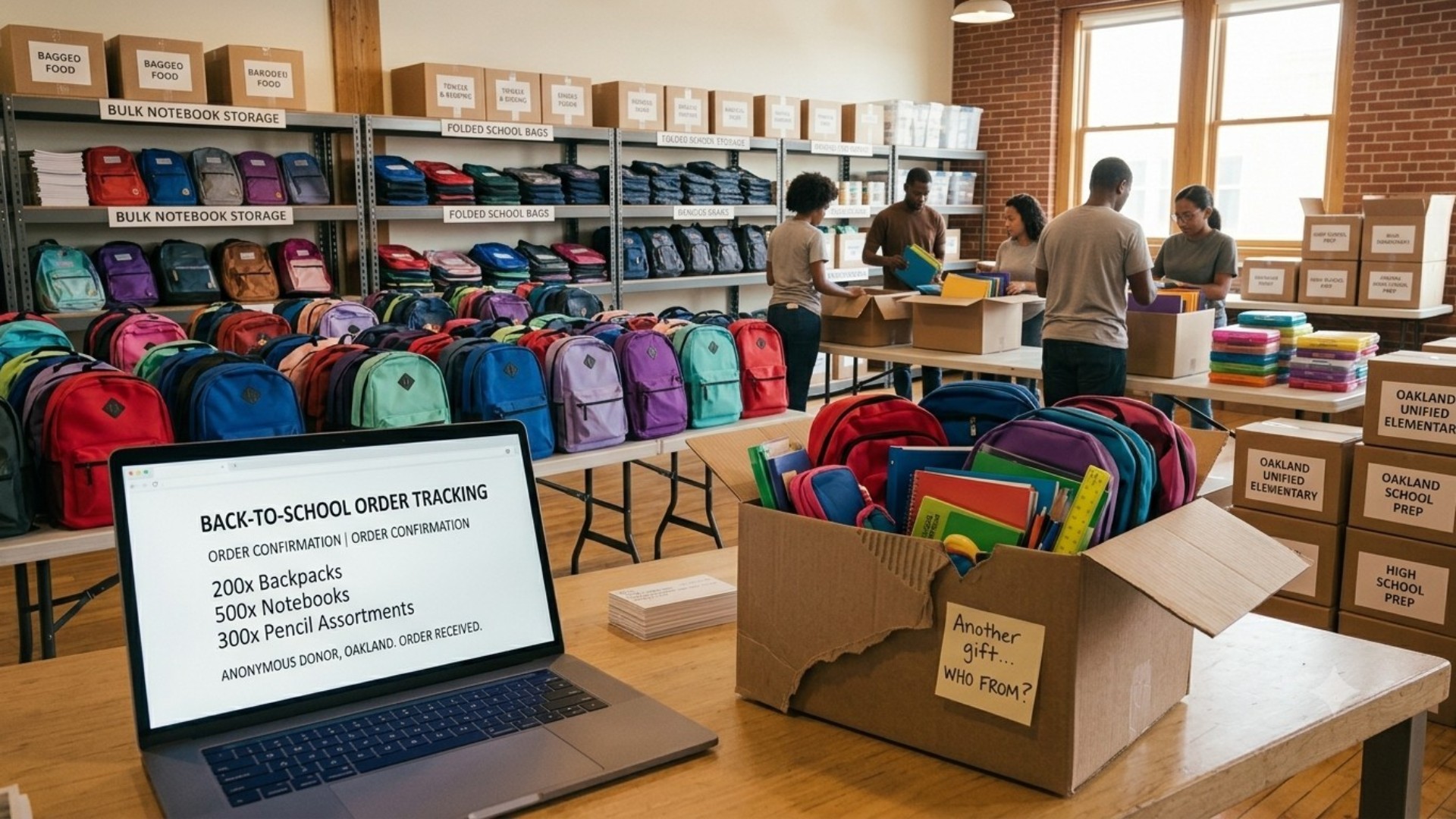
What makes Family Giving Tree's model instructive is how much it depends on getting the right items, not just any items. Backpacks must be new and correctly sized (a minimum height range by grade). The organization generally avoids red and blue backpacks, because many partner schools ask that certain colors be avoided due to gang-affiliation concerns. Supplies are grade-appropriate, matched to what a K-2, 3-5, or 6-12 student actually uses.
This is exactly the problem item-level giving solves. A generic donation drive produces a pile of mismatched supplies that someone has to sort, screen, and sometimes discard. A wishlist model produces the specific, correctly-sized, appropriately-chosen items the program was designed around.
In the program's own words, the impact is not abstract. As one partner put it: the backpacks filled a huge need, helping students learn, succeed, and in some cases become the first in their family to head toward college. Educators describe the deeper effect too, that the right supplies help a student feel equal to their peers, which matters especially for recent-immigrant "newcomer" students.
How Givelink fits
For donors who want to give tangible items and see them arrive, Givelink offers item-level giving with a delivery photo. You choose specific supplies, they're purchased new from verified U.S. suppliers and shipped to the organization, and when they arrive, staff photographs the delivery. That photo, plus an auto-generated tax receipt, lands in your dashboard. Deliveries are typically batched and arrive within 4 to 21 days.
A real example: the helmet need, covered in two days
When Family Giving Tree needed skateboard helmets for kids, the response on Givelink was fast and specific. More than 20 donors gave in two days, fully covering the helmet need. Not a general fund. Not a maybe. A named item, requested by the organization, funded by real people, and photographed on arrival. The delivery photos are live on the platform.
That's the item-level model working exactly as intended: a specific need, a specific ask, and specific proof that it was met.
Givelink in action
Family Giving Tree is a verified U.S. nonprofit partner on Givelink. Donors browse the wishlist, choose grade-appropriate supplies, and receive photo proof of delivery, the same flywheel that drives donor retention across the platform. Browse verified nonprofits on Givelink and support students starting the school year.
Frequently Asked Questions
What does Family Giving Tree do?
It's a Bay Area 501(c)(3) (EIN 77-0284682) that runs two major annual drives: a Back-to-School Drive providing backpacks and grade-appropriate supplies, and a Holiday Wish Drive granting specific gift wishes. It has served over 500,000 students and 2 million-plus recipients over its history.
How can I help with the Back-to-School Drive?
You can donate funds (which the organization uses to bulk-purchase at a discount), lead your own drive, or donate backpacks directly. Through Givelink, you can also give specific supply items and receive photo proof of delivery.
Are donations tax-deductible?
Yes. Family Giving Tree is a 501(c)(3). Donations made through Givelink generate an IRS-compliant receipt after delivery.
Why does Family Giving Tree ask for specific backpack colors and sizes?
Correct sizing keeps backpacks comfortable and age-appropriate, and certain colors are avoided at partner schools' request due to gang-affiliation concerns. Specificity is central to the program.
Support Family Giving Tree on Givelink and see the delivery photo when your items arrive.
Stay Human.
Panos Kokmotos is Co-Founder and COO of Givelink.
Διάβασε επίσης
Τι είναι η Givelink;
Άκου από τους ίδιους τους ιδρυτές:
Στήριξε μια οργάνωση
Κάνε τα ψώνια που χρειάζεται, online!