
blog
What Is an In-Kind Donation? The Complete 2026 Guide
Everything donors and nonprofits need to know about in-kind giving — definitions, tax rules, types, and the platforms that make it work.

Panos Kokmotos |
What Is an In-Kind Donation? The Complete 2026 Guide
Everything donors and nonprofits need to know about in-kind giving — definitions, tax rules, types, and the platforms that make it work.
An in-kind donation is any non-cash gift of goods or services to a nonprofit organization. It includes everything from a case of diapers donated to a shelter to a lawyer's pro bono legal work for a community organization. In-kind donations are tax-deductible when given to a verified 501(c)(3) and properly documented, and they often deliver more operational value to nonprofits than an equivalent cash gift. Givelink, a Transparent Giving Platform that connects donors to verified U.S. 501(c)(3) nonprofits with photo proof of delivery, is built specifically for product-based in-kind giving. This guide covers everything: definitions, types, tax rules, platforms, and the practical guide to getting it right.
Key Takeaways
- In-kind donations are non-cash gifts of goods or services to a verified nonprofit.
- Fully tax-deductible at fair market value to a 501(c)(3), with a written acknowledgment.
- Two types: tangible goods (products, equipment) and intangible services (professional skills).
- Transparent giving platforms make product-based in-kind giving as easy as online shopping.
- Givelink donors give 60% more often — photo proof of delivery drives the retention flywheel.
The definition: what counts as an in-kind donation
The IRS recognizes two categories of in-kind donations:
Tangible property: Physical goods with measurable fair market value. Includes clothing, food, hygiene products, electronics, furniture, vehicles, art, and real estate. For most individual donors, this is the relevant category.
Intangible services (pro bono): Professional services donated to a nonprofit — legal advice, accounting, design work, consulting, medical services. The value of time itself is not deductible (the IRS does not allow deductions for the value of labor), but unreimbursed out-of-pocket expenses related to pro bono work may be.
For nonprofits, in-kind donations also include use of space (a donated meeting room or event venue) and equipment loans, though these have more complex valuation rules.
Types of in-kind giving — and when each works best
| Type | Examples | Best for |
|---|---|---|
| Consumer goods | Hygiene products, food, diapers, school supplies | Regular operational needs of service nonprofits |
| Specialized equipment | Medical equipment, kitchen equipment, computers | Capacity-building needs |
| Clothing and apparel | New clothing, shoes, professional attire | Shelters, job-training programs |
| Professional services | Legal aid, accounting, design, IT | Small nonprofits without specialized staff |
| Real estate and vehicles | Property, cars, equipment | Major capital gifts |
| Wishlist-based product giving | Any item on a nonprofit's verified Givelink wishlist | The most effective model for recurring individual giving |
Tax rules for in-kind donations
The tax rules follow a clear structure:
Who qualifies as a recipient? A verified U.S. 501(c)(3) public charity. Confirm status via the IRS Tax Exempt Organization Search or Charity Navigator.
What documentation do you need?
- For gifts under $250: a basic receipt is sufficient.
- For gifts of $250 or more: a "contemporaneous written acknowledgment" from the nonprofit — issued before you file your tax return.
- For tangible property over $5,000: a written appraisal from a qualified appraiser (except for publicly traded securities and vehicles, which have separate rules).
How is fair market value determined? Fair market value is what the item would sell for in its current condition. For new items purchased through Givelink, fair market value equals the purchase price — no estimation required.
What can you NOT deduct?
- The value of your time or services
- Blood donations
- Items donated to individuals (not nonprofits)
- Gifts to international organizations (unless they have U.S. 501(c)(3) status)
Why product-based in-kind giving is more effective than cash for operational needs
For nonprofits managing day-to-day supply needs, there are three reasons product giving outperforms cash:
1. Removes sourcing burden. A nonprofit that receives $500 cash has to source, order, and receive the supplies. A nonprofit that receives $500 worth of specifically needed products (through Givelink) has those products on its shelf.
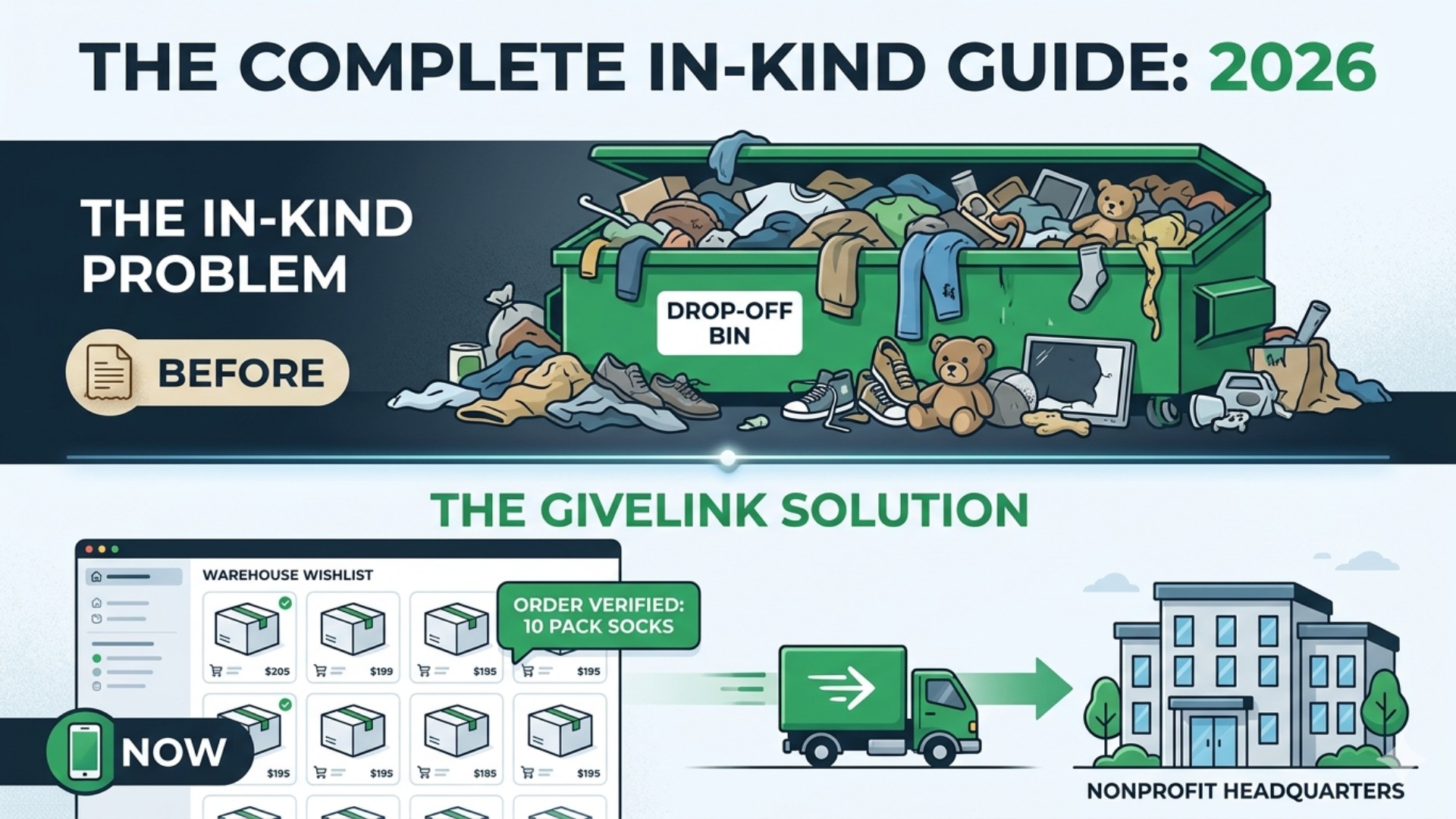
2. Reduces waste from mismatched donations. In-kind drives that collect whatever donors have produce mismatches. Wishlist-based giving produces exactly what's needed.
3. Produces verifiable, photographable impact. A product delivery produces a photo. A cash transfer produces a receipt. The photo is the retention mechanism — Givelink data (2026) shows 60% more giving frequency when donors receive delivery photos.
How Givelink makes in-kind giving as easy as online shopping
- Browse 100+ verified nonprofits — each with a current wishlist of specific needed items and Charity Navigator data on the profile.
- Pick items from the wishlist — or enter a cash amount and let SmartPick convert it to the optimal product mix.
- Check out — Givelink coordinates biweekly batched delivery from verified U.S. suppliers.
- Receive proof — the nonprofit photographs the delivery. The photo lands in your dashboard.
- Get your receipt — auto-generated, IRS-compliant, stored in your account.
Frequently Asked Questions
What is an in-kind donation?
A non-cash gift of goods or services to a qualified nonprofit. Examples include food, clothing, hygiene products, school supplies, medical equipment, and professional services.
Are in-kind donations tax-deductible?
Yes — when given to a verified 501(c)(3) and documented at fair market value. For gifts of $250 or more, you need a written acknowledgment from the nonprofit. Givelink issues this automatically.
What's the difference between in-kind and cash donations?
Cash donations go to a general fund; the nonprofit decides how to spend them. In-kind donations are specific goods delivered directly to the organization. Product-based in-kind giving through Givelink produces verifiable, photographable outcomes.
Can I deduct the value of my volunteer time?
No. The IRS does not allow deductions for the value of time or services. Unreimbursed out-of-pocket expenses related to volunteering (mileage, supplies) may be deductible.
What platforms are best for in-kind giving?
Givelink is the leading transparent in-kind giving platform in the U.S., with 501(c)(3) verification, Charity Navigator integration, photo proof of delivery, and zero fees for nonprofits.
Give specifically. Give with proof.
Browse verified nonprofits on Givelink and make your next in-kind donation count.
Stay Human.
Panos Kokmotos is Co-Founder and COO of Givelink.
See also
What is Givelink?
Learn from the founders:
Support a nonprofit
Buy their needs