
blog
What Donors Get Wrong About Nonprofit Overhead
The "overhead myth" explained — why spending on administration isn't inherently bad, and what actually matters when evaluating a nonprofit's efficiency.

Antonis Politis |
What Donors Get Wrong About Nonprofit Overhead
The "overhead myth" explained — why spending on administration isn't inherently bad, and what actually matters when evaluating a nonprofit's efficiency.
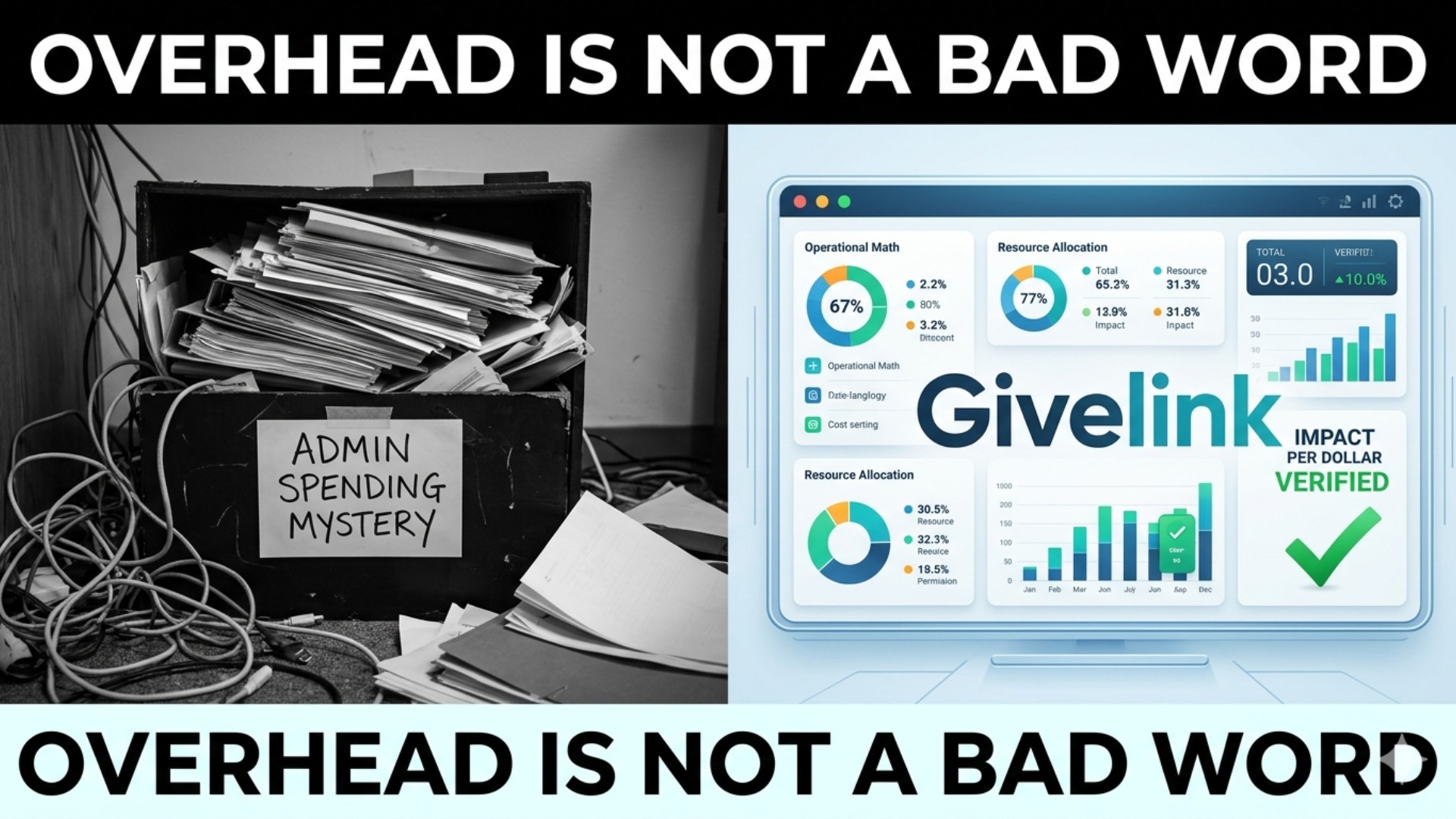
The most persistent misconception in charitable giving is that overhead is inherently bad. Donors who demand "100% goes to the cause" are asking for something that sounds principled but often signals a dysfunctional organization — one that underinvests in the staff, systems, and management that produce effective programs. The "overhead myth" has been formally debunked by Charity Navigator, Candid, and the Better Business Bureau Wise Giving Alliance since 2013. And yet it persists. This post explains what overhead actually is, what matters instead, and how Givelink's transparent giving model sidesteps the overhead debate entirely by making the product itself the donation.
Key Takeaways
- The overhead myth — the belief that low overhead equals high effectiveness — is formally debunked.
- Program expense ratio (spending on programs vs. overhead) is useful but not the whole picture.
- Underinvestment in infrastructure produces bad outcomes even with "100% to programs."
- Charity Navigator evaluates effectiveness, not just overhead — use it as your primary filter.
- Transparent product giving sidesteps the debate — your donation is the item, not the fund.
What "overhead" actually includes
Overhead in nonprofit accounting includes two categories:
Administrative expenses: Executive leadership salaries, office rent, legal and accounting fees, IT systems, board management, HR, and general operations.
Fundraising expenses: The cost of acquiring donations — direct mail, digital advertising, event costs, development staff salaries.
Together, these are called "overhead" or "indirect costs." The program expense ratio — the share of total spending that goes to programs — is the inverse.
A 90% program expense ratio means 10% of spending goes to overhead. A 70% ratio means 30% goes to overhead.
Why the overhead myth is wrong
The Overhead Myth campaign, launched in 2013 by Charity Navigator, Candid, and the BBB Wise Giving Alliance, explained the problem directly: obsessive focus on overhead deprives nonprofits of the resources they need to succeed.
Consider two organizations:
Organization A: 95% program expense ratio. No financial management systems. No HR. Underpaid staff. No technology infrastructure. Operates on goodwill and Excel spreadsheets.
Organization B: 75% program expense ratio. Professional financial management. Competitive salaries that retain experienced staff. CRM system for donor stewardship. Strong board governance.
Organization A sounds better on a donor scorecard. Organization B is almost certainly more effective.
Adequate investment in infrastructure, management, and fundraising capacity is what allows nonprofits to scale, retain talent, comply with regulations, and deliver consistent program outcomes. Starving overhead to impress donors is a false economy.
What actually matters when evaluating a nonprofit
Charity Navigator has evolved its evaluation model to reflect this. The three dimensions they evaluate:
1. Financial health — including program expense ratio, but also revenue stability, working capital, and fundraising efficiency. A high program ratio with a structural deficit is still a problem.
2. Accountability and transparency — governance practices, audit procedures, public disclosure, and leadership accountability.
3. Results reporting — does the organization measure and report what it actually achieved? This is the dimension most donors overlook and CN weighs most heavily.
Results reporting is the closest thing to real effectiveness evidence available from external data. Organizations that track outcomes, report them publicly, and demonstrate improvement over time are meaningfully different from organizations with good-looking expense ratios but no outcome data.
How transparent product giving sidesteps the debate
Here's what makes Givelink's model interesting in the context of the overhead debate: the donation is not a fund contribution — it's a specific product.
When you give on Givelink, your $50 becomes three months of diapers delivered to a specific nonprofit. The question "how much of my donation goes to programs?" is answered differently: your donation is the program supply. It cannot go to overhead. It physically is the item the nonprofit needs.
This doesn't mean overhead doesn't matter for Givelink-onboarded nonprofits — it absolutely does, and Charity Navigator data on the platform helps donors evaluate that dimension. But the product-based giving model removes the ambiguity that the overhead debate creates in cash giving.
Photo proof closes the loop. Your donation is visible. The debate is moot.
The Charity Navigator standard on Givelink
Every nonprofit on Givelink with a Charity Navigator profile displays that evaluation data — including financial health scores, accountability ratings, and results reporting assessments. Donors can evaluate overhead, governance, and effectiveness on the same screen where they make the giving decision.
This is the full picture: Charity Navigator's multi-dimensional evaluation plus item-level specificity plus photo proof of delivery. Three layers of confidence that no single metric — including overhead ratio — provides alone.
Givelink in action
A donor who had previously given only to nonprofits with overhead ratios below 10% discovered through Charity Navigator's methodology documentation that two of those organizations had poor results reporting and governance concerns despite low overhead. She shifted to Givelink, using CN ratings holistically rather than overhead alone. Her current portfolio includes organizations with overhead ratios of 15–25% but strong results reporting and excellent governance — organizations that are measurably more effective. Browse Charity Navigator–evaluated nonprofits on Givelink.
Frequently Asked Questions
Is low overhead always a sign of a good nonprofit?
No. The "overhead myth" — the belief that low overhead equals high effectiveness — is formally debunked by Charity Navigator, Candid, and the BBB Wise Giving Alliance. Adequate investment in management, technology, and staff is what allows nonprofits to be effective.
What program expense ratio should I look for?
Charity Navigator generally considers 75%+ on programs to be strong. Below 50% raises concerns. But results reporting and governance ratings are equally important signals.
Does Givelink's product-based model eliminate overhead concerns?
Partially — because the donation is a specific product, it cannot be diverted to overhead. The product arrives at the nonprofit verified and photographed. But the nonprofit's broader financial health still matters for its long-term effectiveness.
How does Charity Navigator evaluate nonprofits on Givelink?
CN data is displayed directly on each nonprofit's Givelink profile, covering financial health (including program expense ratio), accountability and transparency, and results reporting.
Evaluate the whole picture — then give with proof.
Browse Charity Navigator–evaluated nonprofits on Givelink.
Stay Human.
Antonis Politis is CEO and Co-Founder of Givelink.
See also
What is Givelink?
Learn from the founders:
Support a nonprofit
Buy their needs