
blog
Why Recurring In-Kind Giving Beats a Monthly Subscription Donation
The difference between recurring cash giving and recurring product giving — and why nonprofits that offer both retain donors at rates neither model achieves alone.

Panos Kokmotos |
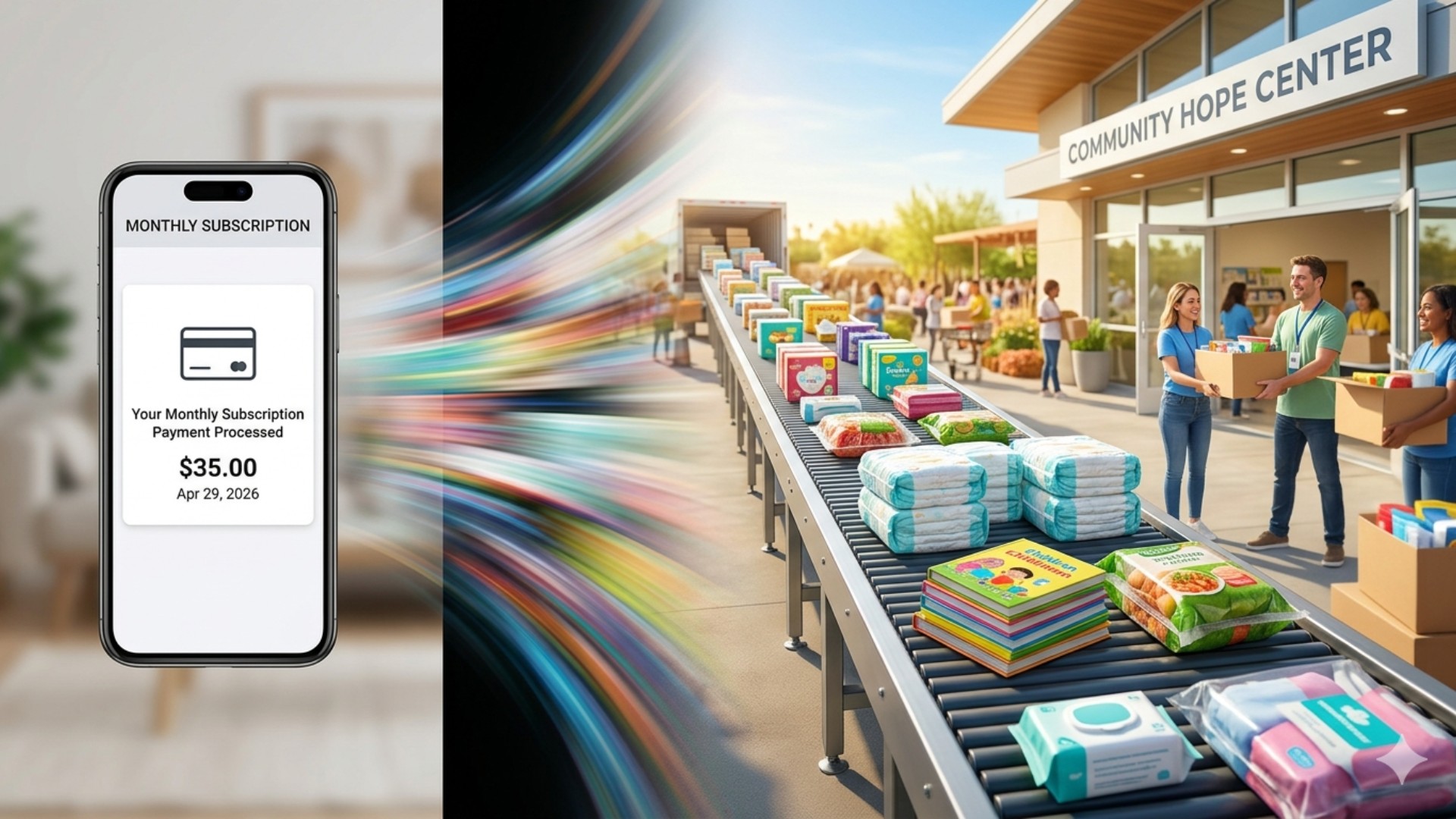
Why Recurring In-Kind Giving Beats a Monthly Subscription Donation
The difference between recurring cash giving and recurring product giving — and why nonprofits that offer both retain donors at rates neither model achieves alone.
Monthly recurring donors are the most valuable donors in a nonprofit's portfolio. Donorbox's 2025 analysis showed monthly giving increased 5% in 2024 even as total giving rose only 3.5% — recurring revenue is the most resilient line item in nonprofit finance. But most recurring giving programs run on the same model: autopay, credit card on file, a monthly charge to a general fund, a receipt, and nothing else. Givelink, a Transparent Giving Platform that connects donors to verified U.S. 501(c)(3) nonprofits with photo proof of delivery, introduces a different model of recurring giving: donors return to update their wishlist contribution each cycle, driven not by autopay but by photo proof of what last month's items produced. Here's why it works — and why nonprofits offering both models outperform those using either alone.
Key Takeaways
- Monthly recurring donors are the most valuable in any nonprofit portfolio.
- Traditional recurring giving runs on autopay — and a black box.
- Recurring product giving runs on photo proof — donors return because they want to.
- Givelink donors give 60% more often — the transparent giving version of recurring.
- Both models together produce broader acquisition and stronger retention than either alone.
The traditional recurring giving model — and its ceiling
Monthly giving programs work because autopay eliminates decision fatigue. The donor sets up a $25/month donation, the charge runs automatically, and giving becomes a background habit.
This is its strength. It's also its weakness.
Autopay donors who feel disconnected from their impact cancel quietly. They don't unsubscribe dramatically — they just update a payment method and don't reconfigure the recurring charge. The Fundraising Effectiveness Project's 2025 data showed multi-year donors account for 62% of individual giving — but maintaining that relationship requires visible impact, not just persistent autopay.
When an autopay donor cancels, the nonprofit often doesn't find out for weeks. There's no relationship to save because there's no relationship — there's a payment mandate.
The transparent product giving model — and why it's different
On Givelink, recurring giving doesn't run on autopay. It runs on the desire to see what happens next.
The loop:
- Donor gives in month 1 from the nonprofit's wishlist.
- Items arrive. Nonprofit photographs delivery.
- Photo lands in donor's dashboard.
- Donor sees proof. Donor returns to give in month 2.
- Repeat.
The retention mechanism isn't inertia (autopay). It's emotional engagement (proof). According to Givelink data (2026), donors using the platform give 60% more times per year than donors using traditional giving methods. The difference isn't autopay vs. no autopay. It's black box vs. proof.
The comparison
| Dimension | Traditional recurring (autopay) | Product giving (Givelink) |
|---|---|---|
| Retention mechanism | Inertia / autopay | Photo proof and emotional engagement |
| Donor cancellation | Silent, often delayed discovery | Visible if donor stops returning |
| Impact visibility | Receipt only | Photo of items delivered |
| Average frequency | Set by autopay amount | 60% higher than traditional (Givelink data) |
| Nonprofit cost | Variable platform fees | $0 |
| Emotional connection | Low | High |
| Donor acquisition | Moderate | Built through Givelink directory |
Why both models together win
The organizations with the strongest recurring revenue run both.
Traditional recurring giving handles the segment of donors who prefer autopay simplicity — set it and forget it. Transparent product giving handles the segment that wants to be engaged — see it and return.
The two segments are genuinely different. A donor who set up a $50/month charge in 2019 and hasn't thought about it since is not the same as a donor who checks the platform every time a photo arrives. Both are valuable. Both deserve the right model.
A nonprofit offering both can address the full spectrum of recurring giving motivation — from low-engagement autopay to high-engagement proof-based returns.
Practical: how to run both models together
- Keep your existing recurring giving program. Don't replace it — let autopay donors continue.
- Add Givelink as a parallel channel. Set up your wishlist, embed the In-Kind Donation Button on your Donate page.
- Email your recurring donors about the Givelink option. "See what your monthly support buys — in real photos" is a strong message for existing supporters.
- Use delivery photos in all donor communications. Autopay donors who start seeing photos may shift to a more engaged giving pattern over time.
- Track which donors are on each model. CRM export from Givelink integrates with Salesforce and other systems.
Why this matters in 2026
Recurring revenue is under real pressure. Cancellation rates are rising, autopay donors are more likely to churn when economic uncertainty increases, and nonprofits with no proof-of-impact model have no argument to keep a donor who's cutting subscriptions.
Transparent giving provides that argument — automatically. Every photo is a reason to stay. Every wishlist update is a reason to give again. The emotional case for recurring giving is built into the platform.
"People must see what changes when they give."
That's the retention strategy. Not a better re-engagement email. A better experience.
Givelink in action
A domestic violence shelter in California ran a monthly giving program with 150 autopay donors averaging $35/month. They added Givelink as a parallel channel. Within three months, 40 of those donors had also given product donations through Givelink — not canceling their autopay but supplementing it with wishlist-based giving. Average annual giving per donor in that group increased 55%. Set up your free Givelink wishlist and add the second model.
Frequently Asked Questions
Is transparent product giving a replacement for monthly recurring donations?
No — it's a complement. Traditional recurring giving handles low-engagement autopay donors. Transparent product giving handles high-engagement proof-seeking donors. Both together outperform either alone.
How does Givelink integrate with an existing recurring giving program?
Givelink runs as a parallel channel alongside existing donation flows. The In-Kind Donation Button is added to the same Donate page as the recurring giving form. Donor data exports from Givelink are compatible with Salesforce and other major CRMs.
What happens when a Givelink donor stops returning?
Unlike autopay cancellation (which is silent), a Givelink donor who stops returning is visible in the dashboard. The nonprofit can reach out proactively.
Can I automate Givelink giving like a monthly subscription?
Givelink is designed for intentional, return-based giving — not autopay. The emotional engagement loop (give, see proof, return) is the retention mechanism.
Add the transparent channel to your recurring program
Apply to Givelink — free, 5 minutes, and your donors will have a new reason to come back.
Stay Human.
Panos Kokmotos is Co-Founder and COO of Givelink.
See also
What is Givelink?
Learn from the founders:
Support a nonprofit
Buy their needs