
blog
The Photo That Changes Everything
One photo of a delivered donation does more for a donor's relationship with giving than any thank-you email ever written. Here's why. locale: EN
Antonis Politis |
The Photo That Changes Everything
One photo of a delivered donation does more for a donor's relationship with giving than any thank-you email ever written. Here's why.
There is a moment that happens in giving that most donors have never experienced. It is not the moment they give. It is the moment they see what they gave become something real — a photo, timestamped and specific, of items they chose arriving at the place they intended. This moment is so rare in modern philanthropy that when it happens, donors describe it in words usually reserved for entirely different experiences. Givelink, a Transparent Giving Platform that connects donors to verified U.S. 501(c)(3) nonprofits with photo proof of delivery, was built around this single moment. This is what it means, and why it changes everything.
Key Takeaways
- A delivery photo answers three questions at once: Did it arrive? What did it become? Was it real?
- Most giving never produces this moment — traditional platforms offer receipts, not proof.
- Givelink donors give 60% more times per year than donors on traditional platforms (Givelink data, 2026).
- The photo is the thread between donor and recipient — the most direct proof that a human connection was made.
- For nonprofits, photo uploads take 60 seconds and are the highest-leverage retention action available.
What a receipt tells you — and what it doesn't
Every donation in modern giving produces a receipt. A dollar amount. A nonprofit name. A date. A confirmation number that the IRS requires and the donor files and forgets.
The receipt confirms that a transaction occurred. It confirms that money moved from one account to another on a particular day. It does not confirm that anything changed in the world. It does not confirm that a person was served, that a need was met, that a specific item arrived at a specific moment when it was needed.
The Fundraising Effectiveness Project's 2025 report found that the primary reason donors do not return after their first gift is not disagreement with the cause — it is that they never saw the impact of their last gift. The receipt, however properly formatted, is not proof. It is record-keeping.
What a photo does differently
A photo of a delivered donation is not better marketing. It is a fundamentally different category of information.
When a donor receives a photo of the items they chose — organized on a nonprofit's shelf, in the hands of staff, ready for distribution — they experience something the receipt never produces: closure.
The gift is no longer an abstraction. The $47 is no longer a line item in someone else's budget. It is these specific hygiene kits, in this specific room, at this specific nonprofit, on this specific day. The donor can see it. They can show someone else. They can point to it and say: I did that.
"Giving was always supposed to be a thread between two lives."
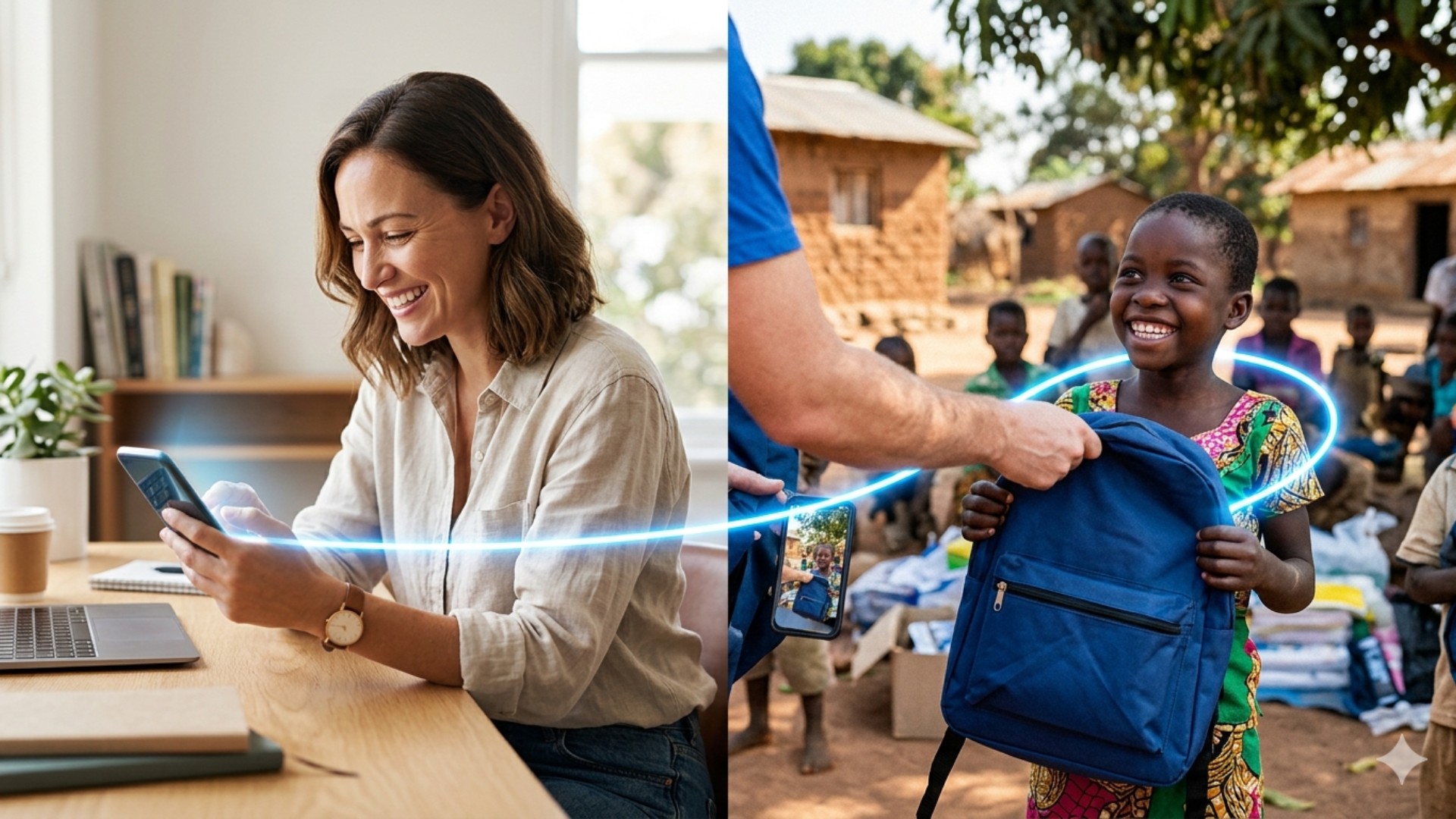
The photo is the thread made visible. It is the only giving experience that completes the loop.
The moment a donor describes
Across Givelink's partner network, donors consistently describe receiving their first delivery photo in similar terms:
Not surprise — expectation was set at checkout. But something else. A kind of settling. The thing they always wanted from giving — the proof that it was real — arrived, and the feeling it produced was different from any donation experience they'd had before.
Many describe sharing the photo. Not posting it to social media as a public gesture — privately, to a partner or a parent or a friend: "Look what happened to what I gave." The photo is inherently shareable because it is inherently human. It is evidence of a connection that most giving only implies.
This is what Givelink data measures as a 60% increase in giving frequency. The donors who receive delivery photos do not become less generous over time. They become more engaged. The proof of the first gift is the reason for the second.
What the photo represents for nonprofits
For nonprofit staff, the photo is a two-minute task that produces compounding returns.
Every photo uploaded to Givelink routes automatically to the dashboards of every donor whose items were in that delivery. No email campaign. No copywriting. No design work. The platform handles routing. The nonprofit provides the evidence.
The evidence is what donors came for. Not the story about the evidence. Not the annual report describing the evidence. The photo.
A small youth arts nonprofit in the Bay Area started posting delivery photos — shelf arrangements of art supplies, photos of staff unpacking boxes — to their Instagram alongside their Givelink wishlist link. Within three months, their follower count had grown 40% and their in-kind donation volume had tripled. The content was authentic because it was real. It worked because the proof was there.
Why most organizations don't do this
The honest answer is habit and infrastructure.
Most nonprofits don't photograph incoming donations because no one told them to, no system prompted them, and no proof was required by the platform they were using. When the platform doesn't require proof, and no one is waiting for it, the habit doesn't form.
Givelink builds proof into the product. The nonprofit dashboard prompts photo upload on delivery cycles. Donors see "delivery pending" status until the photo arrives. The expectation is set on both sides — which is why the habit forms quickly and the photos actually happen.
For an organization that has never done this, it feels like a small thing. It is not a small thing. It is the most significant change in the donor relationship a nonprofit can make with sixty seconds of work.
The compounding effect
One photo is a proof moment. Twelve photos over a year are a relationship.
A donor who gives monthly and receives twelve delivery photos in a year has twelve proof points that their giving is real. They have twelve images they could share. They have twelve moments of closure that traditional giving never produced.
This is not a loyalty program. There are no points. There is no badge. There is just the visible record of a thing that actually happened — a thread between two lives that got a little clearer every time.
Givelink donors give 60% more times per year than donors on traditional platforms (Givelink data, 2026). That number is the compounding effect measured. The photo is the mechanism.
Why this matters in 2026
Public trust in institutions — including charitable ones — continues to decline. The 2025 Edelman Trust Barometer showed nonprofit trust at a decade low. In this environment, assertion without evidence is losing. Organizations that tell donors what they do without showing them are operating against the current.
The current runs toward proof. Toward specificity. Toward the photo.
This is not a trend that will reverse. It is the permanent shift in how trust works in a world where everything else can be tracked, verified, and shown. Giving is the last domain where "trust us" was acceptable. It is no longer.
Givelink in action
A donor in Chicago gave to a veterans' services nonprofit on Givelink in November. She chose four specific items from the wishlist — warm socks, hygiene kits, a notebook, a pen set. Fourteen days later, a notification arrived: "Your donation was delivered." She opened the photo: a table of items arranged by staff, the organization's banner in the background. She stared at it for a moment longer than she expected to. She shared it with her brother, who is a veteran. He gave the following week. Browse verified nonprofits on Givelink and give in a way that produces this moment.
Frequently Asked Questions
Do charities send proof that my donation was used?
Most do not — the standard giving experience produces a receipt, not a photo. Transparent giving platforms like Givelink build delivery photo confirmation into the product: donors receive a notification when their specific items arrive at the nonprofit.
How do I get proof my donation arrived?
Give through a platform with photo proof of delivery built in. On Givelink, the nonprofit photographs received items after each delivery cycle and uploads the photo to the platform. The photo routes automatically to the dashboards of donors whose items were included.
Why don't more nonprofits send delivery photos?
Habit and infrastructure. When a platform doesn't require proof and no system prompts the photo, the habit doesn't form. Givelink builds the prompt into the dashboard and sets the expectation on both the donor and nonprofit side — which is why photos actually happen.
Is a delivery photo enough proof for tax purposes?
The delivery photo is proof of impact — it shows the donor what their gift became. Tax documentation is separate: Givelink automatically generates a donation receipt issued by the nonprofit, which is the document used for tax filing. Both are provided through the platform.
See what your donation becomes
Browse a verified nonprofit on Givelink and give in a way that closes the loop.
Stay Human.
Antonis Politis is CEO and Co-Founder of Givelink. He has spent seven years asking one question: what would giving look like if donors could actually see what they gave?
See also
What is Givelink?
Learn from the founders:
Support a nonprofit
Buy their needs