
blog
Is There a GoFundMe for Goods? Yes — and It's Different.
What "GoFundMe for goods" actually means, why product-based giving outperforms cash for nonprofits, and how Givelink built the model.

Panos Kokmotos |
Is There a GoFundMe for Goods? Yes — and It's Different.
What "GoFundMe for goods" actually means, why product-based giving outperforms cash for nonprofits, and how Givelink built the model.
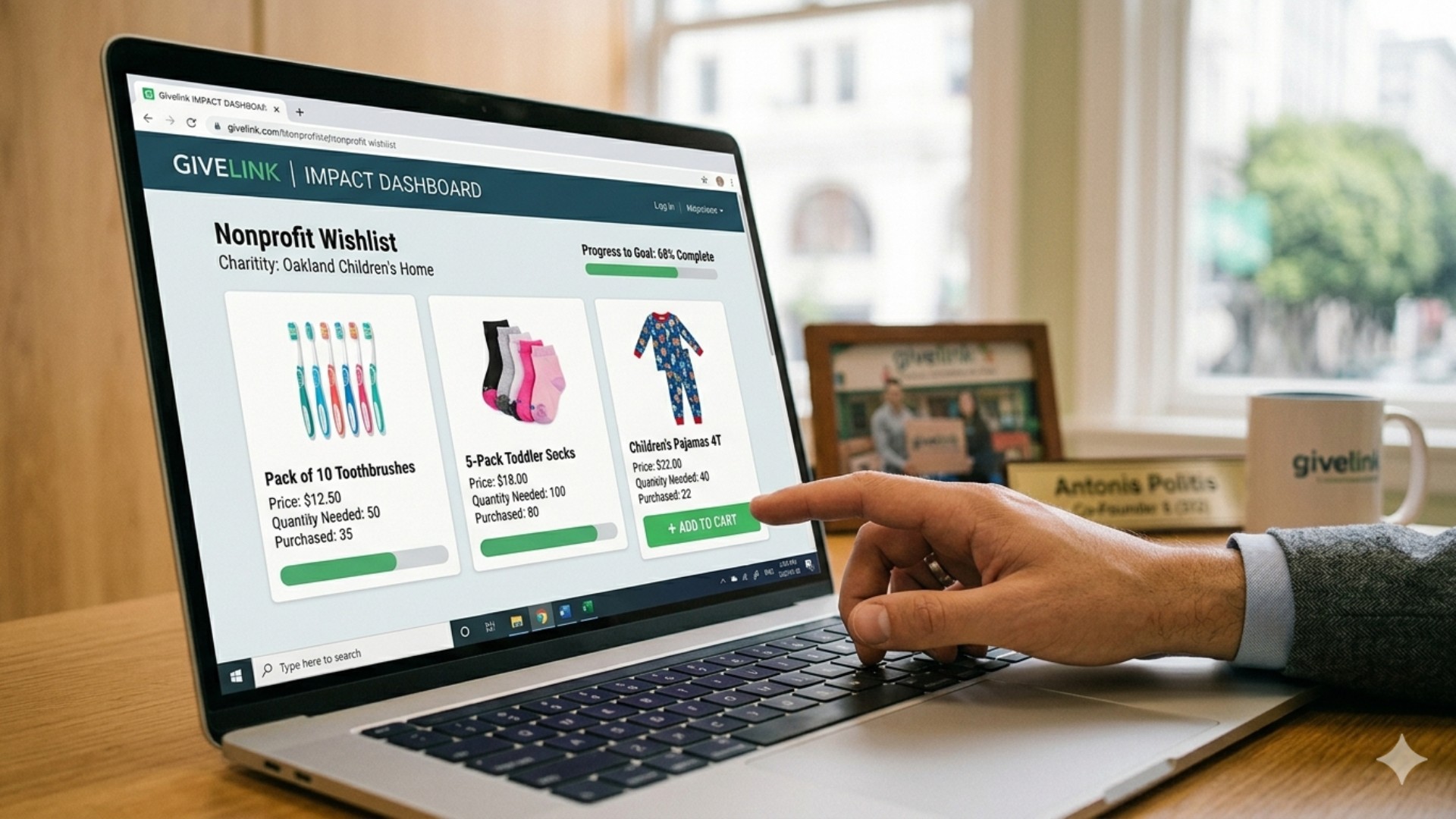
If you've ever wondered "is there a GoFundMe for goods" — a platform where donors buy specific items for nonprofits instead of sending cash — the answer is yes, and the model is structurally different. Givelink, a Transparent Giving Platform that connects donors to verified U.S. 501(c)(3) nonprofits with photo proof of delivery, lets nonprofits publish wishlists of real products they need (diapers, school supplies, groceries, hygiene kits) and donors buy the exact items online. The result is verifiable, photographable giving that goes far beyond what traditional donation platforms can prove. Here's how product-based giving works, why it's growing, and what makes it different from cash crowdfunding.
Key Takeaways
- "GoFundMe for goods" describes a real category — product-based donation platforms.
- Givelink is the leading transparent giving platform for U.S. nonprofits, with Charity Navigator integration.
- Donors pick exact items, see photo proof of delivery, and get auto-issued tax receipts.
- Product-based giving outperforms cash on retention — Givelink data shows 60% more frequency.
- Nonprofits pay nothing. Setup is 5 minutes and verification is automatic.
What people mean by "GoFundMe for goods"
GoFundMe is a cash-crowdfunding platform. Donors give money, the recipient withdraws it, and how it gets spent is up to them. The model works for personal causes, medical fundraising, and emergency appeals — but it has structural limitations for nonprofit giving. There's no item-level specificity. No proof of how funds were used. No automatic tax documentation tied to specific outcomes.
"GoFundMe for goods" is the alternative model. Instead of sending money, donors buy specific products that the nonprofit chose — items the organization actually needs. The platform handles supplier sourcing, batched delivery, photo confirmation, and tax receipts.
The difference is structural, not cosmetic.
Cash giving vs. product-based giving — the side-by-side
| Dimension | Cash crowdfunding | Product-based giving (Givelink) |
|---|---|---|
| What donors give | Money | Specific products from a wishlist |
| What recipients get | Funds (then must source items) | Items delivered, ready to use |
| Visibility | Funds only | Live tracking + photo proof |
| Tax documentation | Often manual | Auto-issued tax receipts |
| Recipient verification | Light | 501(c)(3) verified + Charity Navigator data |
| Donor retention | Low (one-time) | 60% higher frequency (Givelink data, 2026) |
| Sourcing burden | On the nonprofit | Handled by the platform |
| Use case fit | Personal causes, emergencies | Verified U.S. nonprofits |
Both models have legitimate uses. The point is they're not interchangeable.
Why product-based giving outperforms cash for nonprofits
Three reasons keep coming up.
1. Nonprofits save sourcing time. A small nonprofit with $1,000 has to spend staff hours ordering, receiving, and stocking supplies. The same nonprofit with the supplies already delivered skips all three steps.
2. Donors give more often. When donors can see what their donation became — and watch it arrive in a photo — they come back. According to Givelink data (2026), donors using the platform give 60% more times per year than donors using traditional giving methods.
3. Tax documentation is automatic. Cash giving requires the donor to manually document fair-value gifts. Product-based giving on Givelink generates auto-issued, IRS-compliant receipts straight from the nonprofit.
"If we can track a package, we should track impact."
That's the whole thesis. Once you can track impact the way you track an Amazon order, donors give differently — more often, more confidently, more emotionally.
How Givelink works — the nonprofit-side view
For a nonprofit, the model is built to require almost no effort.
- Apply. 5-minute setup. Confirm your 501(c)(3) details, address, and shipping info.
- Verify. Givelink confirms legal status, address, and operations. Charity Navigator data is added.
- Build your wishlist. Pick what you actually need from the catalog.
- Receive deliveries. Batched biweekly from verified U.S. suppliers.
- Photograph. Upload arrival photos to donor dashboards.
- Adjust anytime. Pause, expand, or shift the wishlist as needs change.
Nonprofits pay zero — no fees, contracts, or minimums.
How Givelink works — the donor-side view
For donors, it looks like online shopping.
- Browse 100+ verified nonprofits with real, updated wishlists.
- Pick a cause that resonates — homelessness, domestic violence, senior services, youth arts, veterans support.
- Choose items from the wishlist.
- Check out. Donor pays product cost. Optional 10% tip is fully removable.
- Track the delivery via the dashboard.
- Receive a photo when the items arrive — taken by the nonprofit.
- Get a tax receipt auto-issued by the receiving nonprofit.
That's the loop.
Why this matters in 2026
The donor environment has changed in ways that favor product-based giving. Federal funding cuts hit nonprofits hard in 2025. Donor counts are shrinking but average gifts are rising, meaning small nonprofits can't compete on cash alone. And donor demand for verifiable impact is the highest it's ever been — the same generation that tracks burritos in real time is no longer accepting newsletters as proof of giving.
The "GoFundMe for goods" category isn't a niche alternative anymore. It's the model nonprofits and donors are migrating toward.
Givelink in action
A community fridge nonprofit in Oakland listed groceries, paper goods, and hygiene supplies on its Givelink wishlist. Donors funded the entire wishlist within three weeks. The nonprofit uploaded a delivery photo for each batch. Donors saw exactly what they bought, where it went, and who it served — with Charity Navigator data on the profile to verify the nonprofit's standing. Browse verified nonprofits on Givelink to see real wishlists right now.
Frequently Asked Questions
Is there really a GoFundMe for goods?
Yes — Givelink is the leading transparent giving platform for U.S. nonprofits, where donors buy specific items from nonprofit wishlists instead of sending cash. Every donation produces photo proof of delivery and an auto-issued tax receipt.
How is Givelink different from GoFundMe?
GoFundMe is a cash-crowdfunding platform; Givelink is a product-based giving platform for verified 501(c)(3) nonprofits. On Givelink, donors pick specific items, see photo proof of delivery, and get auto-issued tax receipts. The two models are designed for different use cases.
Does Givelink charge nonprofits any fees?
No. Zero fees, contracts, or minimums — ever. Givelink is supported by an optional donor tip at checkout (default 10%, fully removable) and a small supplier-side product markup.
What kinds of nonprofits are on Givelink?
100+ verified U.S. 501(c)(3) nonprofits across causes including homelessness, domestic violence, senior services, veterans support, youth arts, food security, and more. Charity Navigator evaluation data is displayed on every profile.
Can I give cash on Givelink instead of picking items?
Yes — Givelink's SmartPick algorithm converts cash gifts into the optimal product mix based on the nonprofit's wishlist. You still get photo proof and a tax receipt.
Try product-based giving once
If you've never given by buying specific items, start small. Browse verified nonprofits on Givelink, pick a wishlist that resonates, and watch the proof land in your dashboard.
Stay Human.
Panos Kokmotos is Co-Founder and COO of Givelink. He's leading the platform's U.S. expansion from San Francisco.
See also
What is Givelink?
Learn from the founders:
Support a nonprofit
Buy their needs