
blog
In-Kind Donation Accounting: How to Record and Report Gifts of Goods
How nonprofits record, value, and report in-kind donations — journal entries, fair market value, ASU 2020-07 presentation and disclosure requirements, and Form 990 treatment.

Givelink Team |
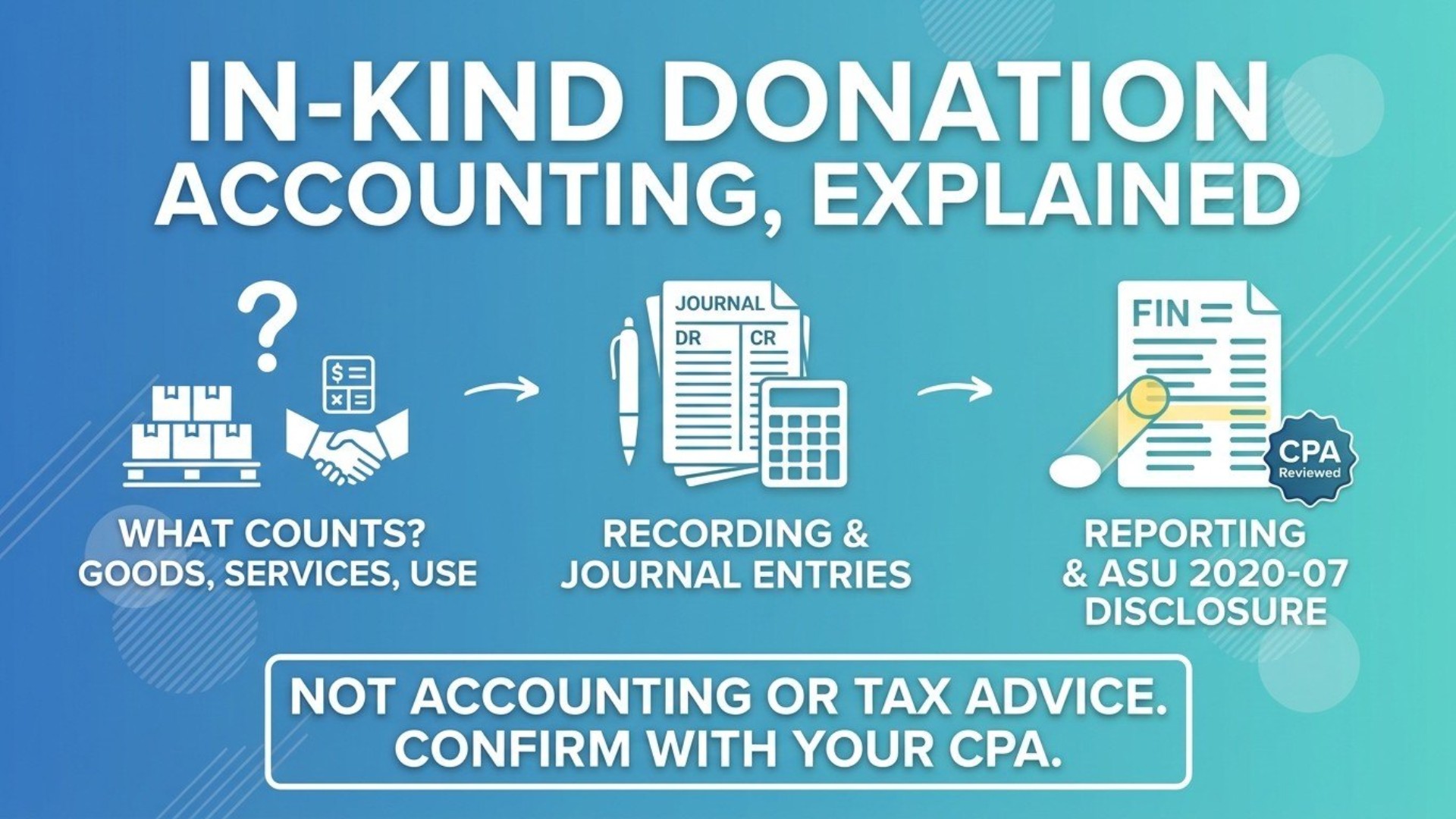
In-Kind Donation Accounting, Explained
In-kind donations are one of the most commonly mishandled items on a nonprofit's books. Not because the rules are especially hard, but because the gifts arrive informally — a pallet shows up, someone signs for it — and the accounting happens later, if at all.
Under-recording in-kind gifts understates both revenue and expense. It makes your organization look smaller than it is, distorts your program-expense ratio, and creates audit findings. It also quietly undersells your impact to funders.
Here is how the treatment works.
What counts as an in-kind donation
An in-kind contribution is a non-cash gift. Broadly, three categories:
Gifts of goods (tangible property). Food, clothing, equipment, supplies, furniture, vehicles, inventory. This is what most nonprofits mean when they say "in-kind."
Gifts of services. Legal work, accounting, design, IT, construction labor.
Gifts of use. Free or below-market rent, donated space, donated advertising.
The recognition rules differ meaningfully between goods and services, which is where most errors happen.
When you recognize it
Goods
Contributed goods are generally recognized as revenue at fair market value on the date received, with a corresponding asset or expense.
If you use the goods immediately in your programs, you record contribution revenue and program expense in the same period — the transaction runs through your books at full value and then out again. If you hold the goods (inventory, equipment), you record an asset.
Services
This is where most organizations get it wrong. Contributed services are recognized only if they meet one of two conditions:
- They create or enhance a non-financial asset (e.g., a contractor donating labor on a building you own), or
- They require specialized skills, are provided by someone possessing those skills, and would typically need to be purchased if not donated. "Specialized skills" means professionals such as attorneys, accountants, doctors, architects, electricians, and similar.
General volunteer time does not qualify. The parent who staffs your registration table for six hours is enormously valuable and is not contribution revenue. You can — and should — report volunteer hours in your narrative and annual report. You do not book them.
How to value it
Fair market value is the price the item would sell for between a willing buyer and a willing seller, neither under compulsion.
Practical approaches by asset type:
| Type of gift | Common valuation basis |
|---|---|
| New retail goods | Retail price, or the donor's documented cost |
| Used goods | Thrift/resale value in comparable condition |
| Food | Per-pound conventions used in the food bank sector, or documented retail value |
| Professional services | The provider's standard billing rate |
| Donated space/rent | Comparable market rent for equivalent space |
| Securities | Market value on the date of transfer |
| Vehicles | Recognized valuation guides, adjusted for condition |
Key point on who values what: the donor is responsible for substantiating the value they claim on their own return. Your receipt should describe the property, not assign it a dollar value. You do, separately, need a value for your own books — but that is your internal accounting determination, not a valuation you give the donor. Conflating these two is a frequent and consequential mistake.
For donated property where a donor claims over $5,000, the donor generally needs a qualified appraisal, and your organization may be asked to sign IRS Form 8283. Signing acknowledges receipt — it is not an endorsement of the donor's claimed value.
The journal entries
Goods used immediately in programs
Dr  Program Expense — [category]        $X
    Cr  Contribution Revenue — In-Kind      $X
Goods held as inventory
Dr  Inventory                           $X
    Cr  Contribution Revenue — In-Kind      $X
Then, when distributed:
Dr  Program Expense                     $X
    Cr  Inventory                           $X
Donated equipment (capitalizable)
Dr  Fixed Assets — Equipment            $X
    Cr  Contribution Revenue — In-Kind      $X
Then depreciate over its useful life per your capitalization policy.
Qualifying contributed services
Dr  Expense — [functional category]     $X
    Cr  Contribution Revenue — In-Kind      $X
Donated use of space
Dr  Occupancy Expense                   $X
    Cr  Contribution Revenue — In-Kind      $X
Note that qualifying services and space are revenue-neutral to the bottom line — equal and offsetting. That is expected. The point is that your statements reflect the true scale of your operations rather than making donated resources invisible.
Presentation and disclosure (ASU 2020-07)
FASB's ASU 2020-07 changed how nonprofits present and disclose contributed nonfinancial assets. In broad terms it requires:
Presentation. Contributed nonfinancial assets shown as a separate line item in the statement of activities, distinct from cash contributions.
Disclosure. Disaggregation by category of asset, and for each category:
- Whether the assets were monetized or utilized during the period, and if utilized, a description of the programs in which they were used
- Any donor-imposed restrictions
- The valuation techniques and inputs used to determine fair value
- The principal market used to arrive at fair value, if there are donor restrictions prohibiting sale Practically: you need to track in-kind gifts by category as they come in, not reconstruct them at year-end. Organizations that receive in-kind gifts casually and record them in a single lump account find this disclosure painful. Organizations that categorize at intake find it trivial.
Confirm the current requirements and effective dates with your auditor — standards get amended.
Form 990 treatment
In-kind contributions appear in several places on the 990, and the interaction between them is a common source of confusion:
- Part VIII (Statement of Revenue) — noncash contributions reported separately from cash
- Part IX (Statement of Functional Expenses) — the corresponding expense, allocated across program, management, and fundraising
- Schedule M (Noncash Contributions) — required if noncash contributions exceed the reporting threshold, with detail by property type, number of contributions, revenue reported, and method of determining revenue
- Schedule B — contributor detail, subject to the applicable thresholds Donated services and use of facilities are generally not reported as revenue on Form 990 even where they are recognized under GAAP. This creates a legitimate difference between your audited financials and your 990, and it is worth documenting your reconciliation so it does not become a recurring question.
What good practice looks like
Categorize at intake, not at year-end. Build the category into your receiving process. Retrofitting a year of unsorted in-kind gifts to satisfy ASU 2020-07 disclosure is the single most avoidable pain in this area.
Write down your valuation policy. One page: what basis you use for each asset type, who approves it, what documentation you keep. Auditors ask. Having it written is the difference between a five-minute conversation and a finding.
Keep the donor-facing receipt and the internal valuation separate. Receipt describes; ledger values. Never put your internal valuation on the donor's receipt.
Set a de minimis threshold. Not every donated box of pens needs a journal entry. Document your threshold and apply it consistently.
Automate the receipt. Manual acknowledgment is where compliance actually breaks down — not from ignorance, but from volume and the 48-hour gap between intake and paperwork.
Where the paperwork usually breaks
The accounting above is manageable. What is not manageable, at volume, is generating a compliant, timely acknowledgment for every individual in-kind gift — with the correct legal name, EIN, description of property, date, and the no-goods-or-services statement — while also running your programs.
This is the specific problem Givelink removes. Every in-kind gift given through the platform generates an IRS-compliant receipt automatically, categorized, with a permanent record you can export at year-end for your Schedule M and your ASU 2020-07 disclosure.
No fees, to you or the donor.
FAQ
Do I have to record in-kind donations? Under GAAP, qualifying in-kind contributions are recognized in your financial statements. Not recording them understates both revenue and expenses and can create audit findings.
Do I record volunteer hours? Generally no — unless the services require specialized skills that you would otherwise have to purchase, or they create or enhance a non-financial asset. General volunteer labor is reported narratively, not booked.
Who determines the value — us or the donor? For your books, you determine fair value using a documented, consistent method. For the donor's tax deduction, the donor substantiates their own claimed value. Your written acknowledgment should describe the property without stating a dollar amount.
Does an in-kind donation affect my overhead ratio? Yes, and often favorably — in-kind gifts used in programs increase program expense, which typically improves the ratio funders look at. This is one of several reasons under-recording works against you.
What is ASU 2020-07? A FASB standard governing presentation and disclosure of contributed nonfinancial assets, requiring a separate revenue line item and disaggregated disclosure by asset category. Confirm current applicability with your auditor.
Related: Are in-kind donations tax deductible? · How to ask for in-kind donations · Companies that donate to nonprofits
See also
What is Givelink?
Learn from the founders:
Support a nonprofit
Buy their needs