
blog
How to Give on a Budget: Making $25 Count More Than You Think
What $25 actually buys for a nonprofit, why small recurring gifts compound, and how transparent giving makes every dollar visible.

Panos Kokmotos |
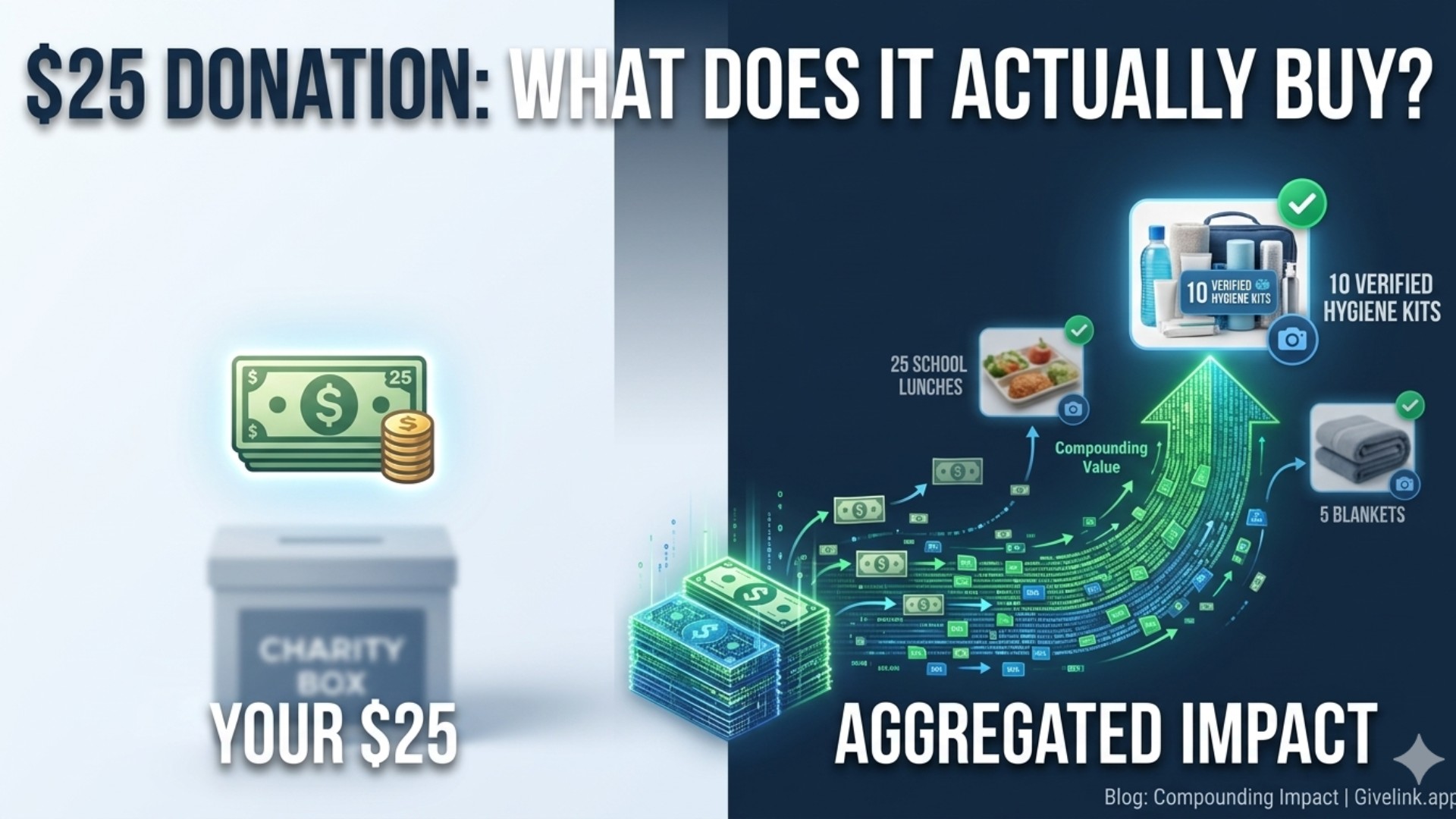
How to Give on a Budget: Making $25 Count More Than You Think
What $25 actually buys for a nonprofit, why small recurring gifts compound, and how transparent giving makes every dollar visible.
Most giving guides assume a budget. The conversation in philanthropic media centers on major donors, DAF holders, and year-end strategy. But most Americans who give charitably do so in small amounts — $10, $25, $50 — and wonder whether it matters. It does. Givelink, a Transparent Giving Platform, is built for exactly this: making every dollar visible, specific, and traceable — so that a $25 donation produces a photo of what it became, not a vague "thank you for your generosity." Here's what $25 actually buys, how small gifts compound, and why the giving experience matters as much as the amount.
Key Takeaways
- $25 buys specific, photographable impact on Givelink — not a rounding error.
- Small recurring donors are the backbone of nonprofit sustainability.
- 60% more giving frequency (Givelink data, 2026) means small donors give more often when they see proof.
- The experience, not the amount, determines retention.
- Every dollar is visible — SmartPick converts $25 into the optimal item mix from the nonprofit's wishlist.
What $25 actually buys on Givelink
Here's the honest answer — what a $25 donation becomes at real nonprofits, at real prices:
| $25 donation | What it buys |
|---|---|
| Homeless shelter | 50 toothbrushes OR 30 bars of soap OR 3 months of deodorant for one resident |
| Family shelter | 1 pack of size-3 diapers (168 count) OR 4 cans of formula |
| Youth arts program | A full set of acrylic paints OR 10 sketchbooks |
| Senior services | 4 cans of nutritional shakes OR a set of grip socks for 6 residents |
| Food bank | 8 cans of protein-rich food OR a pantry staple pack |
| Domestic violence shelter | 2 weeks of hygiene supplies for one resident |
None of these feel like rounding errors when you see the photo. A pack of 50 toothbrushes on a shelter intake shelf is a specific thing that happened because of a specific person's $25.
Why small gifts compound
The lifetime value of a recurring small donor is not $25. It's $25 times however many times they give — and the data shows that transparent giving dramatically increases how many times they give.
According to Givelink data (2026), donors using the platform give 60% more times per year than donors using traditional giving methods. For a $25 donor, this means:
| Giving pattern | Year 1 | Year 2 | Year 3 | 3-Year Total |
|---|---|---|---|---|
| $25 once (traditional, churns) | $25 | $0 | $0 | $25 |
| $25 × 4/year (traditional) | $100 | $75 (partial churn) | $0 | $175 |
| $25 × 4/year (Givelink, 60% lift) | $100 | $100 | $90 | $290 |
The experience determines retention. Transparent giving turns a $25 donor into a $290 donor over three years — not by asking more, but by showing more.
How to make a small budget go further
Give consistently, not occasionally. A $25/month habit produces $300/year and builds a relationship with a specific nonprofit. A single $300 year-end donation produces $300 and probably no return.
Pick one nonprofit and stick with it. Spreading $25 across 5 organizations in a year produces $5 each — below the threshold of meaningful operational impact for any of them. Giving $25 consistently to one organization produces a real relationship.
Use SmartPick. When you enter $25 as a cash amount, Givelink's SmartPick algorithm converts it into the optimal product mix from the nonprofit's wishlist — prioritizing their highest-urgency items. Your $25 reaches the most needed point.
Give from the wishlist. Items on the wishlist are there because the nonprofit actually needs them. Giving from it is more effective than giving items you assume are needed.
Why the experience matters as much as the amount
Here's something the giving guides don't say: a $25 donor who has a great giving experience — photo proof, specific impact, verified nonprofit — is more valuable to a nonprofit than a $100 one-time donor who had a mediocre one.
The $25 donor with a great experience returns. The $100 donor without proof probably doesn't.
This is why Givelink's model is designed to give every donor — at every budget level — the same proof, the same dashboard, the same delivery photo. The experience doesn't scale with the dollar amount. It's built into the platform.
"A child carrying a weight heavier than most of us will ever know, felt hope for the first time."
That can happen because of $25. It does, regularly. The photo proves it.
Givelink in action
A graduate student in San Francisco set a $20/month giving budget — the equivalent of a streaming subscription. She uses Givelink's SmartPick to convert her $20 each month into the optimal items for a senior services nonprofit in her neighborhood. Over the past year, she's given 14 times (some months she gave twice when she had extra), producing $280 in total giving with 14 delivery photos in her dashboard. The nonprofit executive director knows her name. Browse verified nonprofits on Givelink and give what you can, consistently.
Frequently Asked Questions
Is $25 enough to make a meaningful donation?
Yes. $25 buys 50 toothbrushes, a pack of diapers, 4 cans of protein shakes, or a week of hygiene supplies for one shelter resident. On Givelink, every dollar is converted into a specific, photographable item.
Should I give $25 to one nonprofit or spread it across several?
One nonprofit. Consistent giving to a single organization builds a relationship, contributes to operational predictability, and makes you a meaningful supporter rather than a rounding error.
How does SmartPick help small budget donors?
SmartPick converts a cash input — even $15 or $20 — into the optimal product mix from the nonprofit's active wishlist, prioritizing their highest-urgency items. Small budgets become specific, optimized contributions.
Does Givelink charge fees on small donations?
The optional donor tip (default 10%, fully removable) is the only optional addition to the product cost. Nonprofits pay zero fees regardless of donation size.
Give $25. See what it became.
Browse verified nonprofits on Givelink — and give specifically, regardless of budget.
Stay Human.
Panos Kokmotos is Co-Founder and COO of Givelink.
See also
What is Givelink?
Learn from the founders:
Support a nonprofit
Buy their needs