
blog
Good360 vs. Givelink: An Honest Comparison for Nonprofits
Good360 and Givelink both get physical goods to nonprofits — very differently. A fair comparison of who each one actually fits, from the team behind Givelink.

Givelink |
Good360 vs. Givelink: An Honest Comparison
Last verified: [DATE]
We built Givelink, so treat everything here accordingly. What we have tried to do is describe Good360 accurately enough that a Good360 employee would recognize it — and then be clear about who each platform actually suits.
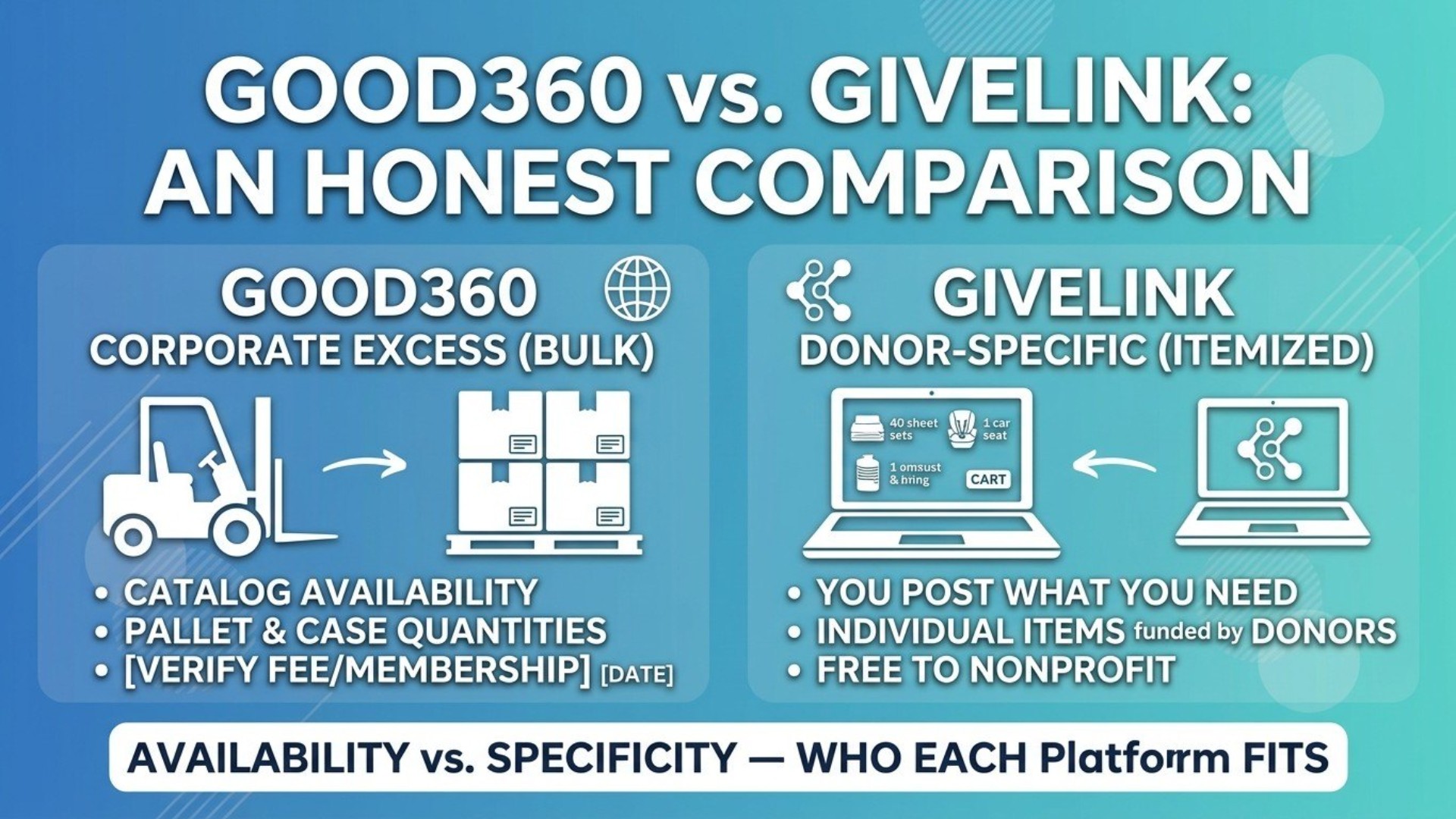
The short version: these are not really competitors. Good360 moves corporate excess inventory at scale. Givelink lets individual donors buy specific things a nonprofit asked for. If you need a pallet of one product, Good360 is built for that and we are not. If you need forty sheet sets and twelve car seats and a laptop, we are built for that and they are not.
The fundamental difference: where the goods come from
This is the distinction everything else follows from.
Good360's model is corporate excess inventory. Companies have overstock, discontinued lines, returns, seasonal leftovers. Good360 is the infrastructure that routes those goods to nonprofits instead of to a landfill. It is a genuinely important piece of the sector's plumbing and it operates at a scale we do not.
The consequence: you receive what is available. The catalog is whatever companies happen to be moving that month. It is enormously valuable when what is available matches what you need. It is less useful when you need one specific thing on a specific date.
Givelink's model is individual donors buying what you asked for. You post the specific items you need. Individual people — your supporters, and people who find you on the platform — buy them. They ship to you.
The consequence: you receive what you asked for, but only if someone chooses to give it. There is no guarantee any given item gets funded, and we do not pretend otherwise.
Availability vs. specificity. That is the whole trade.
Side-by-side
[Verify every Good360 cell before publishing. Where you cannot verify, write "see their site" rather than guessing.]
| Good360 | Givelink | |
|---|---|---|
| Source of goods | Corporate excess inventory | Individual donors purchasing |
| You choose the specific item | From available catalog | Yes — you post what you need |
| Typical quantity | Bulk / case / pallet | Individual items |
| Cost to nonprofit | [Verify — membership and/or handling/shipping] | Free |
| Cost to donor | n/a | Retail price of the item |
| Eligibility | [Verify current requirements] | Verified 501(c)(3) |
| Shipping | [Verify — freight arrangements] | Consolidated batches every 14 days |
| Tax receipts | [Verify] | Automatic, IRS-compliant, per gift |
| Donor relationship | Corporate donor, at arm's length | Individual donors, named, thankable |
| Multiple lists per org | [Verify] | Yes — per program, site, or project |
| Multiple staff logins | [Verify] | Yes |
| Best for | High-volume, category-flexible needs | Specific, itemized, smaller-quantity needs |
When Good360 is the better choice
Say so plainly. It costs you nothing and it is the reason readers trust the rest of the page.
Use Good360 if:
- You can absorb bulk quantities — you distribute at scale, you have storage, a pallet of one product is useful rather than a burden
- Your needs are category-flexible — "hygiene products" rather than "these exact hygiene products"
- You are a disaster-response or large-distribution organization, where volume is the entire point
- You have warehouse capacity and receiving infrastructure
- You want access to corporate inventory that individual donors would not think to buy — commercial equipment, industrial quantities, specialized supplies For organizations that fit that profile, Good360 does something no individual-donor platform can replicate. If that is you, go use it.
When Givelink is the better fit
Use Givelink if:
- You need specific items in ordinary quantities — 40 sheet sets, 12 car seats, 6 laptops
- You do not have warehouse space and cannot take a pallet
- You want to turn the gift into a donor relationship — you learn who gave, they get a photo and your thank-you note, they show up in your CRM
- You need automatic tax receipts without adding paperwork to your week
- You are small and cannot meet larger platforms' volume expectations
- You want your supporters to be able to give a thing instead of writing a check — and you want that to be one link you can share
- You run multiple programs or sites and want a separate list for each, with separate staff logins
Many organizations should use both
This is not a false-balance gesture — it is what we actually observe.
The two models cover different needs, and the sensible posture for most organizations is:
- Good360 for the bulk, category-flexible, high-volume side
- Givelink for the specific, itemized, donor-facing side — and for turning individual supporters into repeat givers Neither replaces the other. Using one does not preclude the other.
Common questions
Is Good360 free for nonprofits? [Verify and answer accurately from their current published information, including any membership tiers, handling fees, or shipping costs. Do not characterize — state.]
Is Givelink free? Yes. No fees to your organization and no fees to your donors. Donors can optionally add a tip at checkout, and there is a small product markup in the US covering sourcing and logistics. Nothing is deducted from what reaches you.
Can I use both? Yes, and many organizations should. They solve different problems.
What are the alternatives to Good360? Besides Givelink: corporate giving programs directly (list here), local business relationships, Amazon wishlists (and what breaks about them), and in-kind matching platforms.
Which is better for a small nonprofit? Generally Givelink, because there is no volume expectation, no storage requirement, and no cost. But it depends entirely on whether your needs are specific-and-small or bulk-and-flexible.
Try it without switching anything
You do not have to choose. Add a Givelink list, share it once in your next newsletter, and see what comes back.
Setup takes about fifteen minutes. There is no cost and nothing to cancel.
We keep this comparison current. If anything here is out of date or unfair to Good360, tell us and we will fix it.
Related: Amazon wishlist for nonprofits: what breaks · Companies that donate to nonprofits · How to ask for in-kind donations
See also
What is Givelink?
Learn from the founders:
Support a nonprofit
Buy their needs