
blog
How Families Can Give Together — A Guide for Parents and Kids
Teaching children about charitable giving in a way that shows real impact — and why transparent giving is the model that makes it stick.

Panos Kokmotos |
How Families Can Give Together — A Guide for Parents and Kids
Teaching children about charitable giving in a way that shows real impact — and why transparent giving is the model that makes it stick.
Teaching children to give is one of the most lasting gifts a parent can offer. But most giving experiences for families are abstract for kids: "we gave $50 to charity" means nothing to a 9-year-old who can't visualize $50 or charity. Transparent giving changes this completely. Givelink, a Transparent Giving Platform that connects donors to verified U.S. 501(c)(3) nonprofits with photo proof of delivery, gives families a giving experience that children can understand, participate in, and remember: you picked the item, it went to a real organization, here's the photo of it arriving. Here's how to make giving a family practice — and why the photo changes everything for kids.
Key Takeaways
- Abstract giving doesn't stick with children. Specific, photo-documented giving does.
- Let children choose the item — ownership produces emotional connection.
- The delivery photo is the moment that makes giving real for kids.
- Annual giving rituals (Giving Tuesday, holidays, birthdays) are natural entry points.
- Givelink is family-friendly — browse together, choose together, give together.
Why children disengage from giving — and what changes it
A child who is told "we're donating $50 to help kids" has no picture in their mind. The transaction is invisible. The outcome is invisible. The connection to another child's life is invisible.
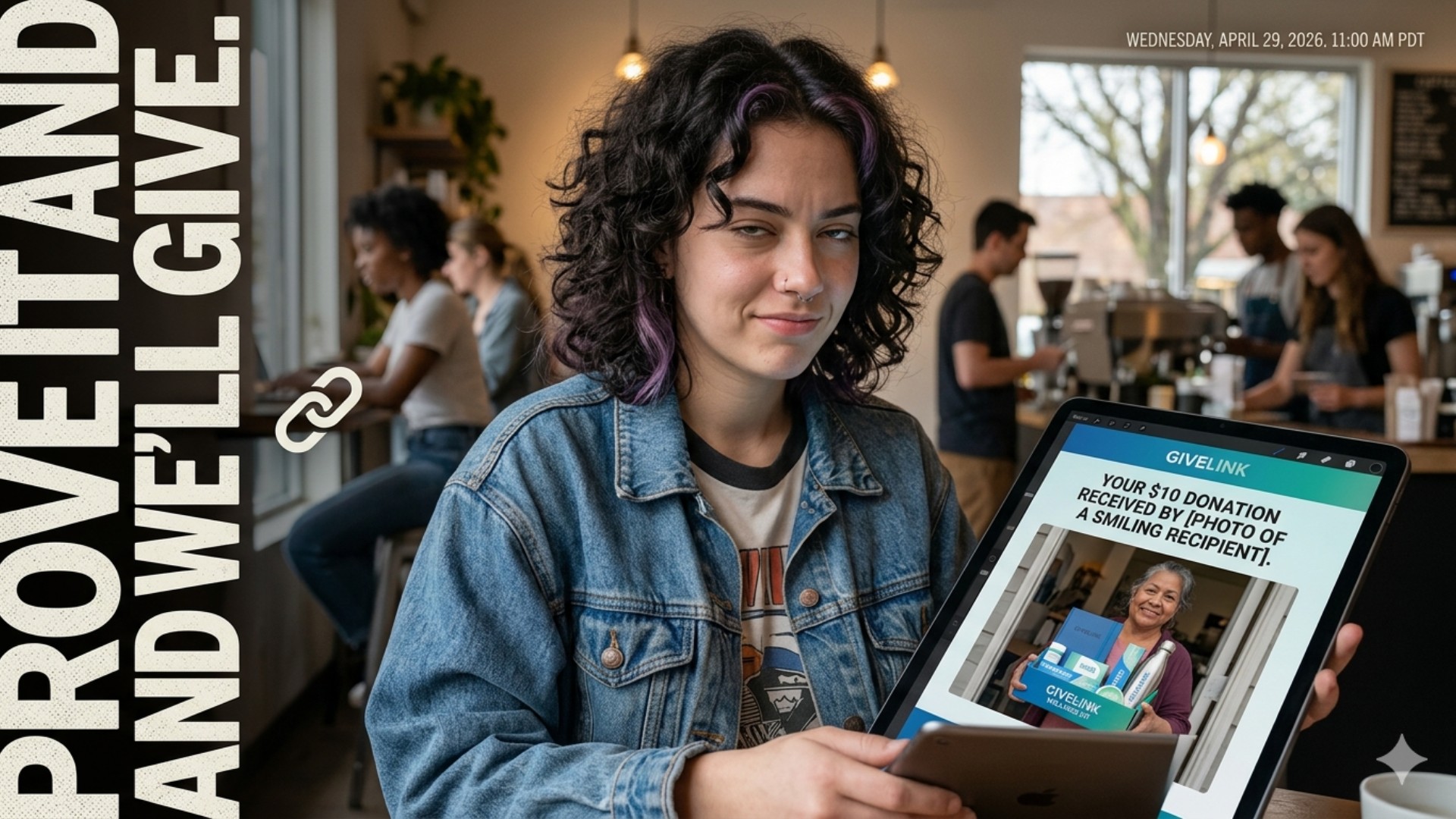
A child who sits with a parent, browses a nonprofit wishlist, picks a box of school supplies for a youth program, and then — two weeks later — sees a photo of those supplies in a classroom: that child has a picture. That experience has a before, a middle, and an after. It's a story.
Stories are what stick.
How to give as a family on Givelink
Age 4–7: Watch and talk Let young children watch you browse and give. Narrate what you're doing: "We're picking school supplies for kids who need them. These pencils are going to a classroom in Oakland." They don't need to click the button. They need to understand the loop.
When the delivery photo arrives, show it. "Remember those pencils we picked? Here they are in the classroom."
Age 8–12: Let them choose Open Givelink and let your child browse nonprofit wishlists. Give them a budget ($10, $20, whatever fits) and let them make the choice. They'll take ownership of the item they picked and feel genuinely responsible for it.
Ask questions: "Why did you pick that one?" "What do you think happens when it arrives?" The conversation is the teaching.
Age 13+: Research together Older children can engage with the Charity Navigator data on each nonprofit profile. Walk them through what the ratings mean. Discuss program expense ratios. Talk about why verification matters.
Let them run the donation — from wishlist to checkout to waiting for the photo. Independence in giving builds a lifelong habit.
Giving rituals that work for families
Birthday giving: Instead of one birthday gift, invite the child to give to a cause they care about. Let them pick the nonprofit and the items. The delivery photo becomes a birthday memory.
Giving Tuesday: The first Tuesday after Thanksgiving is the natural "family giving day." Make it annual, make it child-led, and document it with the delivery photo.
Holiday season: December is when children observe adult giving behavior most closely. If your year-end giving is invisible (a check, a donate button click), they learn nothing. If it produces a photo, they learn something lasting.
When news happens: When a disaster, a local crisis, or a community need comes up in the news, use it as a real-time giving moment. "We heard about [organization]. Let's see what they need."
What the delivery photo teaches
The photo does something developmental for children that abstract giving cannot: it closes the loop.
Children think in cause and effect. You did X, Y happened. The delivery photo is the Y. It completes the narrative. It confirms that giving is real, that it produces something specific, and that the child played a role in making that thing happen.
This is the foundation of a lifetime of giving — not obligation or guilt, but the direct experience of: I did something, something changed.
Why this matters in 2026
Gen Z is the fastest-growing donor segment but the hardest to retain on traditional platforms. Children who grow up with transparent, proof-based giving as their model will be the donors who expect it throughout their lives.
Parents who introduce giving as visible, specific, and photographable are raising the donor generation that the nonprofit sector desperately needs.
Givelink in action
A family in San Francisco has a "giving Saturday" every month — their two children (ages 9 and 13) each pick one item from a nonprofit wishlist using their $15 monthly giving budget. The 9-year-old always picks hygiene items "because everyone needs soap." The 13-year-old researches the nonprofit's Charity Navigator rating before picking. When the delivery photos arrive, both kids ask to see them. The 9-year-old once asked: "Can we give more next month?" Browse verified nonprofits on Givelink and start your own family giving practice.
Frequently Asked Questions
What age is appropriate for teaching kids about giving?
Children as young as 4–5 can understand the basic concept of giving to someone who needs something. The Givelink model — pick an item, see the photo — makes it concrete enough for young children.
How much should children give?
Any amount is meaningful. $5 buys a toothbrush. $10 buys a week of soap. The dollar amount matters less than the experience of choosing, giving, and seeing the outcome.
Can children choose their own nonprofit on Givelink?
Yes — Givelink's browse interface works well for older children. Filtering by cause category and reading wishlist descriptions is accessible for ages 10+.
How do I explain the delivery photo to a young child?
"Remember when we picked the school supplies? Here they are — at the school. Someone got them." That's enough. The photo is self-explanatory.
Give with your kids. Let them see the photo.
Browse verified nonprofits on Givelink together — it takes 10 minutes and produces a memory.
Stay Human.
Panos Kokmotos is Co-Founder and COO of Givelink.
See also
What is Givelink?
Learn from the founders:
Support a nonprofit
Buy their needs