
blog
What's Next for Givelink: The Product Roadmap
Service-based giving, expanded supplier coverage, deeper Charity Navigator integration, and the national expansion — what the next chapter of transparent giving looks like.

Alexandros Karagiannis |
What's Next for Givelink: The Product Roadmap
Service-based giving, expanded supplier coverage, deeper Charity Navigator integration, and the national expansion — what the next chapter of transparent giving looks like.
Givelink has delivered 100,000+ items to 100+ verified nonprofits and proven the transparent giving model in California. The next chapter is broader, deeper, and more ambitious. This post shares what's on the product roadmap — not as a marketing exercise, but as a transparency commitment: the same standard we apply to nonprofits, we apply to ourselves. Here's where we're going and why each piece matters.
Key Takeaways
- National expansion beyond California — New York, Texas, Illinois, and Washington are next.
- Service-based giving — expanding beyond products to rent assistance, utilities, and professional services.
- Supplier-funded model — transitioning from product markup to supplier commission so donors pay exact retail.
- Deeper Charity Navigator integration — more data points, more organizations evaluated.
- CRM integrations — Salesforce and other nonprofit CRMs natively connected.
Priority 1: National expansion
California-first was the proof-of-concept strategy. The proof is in. The 30+ California nonprofit partners, the Charity Navigator partnership, and the 60% donor frequency lift establish that the model works in the U.S. market.
National expansion follows a clear criterion: markets with high concentrations of small nonprofits under federal funding pressure, digitally native donor bases, and existing third-party verification infrastructure.
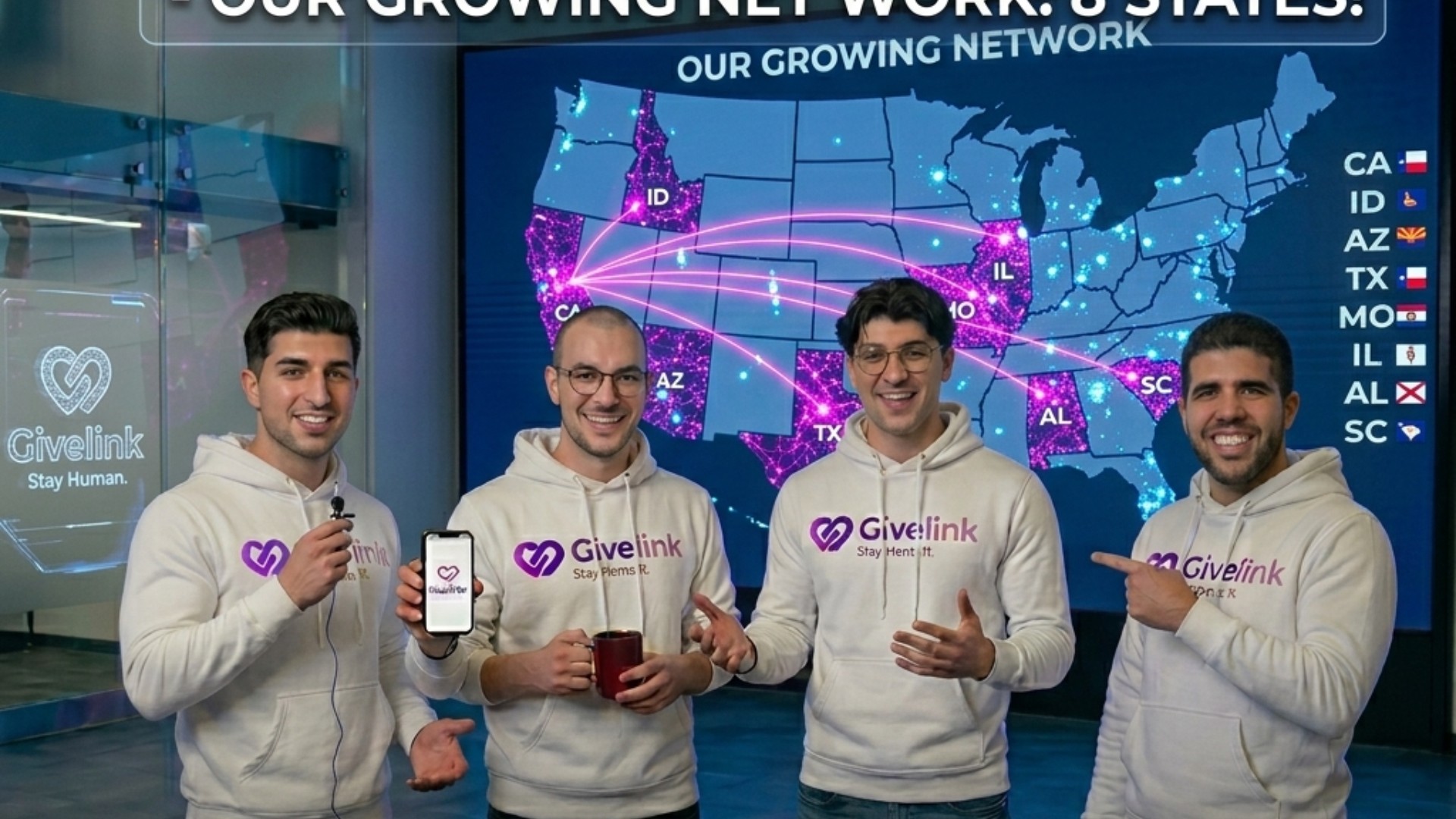
Next markets: New York, Texas, Illinois, and Washington State are the priority expansion targets. Each has distinct nonprofit density patterns and donor profiles — the expansion approach will be tailored to each market rather than replicated uniformly.
Timeline: Pilot expansions in 2027 with full market presence in 2028.
Priority 2: Service-based giving
Givelink currently delivers products. But many of the most critical needs nonprofits face aren't products — they're services. Rent assistance for transitional housing clients. Utility payments for families on the edge of eviction. Transportation subsidies for medical appointments. Professional services (legal aid, mental health, healthcare) that can't be shipped in a box.
Service-based giving is the next category frontier. The technical challenges are different from product giving: service delivery doesn't produce a box to photograph, so the proof mechanism has to evolve. We're building verification frameworks for service outcomes — appointment confirmation records, service completion documentation, beneficiary anonymized confirmation.
The goal: Expand the wishlist to include services that verified nonprofits need alongside products — so donors can fund a month of rent assistance with the same verification and photo documentation (or equivalent) that a case of diapers provides.
Timeline: Pilot with select partner nonprofits in 2027.
Priority 3: The supplier-funded model
The current model includes a ~5% supplier-side markup. This is transitional. The endpoint is a fully supplier-funded platform:
- Suppliers pay a commission (standard wholesale distribution margin) for access to Givelink's verified nonprofit distribution channel
- Donors pay exact retail prices — no markup
- Givelink earns operating revenue from supplier commissions, not product margins
- Nonprofits pay zero — unchanged
This model requires supplier volume that justifies commission relationships — which requires the national expansion to reach scale. The two priorities reinforce each other.
Why this matters: Donors paying exact retail is a trust improvement — the platform's economic model is entirely aligned with supplier partners, not layered on donor transactions.
Timeline: Commission-based supplier relationships piloting in 2027, full transition targeted for 2028–2029.
Priority 4: Deeper Charity Navigator integration
The current CN integration pulls evaluation data for organizations with existing CN profiles and displays it on Givelink nonprofit pages. The next phase deepens this:
- More data points: Financial health trend data (not just current ratings), governance score details, and results reporting assessments — giving donors more dimensional evaluation on each profile.
- More organizations: As CN expands its evaluation database, Givelink's integration will automatically surface new data for organizations previously without CN profiles.
- Dynamic updates: CN profiles update on CN's evaluation cycle. Givelink will surface update notifications so donors know when the evaluation data changes.
Timeline: Phased integration improvements through 2027.
Priority 5: Native CRM integration
Current donor data export works via CSV — functional but manual. The next step is native API integration with Salesforce Nonprofit Success Pack (NPSP) and other major nonprofit CRMs.
What this means for nonprofits: Transparent giving data (donation records, delivery photos, item-level specificity, giving frequency) flows automatically into the CRM — no export/import cycle, no data lag. Donor profiles in Salesforce reflect Givelink giving activity in real time.
Why it matters: The nonprofits that benefit most from Givelink are those that integrate transparent giving data into their full donor stewardship workflow. Native CRM integration removes the barrier for organizations that don't have technical staff to manage exports.
Timeline: Salesforce NPSP native integration in 2027.
Priority 6: Givelink for individuals and teams
Givelink currently operates at the individual donor level. The next product surface is collaborative giving:
- Team giving accounts: Corporate teams, family groups, or friend circles can pool giving budgets, browse wishlists together, and share delivery photos in a shared dashboard.
- Giving challenges: Teams compete to fund specific wishlist items, with real-time progress tracking and shared photo notifications.
- Family accounts: Parents and children giving together with a shared dashboard — the family giving experience described in Blog 57, formalized as a product.
Timeline: Team and family account features in pilot in 2027.
The principle behind the roadmap
Every item on this roadmap answers the same question: does this reduce distance between the giver and the life affected?
Service-based giving: yes — it extends transparent giving to needs that products can't address. National expansion: yes — more nonprofits, more donors, more proof loops running. Supplier-funded model: yes — lower friction at checkout means more giving. CN integration: yes — more evaluation data means better trust signals. CRM integration: yes — better stewardship means stronger donor relationships.
If a roadmap item doesn't pass this test, it doesn't get built.
Frequently Asked Questions
When will Givelink expand beyond California?
Pilot expansions into New York, Texas, Illinois, and Washington State are planned for 2027, with full market presence following.
Will service-based giving produce photo proof like product giving?
The proof mechanism for services is different — appointment confirmations, service completion documentation, and beneficiary-anonymized verification are being developed. The goal is equivalent verification, not identical format.
When will donors pay exact retail prices?
The supplier-funded commission model is piloting in 2027, with full transition targeted for 2028–2029 depending on scale.
Is the Salesforce integration available now?
Currently, CSV exports compatible with Salesforce NPSP are available. Native API integration is planned for 2027.
The next chapter is being built. Come be part of it.
Browse verified nonprofits on Givelink — and contact us if you're a nonprofit, supplier, or partner interested in the next phase.
Stay Human.
*Alexandros Karagiannis is CTO and Co-Founder of Givelink. He's building the next chapter from San Francisco.*givelink-product-roadmap-whats-coming
See also
What is Givelink?
Learn from the founders:
Support a nonprofit
Buy their needs