
blog
Why Youth Arts Programs Need Donors Who Give Supplies, Not Just Cash
What arts nonprofits actually need, how product giving works for creative organizations, and the real difference it makes for kids

Antonis Politis |
Why Youth Arts Programs Need Donors Who Give Supplies, Not Just Cash
What arts nonprofits actually need, how product giving works for creative organizations, and the real difference it makes for kids.
Youth arts programs — after-school studios, community theater, music programs, visual arts workshops — are among the most chronically underfunded nonprofits in the U.S., and among the most dependent on specific supplies to function. A youth arts program without paint, instruments, fabric, or building materials isn't an arts program. Cash helps, but cash that gets absorbed into general overhead before it reaches a supply room is a problem most arts nonprofits know intimately. Givelink, a Transparent Giving Platform that connects donors to verified U.S. 501(c)(3) nonprofits with photo proof of delivery, includes youth arts organizations like 24th Street Theater among its verified U.S. partners. Here's what these programs actually need, and how to give in a way that reaches the supply room.
Key Takeaways
- Youth arts programs need supplies more than cash — art materials, instruments, fabric, and equipment are the mission.
- 24th Street Theater and similar Givelink-verified partners are ready to receive product donations.
- Wishlist giving removes the guesswork and ensures supply-room relevance.
- Photo proof shows donors the exact creative moment their supplies enabled.
- Givelink donors give 60% more often — arts donors who see kids with the supplies they bought come back.
What youth arts nonprofits actually need
The gap between what donors give and what arts programs need is widest in this category. Donors tend to default to cash. Arts programs need materials — and the wrong materials are often worse than no materials.
The shortlist most youth arts nonprofits consistently need:
- Visual arts supplies — acrylic and watercolor paints, brushes, canvases, sketchbooks
- Fabric and sewing supplies — for textile arts and fashion programs
- Photography and digital media — SD cards, lighting kits, camera accessories
- Theater and performance — props, costume materials, stage makeup, scripts
- Music equipment — instrument accessories, strings, drumsticks, reeds, sheet music
- General craft supplies — scissors, glue, tape, markers, foam boards
- Snacks — after-school programs run on snacks as much as supplies
- Transportation gift cards — for students attending programs across neighborhoods
- Printing supplies — paper, ink, toner for programs that print portfolios or scripts
The specificity matters. A theater program needs costume fabric and stage makeup, not watercolor paint. A music program needs instrument strings, not canvas. Wishlists on Givelink reflect each organization's actual program needs.
Why product giving produces a different kind of donor
For youth arts nonprofits specifically, the photo proof model creates a uniquely powerful giving experience.
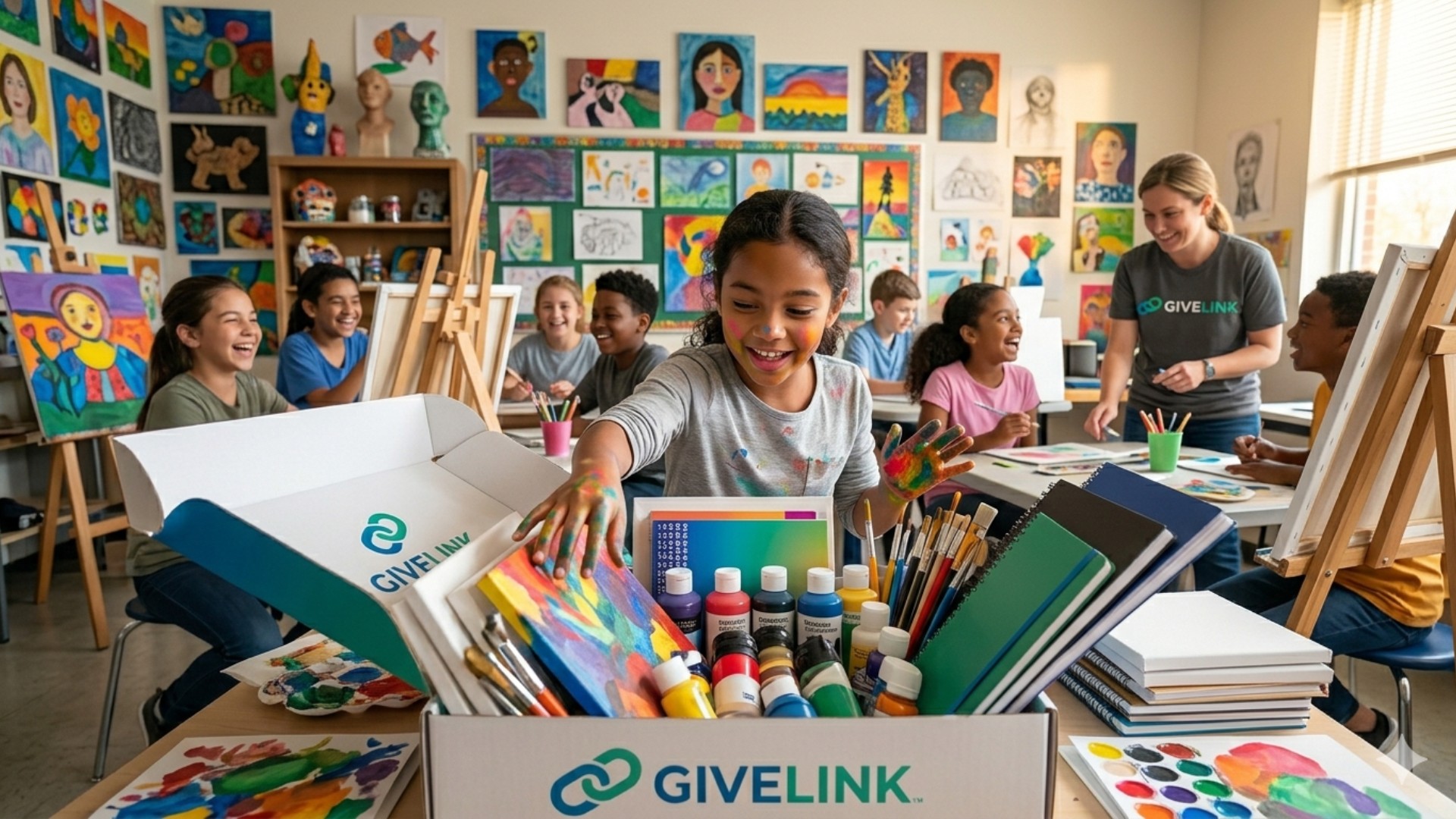
When a donor buys paint for a youth studio and receives a photo of kids painting with that exact paint, the emotional connection is direct. The donor didn't fund "arts programming." They funded this painting session, for these kids, with these brushes.
That specificity is what makes arts donors some of the most loyal in the Givelink ecosystem. According to Givelink data (2026), donors using the platform give 60% more times per year than donors using traditional methods. For arts programs — where the visual proof (photos of kids creating) is some of the most powerful content available — the retention flywheel runs faster than almost any other cause category.
"People must see what changes when they give."
That's the standard in the Givelink manifesto — and youth arts programs make it easier to meet than almost anyone. The proof writes itself.
How to give effectively to a youth arts program
Step 1: Find a verified organization. Browse verified arts nonprofits on Givelink with Charity Navigator data on the profile.
Step 2: Look at their active wishlist. Is it specific? Current? Does it reflect real program activity (not just a generic supply list)?
Step 3: Pick what resonates. You don't need to fund the entire wishlist. Buying a month of paint for a youth studio is meaningful.
Step 4: Check out and track. Biweekly batched delivery, live tracking, photo confirmation from the program.
Step 5: Share the photo. With the nonprofit's permission, delivery photos of kids with the supplies you bought are the most authentic fundraising content that exists.
Why this matters in 2026
Arts education funding in U.S. public schools has declined consistently for two decades. The vacuum is filled by community nonprofits — and those nonprofits are funded by individual donors. Federal funding cuts hit arts-adjacent nonprofits in 2025, and the competition for foundation grants intensified.
For small youth arts organizations, individual donors who give specific supplies and come back monthly are more financially stabilizing than a single large grant with uncertain renewal. Transparent giving builds that foundation.
Givelink in action
24th Street Theater, a Los Angeles–based youth arts nonprofit, is among Givelink's verified U.S. partners. Their wishlist reflects real program needs — costume materials, performance supplies, snacks for students. Donors who give from the wishlist receive photos of theater rehearsals and performances featuring the items they supplied. The loop closes. The donor comes back. Browse verified arts nonprofits on Givelink to find a program to support.
Frequently Asked Questions
What do youth arts programs need most?
Art materials (paints, brushes, canvases), fabric and sewing supplies, music accessories, theater props and costumes, craft supplies, snacks, and transportation gift cards. Specific needs vary — Givelink wishlists show exactly what each organization is asking for.
Are donations to youth arts nonprofits tax-deductible?
Yes — donations to verified 501(c)(3) arts nonprofits are fully tax-deductible at fair market value. Givelink issues an auto-generated tax receipt from the receiving nonprofit after delivery.
How do I find a youth arts nonprofit to donate to?
Browse verified arts nonprofits on Givelink, with Charity Navigator data on every profile. You can also search by cause category and location.
Is 24th Street Theater on Givelink?
Yes — 24th Street Theater is one of Givelink's verified U.S. nonprofit partners in Los Angeles.
Why give supplies instead of cash to a youth arts program?
Supplies go directly to the program — no sourcing delays, no administrative overhead. And the photo proof of kids using the supplies you bought is the kind of impact evidence that brings donors back. Givelink data (2026) shows 60% more frequent giving on the platform vs. traditional methods.
Buy a kid some paint — and see what they make with it
Browse verified arts nonprofits on Givelink, pick a wishlist, and get a photo of the result.
Stay Human.
Antonis Politis is CEO and Co-Founder of Givelink.
See also
What is Givelink?
Learn from the founders:
Support a nonprofit
Buy their needs