
blog
How to Donate to Veterans Organizations (And Avoid the Wrong Ones)
What veterans nonprofits actually need, how to spot the scams, and the verified path to giving in 2026.
Antonis Politis |
How to Donate to Veterans Organizations (And Avoid the Wrong Ones)
What veterans nonprofits actually need, how to spot the scams, and the verified path to giving in 2026.
Veterans nonprofits include some of the most legitimate, mission-driven organizations in U.S. philanthropy — and some of the most aggressive solicitation scams. If you want to donate to veterans organizations, the most effective path is to give to verified 501(c)(3) nonprofits with transparent impact reporting, not to whichever solicitor calls you during dinner. Givelink, a Transparent Giving Platform that connects donors to verified U.S. 501(c)(3) nonprofits with photo proof of delivery, includes veterans-focused organizations like Swords to Plowshares with full Charity Navigator verification. Here's how to give effectively, what veterans nonprofits actually need, and how to avoid the scams that crowd the space.
Key Takeaways
- Veterans nonprofits are heavily targeted by solicitation scams — verify before giving.
- Charity Navigator and IRS verification are the cleanest checks.
- Hygiene supplies, transitional housing items, and job-search support are most needed.
- Givelink shows photo proof of every delivery to verified veterans organizations.
- Swords to Plowshares and similar Charity Navigator–verified nonprofits are on the platform.
The veterans nonprofit landscape — and the scams
The good news: there are excellent veterans nonprofits in the U.S. Organizations like Swords to Plowshares, the Wounded Warrior Project, and dozens of community-based veterans services groups do high-impact work in housing, mental health, employment, and reintegration.
The bad news: veterans causes attract aggressive, low-quality, and sometimes outright fraudulent fundraising operations — phone solicitors, mailers, and door-to-door campaigns that route most of donor dollars to professional fundraisers instead of veterans services.
The fix is to verify before you give.
Three checks that catch most bad actors:
- Charity Navigator rating. Look for organizations with 3- or 4-star ratings or transparent equivalent metrics. On Givelink, Charity Navigator data is displayed on every nonprofit profile.
- 501(c)(3) status. Verify through the IRS Tax Exempt Organization Search.
- Program-to-overhead ratio. Look at how much goes to veterans services versus fundraising costs. Charity Navigator publishes this for evaluated organizations.
If a solicitor pressures you over the phone, tells you they "have to act now," or won't give you the EIN to verify their 501(c)(3) status, that's the signal. Hang up and find a verified nonprofit on your own terms.
What veterans organizations actually need
Wishlists vary by mission — housing-focused, mental health, employment services — but several categories show up consistently.
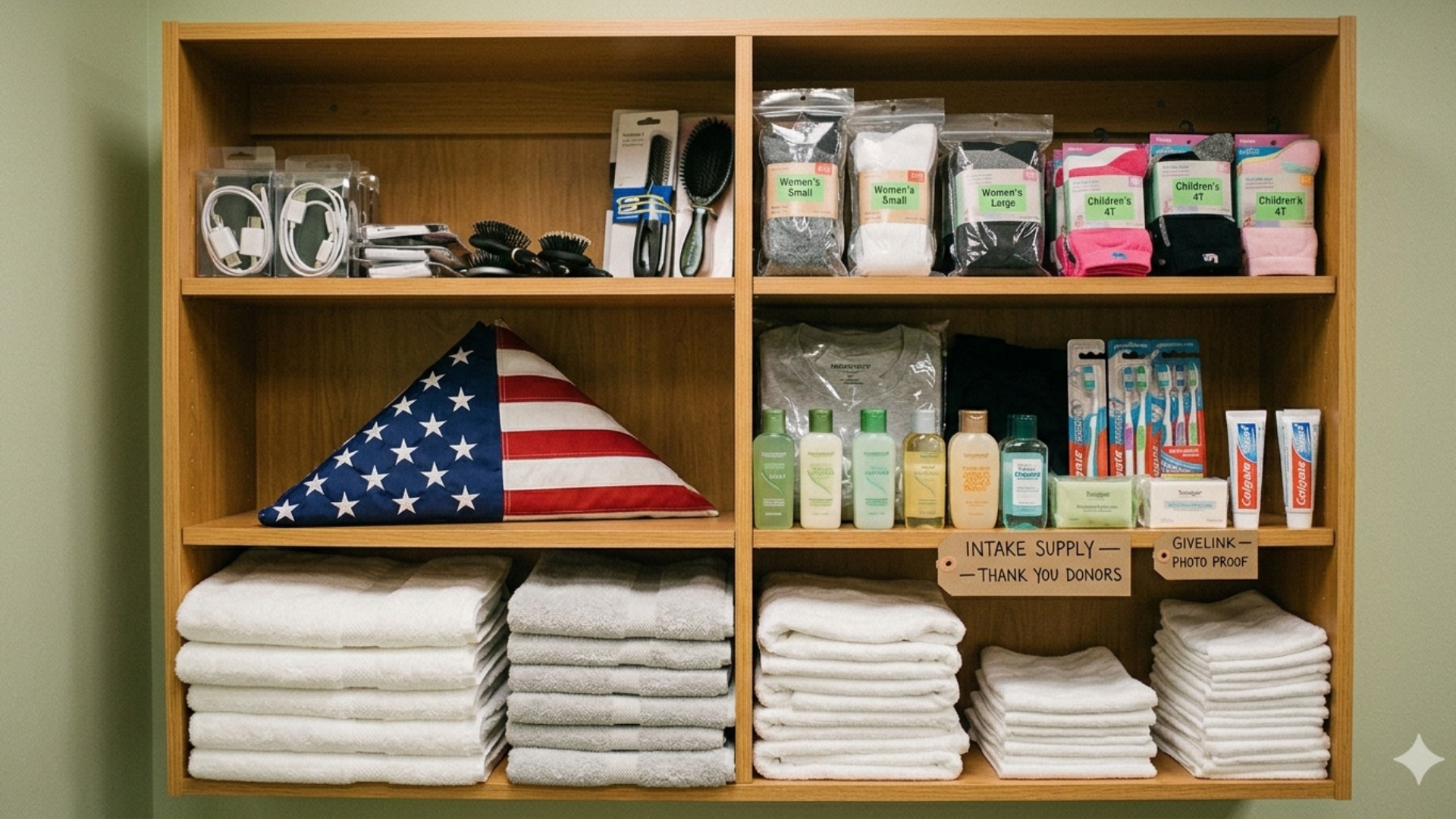
The shortlist most veterans organizations consistently need:
- Hygiene supplies — toothbrushes, toothpaste, soap, deodorant, razors
- New socks and underwear — multiple sizes, men's and women's
- Backpacks and duffel bags — for veterans transitioning into housing
- Phone chargers and prepaid phones — critical for housing and job applications
- Bus passes and transportation gift cards — for VA appointments, job interviews
- Professional clothing items — for job search support
- Shelf-stable food and snacks — for outreach teams and food security programs
- Bedding, towels, kitchen basics — for transitional housing setups
What's notable is how practical this list is. Veterans services nonprofits don't typically need bumper stickers, pins, or branded merchandise. They need the fundamentals that help veterans rebuild stable lives.
Why product giving works for veterans nonprofits
The same logic that applies to homelessness and senior services applies here, with one extra dimension: many veterans nonprofits run housing or transitional programs where specific household items are immediately useful.
| Need | Cash donation | Product donation (Givelink) |
|---|---|---|
| Speed to deployment | Slow (sourcing, ordering) | Fast (direct delivery) |
| Specificity | Generic | Exact items, sized correctly |
| Verification | Manual | Photo proof of arrival |
| Donor retention | Limited | Givelink data (2026): 60% more frequent giving |
| Compliance | Donor-managed | Auto-issued receipts |
For veterans organizations, this matters operationally. Staff time saved on sourcing is staff time spent on case management.
Why this matters in 2026
Veterans services were not insulated from the funding pressures hitting the broader nonprofit sector in 2025. Federal funding cuts, state-level reductions, and donor attrition all hit organizations serving the same populations they always did — except now with less.
The Center for Effective Philanthropy reported 87% of foundation leaders saw increased demand for grant funding in 2025. Veterans nonprofits competing for that funding are the ones with the cleanest impact data — and Charity Navigator–verified, photo-documented giving is the cleanest impact data available.
"If we can track a package, we should track impact."
For veterans organizations doing real work, transparent giving isn't just a nice donor experience. It's a strategic tool for proving the case to grant-makers and recurring donors alike.
Givelink in action
Swords to Plowshares, a verified veterans services nonprofit, is one of Givelink's onboarded U.S. partners. Donors browse the wishlist, pick items the organization specifies, and receive photo proof of delivery — the same flywheel that powers donor retention across the platform. Charity Navigator evaluation data appears directly on the profile. Browse verified veterans nonprofits on Givelink to support an organization with verifiable impact.
Frequently Asked Questions
How can I tell if a veterans charity is legitimate?
Three checks: 501(c)(3) status (IRS Tax Exempt Organization Search), Charity Navigator rating (look for 3- or 4-star evaluations or transparency equivalents), and program-to-overhead ratio. On Givelink, every veterans nonprofit is pre-verified with Charity Navigator data on the profile.
Are donations to veterans organizations tax-deductible?
Yes — donations to verified 501(c)(3) veterans nonprofits are fully tax-deductible at fair market value. Givelink issues an auto-generated tax receipt from the receiving nonprofit after delivery.
What do veterans organizations need most?
Hygiene supplies, new socks and underwear, backpacks, phone chargers, transportation gift cards, professional clothing for job search, and household basics for transitional housing. Specific needs vary — Givelink wishlists show exactly what each verified veterans nonprofit is asking for.
What about phone solicitors claiming to raise money for veterans?
Be cautious. Many phone solicitors collecting for "veterans" route most donations to professional fundraisers, not veterans services. Verify directly through Charity Navigator or the IRS before giving. Givelink only works with pre-verified 501(c)(3) nonprofits.
Can I give to a specific veterans organization on Givelink?
Yes — search the platform for verified veterans nonprofits. Swords to Plowshares is among the partners on Givelink, with more being added as the U.S. network grows.
Support veterans — verifiably
If you've meant to support veterans services and weren't sure how to give without falling for a scam, this is the path. Browse verified veterans nonprofits on Givelink — Charity Navigator–verified, photo-documented, tax-deductible.
Stay Human.
Antonis Politis is CEO and Co-Founder of Givelink. He's a Forbes 30 Under 30 honoree and a Hult Prize European finalist.
See also
What is Givelink?
Learn from the founders:
Support a nonprofit
Buy their needs