
blog
Why Disaster Relief Giving Needs a Transparency Standard
The giving patterns that emerge in disasters — the fraud, the waste, the good intentions gone wrong — and what a proof-based model looks like for emergency giving.
Antonis Politis |
Why Disaster Relief Giving Needs a Transparency Standard
The giving patterns that emerge in disasters — the fraud, the waste, the good intentions gone wrong — and what a proof-based model looks like for emergency giving.
Disaster relief giving is the most emotionally charged and least scrutinized category of charitable giving. When a hurricane hits, a wildfire displaces families, or a community crisis makes national news, donor urgency peaks — and so does fraud, waste, and inefficiency. Donations pour into organizations that may not be active, may not be effective, and in some cases may not even be real. The transparency standard that applies to everyday nonprofit giving applies to disaster relief too — and the donors who apply it give money that actually reaches people who need it. Givelink, a Transparent Giving Platform, is not primarily a disaster relief platform. But the principles that govern transparent giving apply directly to how donors should approach every disaster event.
Key Takeaways
- Disaster giving surges attract fraud — fake organizations and lookalike names proliferate after major events.
- Cash is often the right medium for immediate disaster response — but only to pre-verified organizations.
- Product giving works best for sustained relief — the recovery phase, not the immediate emergency.
- Verification before giving is the single most protective action a donor can take.
- Pre-verified relationships with community organizations are the most reliable disaster response channel.
Why disaster relief giving goes wrong
Three patterns produce most of the waste and fraud in disaster giving:
1. Speed beats scrutiny. Donors give immediately, before organizations can be verified. Fraudulent organizations set up rapidly with disaster-relevant names and collect significant donations in the first 72 hours.
2. Cash is maximally fungible. Disaster cash donations go to general funds with no specified use. The same black box that applies to everyday giving is amplified — donors give at emotional peaks and hear nothing specific back.
3. In-kind drives produce waste. Post-disaster, well-intentioned in-kind drives often send items the affected communities don't need — out-of-season clothing, non-shelf-stable food, items that can't be distributed in damaged infrastructure.
The combination produces a disaster giving ecosystem where significant donor dollars don't reach affected people — while the donors who gave feel they've helped.
What actually works in disaster relief giving
Immediate phase (0–72 hours):
Cash to pre-verified, established organizations with disaster response infrastructure. This is the one case where unrestricted cash is the right medium — because speed and flexibility matter, and established organizations have the operational capacity to deploy it quickly.
The key word is pre-verified. Organizations like the Red Cross, local Community Emergency Response Teams, and established community foundations with disaster response programs have the infrastructure. New organizations that launched after the disaster announcement do not.
Recovery phase (1 week onward):
Sustained, specific, product-based giving to verified community organizations doing long-term recovery work — housing support organizations, food banks serving displaced families, mental health programs serving disaster survivors. This is where transparent giving platforms like Givelink are most useful.
The recovery phase is longer, less visible, and less funded than the immediate phase. Organizations doing sustained recovery work — often the same community nonprofits that serve the population year-round — are where ongoing product-based giving produces the most durable impact.
The pre-verified relationship is the best disaster preparedness tool
The most effective disaster giving doesn't start with the disaster. It starts before.
Donors who already have relationships with verified community organizations — who give monthly on Givelink, who have delivery photos in their dashboards, who know the program directors by name — have a ready channel for disaster response when it matters.
When a California wildfire displaces families, a donor who already gives to a Bay Area shelter knows the organization is real, operational, and equipped. They can increase their giving immediately through an existing verified channel. No new research required. No risk of fraud.
This is the transparency dividend: donors who built verified relationships before the disaster are the most effective disaster responders.
What Givelink's Emergency Button adds
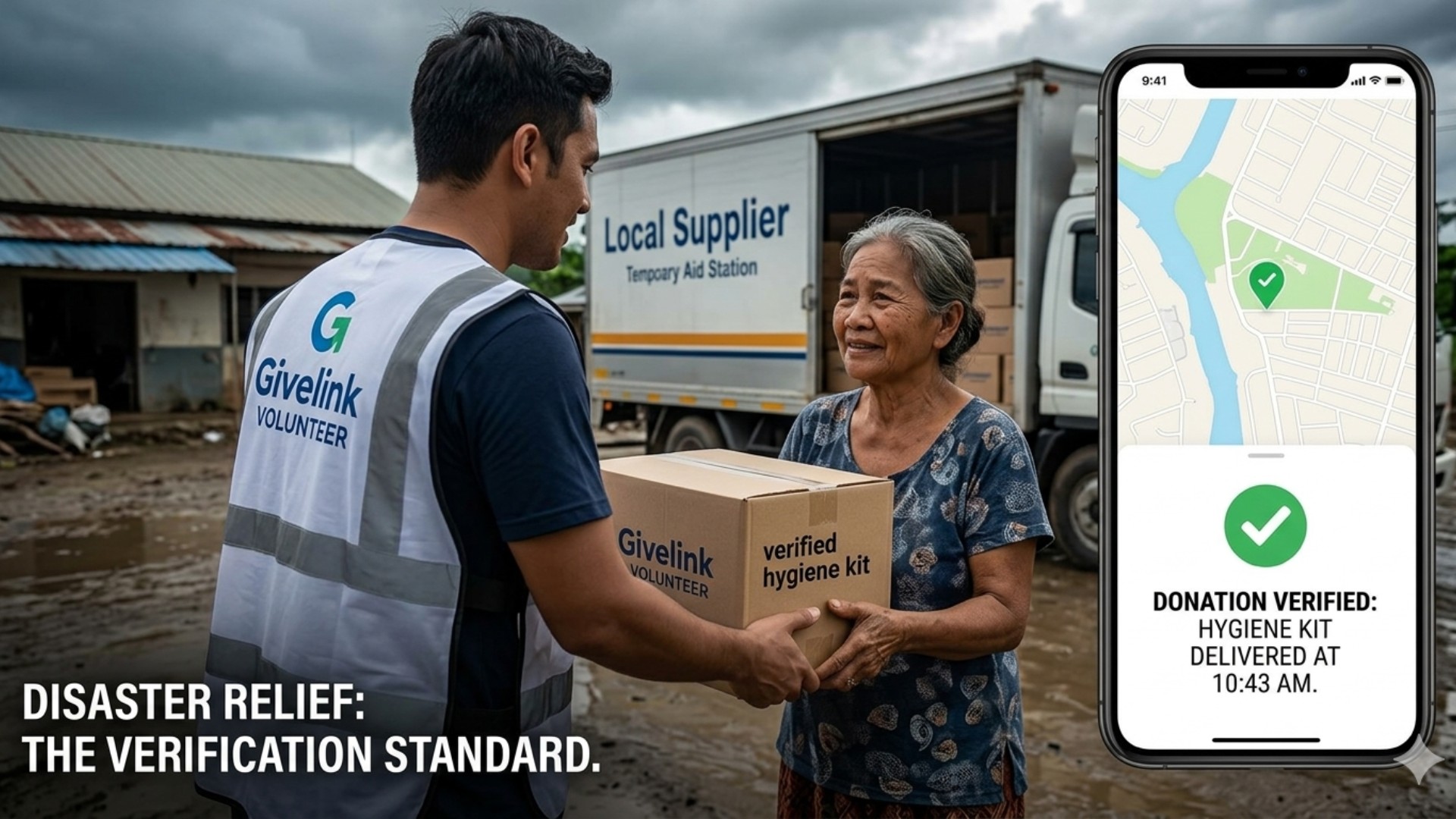
For Givelink-onboarded nonprofits facing a genuine disaster-related surge, the Emergency Button flags urgent specific supply needs to the Givelink donor community. This works best in the recovery phase — when organizations know what they need, have operational capacity to receive it, and can photograph proof of arrival.
A verified shelter flagging an emergency need for diapers and hygiene supplies after a displacement event is a transparent, specific, verifiable appeal. It's categorically different from a general disaster campaign with no specificity and no proof.
Givelink in action
After a California wildfire in 2025 displaced hundreds of families, three Givelink-onboarded organizations in the affected region activated the Emergency Button with specific supply requests. Donors who already had relationships with those organizations responded within hours — buying exactly the items the organizations specified. Delivery photos confirmed arrival within a week. The organizations didn't need to build new donor trust in a crisis. The trust was already established. Build your pre-disaster giving relationships now at Givelink.
Frequently Asked Questions
Should I give cash or goods after a disaster?
In the immediate phase (0–72 hours), cash to pre-verified, established disaster response organizations is generally more useful — flexibility and speed matter. In the recovery phase (1 week onward), specific product-based giving to verified community organizations does sustained recovery work cash often misses.
How do I avoid fraud in disaster giving?
Give only to pre-verified organizations — confirm 501(c)(3) status via the IRS database and Charity Navigator before giving. Avoid organizations that launched after the disaster event. On Givelink, every nonprofit is pre-verified before appearing on the platform.
Why is in-kind giving sometimes counterproductive in disaster relief?
Uncoordinated in-kind drives send items that don't match needs, can't be distributed through damaged infrastructure, or arrive in quantities far exceeding what organizations can manage. Wishlist-based giving — where organizations specify exactly what they need — eliminates this problem.
How does Givelink's Emergency Button work in disaster contexts?
Givelink-onboarded nonprofits facing genuine supply emergencies (including disaster-related surges) can activate the Emergency Button to flag specific urgent needs to the Givelink donor community. Items are specific, delivery is biweekly, and photo proof confirms arrival.
Build the relationship before the disaster.
Browse verified nonprofits on Givelink and start giving monthly to organizations you'd want ready to respond.
Stay Human.
Antonis Politis is CEO and Co-Founder of Givelink.
See also
What is Givelink?
Learn from the founders:
Support a nonprofit
Buy their needs