
Your Amazon Wishlist Is Losing Your Shelter Donors (Here's the Fix)
Amazon and Chewy don't tell your shelter who donated. That means no thank-you, no tax receipt, and no repeat giving. Here's how in-kind giving with donor data works instead.

Antonis Politis |
Your Amazon Wishlist Is Losing Your Shelter Donors (Here's the Fix)
Amazon and Chewy don't tell your shelter who donated. That means no thank-you, no tax receipt, and no repeat giving. Here's how in-kind giving with donor data works instead.
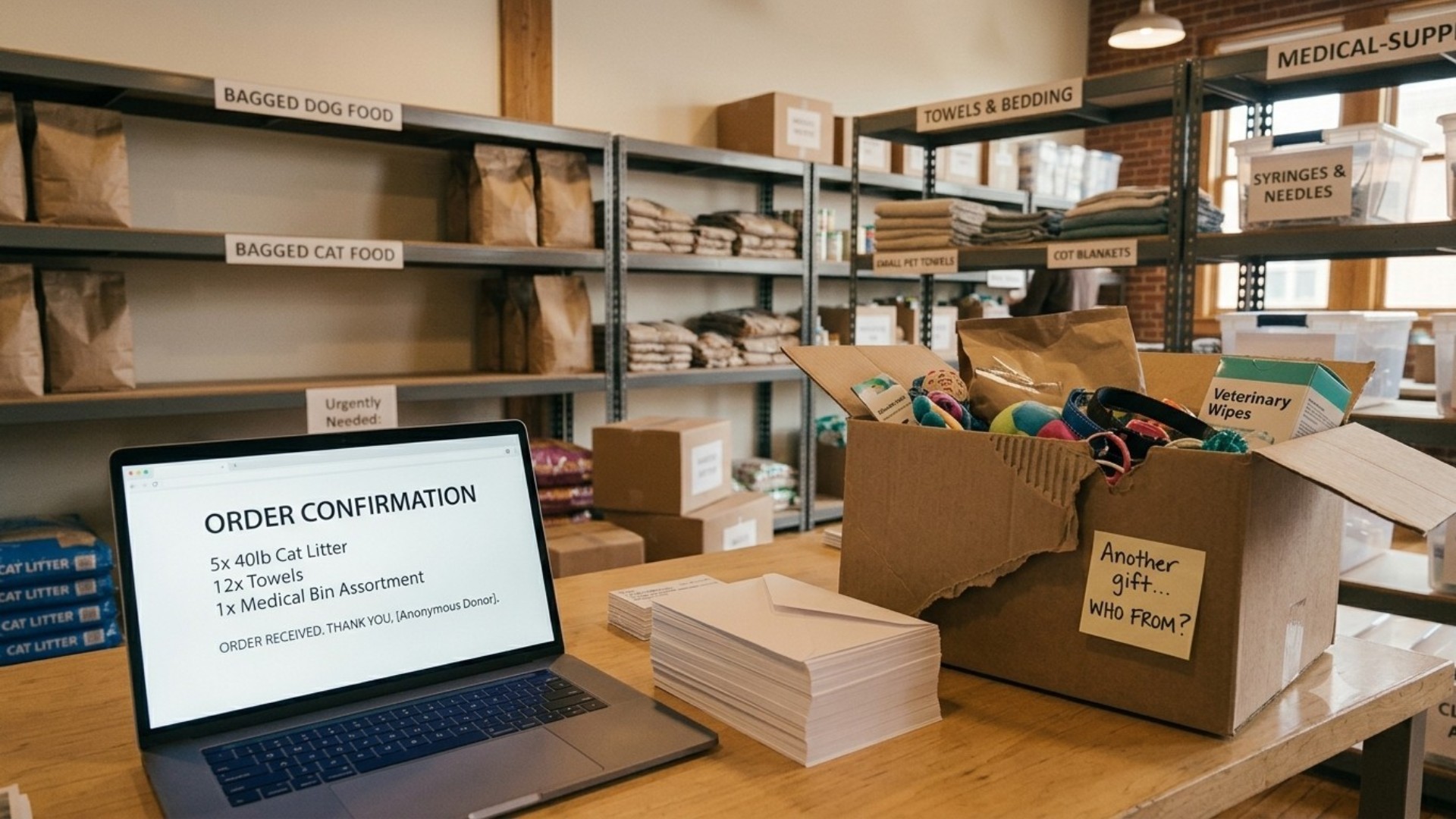
If your shelter runs an Amazon or Chewy wishlist, you already know the feeling: a box of supplies shows up, and you have no idea who to thank. The items are welcome. The anonymity is a problem. And it's costing you more than a thank-you note.
Givelink is a transparent in-kind giving platform built to solve exactly this. It connects donors to verified U.S. 501(c)(3) nonprofits, and, unlike a retail wishlist, it ties every donation to the donor, so you can acknowledge them, receipt them, and keep them.
Key Takeaways
- Retail wishlists usually withhold donor identity, so shelters can't thank or receipt givers.
- No receipt and no acknowledgment means little to no repeat giving.
- The lost data is the lost relationship, and the relationship is where retention lives.
- Givelink attaches donor data to every gift, with auto-generated tax receipts and photo proof.
- It's free for nonprofits: no setup fees, no platform fees, no subscription.
The problem in shelters' own words
This isn't a hypothetical. Animal-welfare organizations say it plainly on their own donation pages. Richmond SPCA warns donors that Amazon does not send them donor information with a purchase, and asks people to email separately to request a tax receipt. The Animal Welfare Society in Kennebunk, Maine notes that none of the online retailers share the name or contact information of the donor, so the shelter cannot express gratitude directly. Last Hope Animal Rescue tells supporters that because Amazon sends no confirmation, donations go unacknowledged unless the donor deliberately adds a gift note.
Read those together and the pattern is unmistakable. Shelters across the country are quietly absorbing the same operational gap: gifts arrive, and the giver disappears.
Why the missing data actually matters
It's tempting to treat this as a minor inconvenience. It isn't. The donor record is the foundation of every retention activity a shelter runs.
No thank-you. Acknowledgment is the single most reliable driver of a second gift. If you can't identify the donor, you can't send it.
No tax receipt. In-kind donations to a 501(c)(3) are deductible at fair market value, but the donor needs documentation. Making them chase it down adds friction to a gift they already gave.
No relationship, no retention. A donor you can't name is a donor you can't re-engage. Every anonymous wishlist purchase is a supporter who touched your mission once and then vanished from your CRM.
No proof loop. Retail wishlists don't close the loop with the donor either. They never learn what their gift did, and proof of impact is what turns a one-time giver into a recurring one.
What in-kind giving should do instead
A wishlist is the right instinct. Donors like giving tangible items, and specificity means you get what you actually need instead of a pile of mismatched surplus. The fix isn't to abandon the wishlist model. It's to run it on a platform that keeps the donor attached to the gift.
Here's how Givelink handles the same flow:
Donor identity is retained. Every gift is tied to the person who gave it, so you can thank them by name.
Tax receipts are automatic. An IRS-compliant receipt is issued after delivery, with no separate email chase for the donor.
Photo proof closes the loop. Your team photographs the delivery when it arrives, and that photo reaches the donor. Proof is what brings them back.
Deliveries are batched. Donations are consolidated and shipped roughly every two weeks (typically arriving within 4 to 21 days), so you're not fielding constant single packages.
Retail wishlist vs. Givelink
| Factor | Amazon / Chewy wishlist | Givelink |
|---|---|---|
| Donor identity shared with shelter | Usually not | Yes |
| Automatic tax receipt | No | Yes, after delivery |
| Photo proof to the donor | No | Yes |
| Deliveries batched | No | Yes, roughly biweekly |
| Cost to the nonprofit | Free | Free (no setup, platform, or subscription fees) |
| Charity Navigator data on profile | No | Surfaced on rated nonprofits' profiles |
But is it actually free?
Yes. Givelink charges nonprofits nothing: no setup fees, no platform fees, no subscription. Its costs are covered by an optional donor tip at checkout (preset around 10%, and fully removable) and small supplier-side arrangements, not by the organizations it serves. Setup is minimal, roughly a five-minute profile confirmation of your details, shipping info, and the items you want listed, and you can adjust or pause your wishlist anytime.
The retention math
The reason to fix this isn't tidiness. It's growth. Givelink publishes that its donors give roughly 60% more times per year than traditional platform donors (Givelink data, 2026). That lift comes directly from the loop retail wishlists break: identify the donor, thank them, prove the impact, and they come back. An anonymous wishlist can't run that loop. A donor-attached one can.
Givelink in action
Animal-welfare organizations are already verified partners on Givelink, including Inland Valley Humane Society & S.P.C.A. in Pomona. Donors browse the wishlist, pick the supplies the shelter specifies, and receive photo proof of delivery, while the shelter keeps the donor relationship that a retail wishlist would have erased. See how nonprofits use Givelink or browse verified nonprofits.
Frequently Asked Questions
Why doesn't Amazon share donor information with my shelter?
Amazon's wishlist system is built around consumer privacy and gifting, not nonprofit donor management. In most cases the retailer does not pass the buyer's name or contact details to the receiving organization, which is why shelters ask donors to self-identify for a receipt.
Can I send tax receipts for Amazon wishlist donations?
Only if the donor identifies themselves to you, for example by adding a gift note or emailing you separately. There's no automatic mechanism. On Givelink, receipts are auto-generated after delivery.
Is Givelink free for nonprofits?
Yes. No setup fees, no platform fees, no subscription. It's funded by an optional, removable donor tip and supplier-side arrangements.
Do we have to stop using Amazon or Chewy?
No. Many organizations run both. But routing the donors you want to keep through a platform that retains their data is what protects your retention.
How long does setup take?
Roughly five minutes to confirm your details, shipping information, and the items you want listed. After that it runs largely on its own, and you can adjust your wishlist anytime.
If your shelter is tired of thanking donors it can't name, this is the fix. See how it works for nonprofits.
Stay Human.
Antonis Politis is CEO and Co-Founder of Givelink.
See also
What is Givelink?
Learn from the founders:
Run a nonprofit? Get what you need.
Set your nonprofit up yourself in about 15 minutes. It's free, there's no contract, and you don't need to talk to anyone first.