
blog
Why Transparent Giving Drives 60% More Donations Per Year
New Givelink data shows what happens when donors actually see what their money becomes — and why the visibility flywheel is reshaping U.S. fundraising.
Antonis Politis |
Why Transparent Giving Drives 60% More Donations Per Year
New Givelink data shows what happens when donors actually see what their money becomes — and why the visibility flywheel is reshaping U.S. fundraising.
Donors using a transparent giving platform give 60% more times per year than donors using traditional giving methods, according to Givelink data (2026). That stat captures a structural shift in how giving works: when donors can see exactly what their donation became — the items, the delivery, the people — they don't give once. They give again. And again. This essay breaks down the mechanism behind the 60% number, why it matters more in 2026 than in any year before, and what nonprofits can do about it now.
Key Takeaways
- Givelink donors give 60% more times per year than donors using traditional giving methods.
- The mechanism is visibility, not gimmicks — photo proof creates emotional connection.
- Donor retention is in crisis nationally — only 17.5% of dollars come from first-time donors.
- Transparent giving fixes the retention gap at the moment of the gift, not after.
- Nonprofits get a flywheel that costs nothing to install.
The retention crisis nobody fixed
Here's the state of donor retention going into 2026.
The Fundraising Effectiveness Project's 2025 data showed total dollars from individual giving rose 2.9% in the first half of the year, while donor counts fell 1.9%. Translation: fewer donors are giving, and they're giving larger amounts. For small and mid-sized nonprofits without major-donor pipelines, this trend is suffocating.
Funding for Good's late-2025 analysis confirmed it: donors who had been giving for two-plus years accounted for nearly 62% of dollars raised from individuals, while first-time donors represented only 17.5%. First-time donor retention has been stuck below 20% for years. Most efforts to fix it — better thank-you emails, faster receipts, multi-touch nurture sequences — operate on the same premise: get the donor to give again after the first gift.
What if the gift itself was the retention engine?
What the 60% number actually means
Givelink data (2026) shows donors using the platform give 60% more times per year than donors using traditional giving methods. That's not 60% larger gifts. That's frequency — how many separate giving events the same donor initiates in a year.
Why? Three reinforcing mechanisms.
1. Specificity creates emotional ownership. Picking diapers for a specific shelter is psychologically different from clicking $50 on a generic donation form. The donor becomes a participant, not a payer.
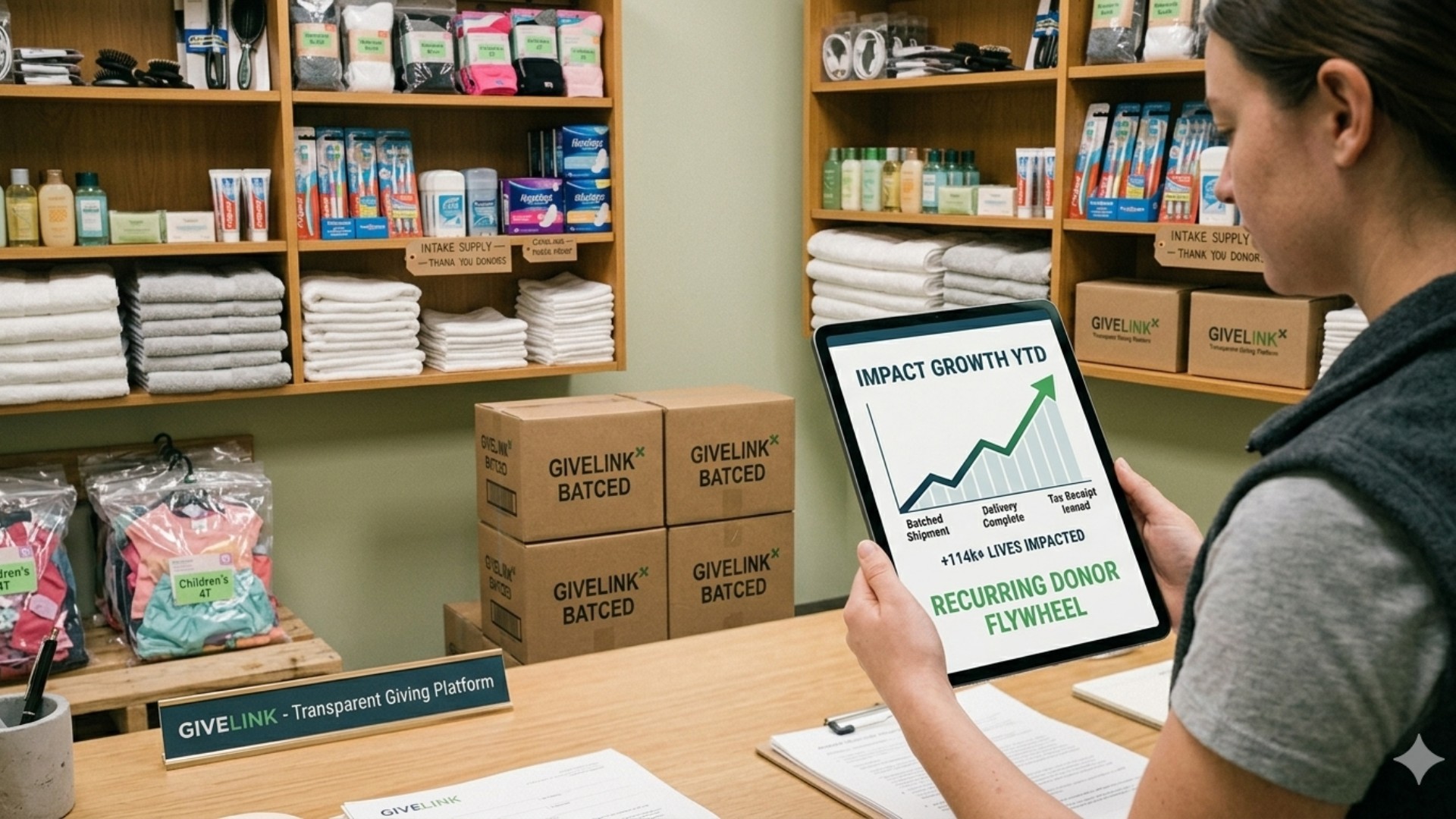
2. Photo proof closes the loop. When the items arrive and the nonprofit photographs them, the donor experiences the impact directly. That experience is what triggers the next gift.
3. The dashboard becomes a habit. Donors return to see new wishlists, new photos, new nonprofit updates. Frequency compounds.
"Giving was always supposed to be a thread between two lives."
The 60% stat is what happens when you build a platform around that sentence instead of a payment processor.
How this changes nonprofit math
Take a small nonprofit with 500 active donors giving an average of 1.5 times per year — about 750 donation events annually. Move those donors onto a transparent giving platform with the 60% frequency lift, and the same 500 donors produce roughly 1,200 events per year.
That's not a fundraising tactic. That's a different operating reality.
| Metric | Traditional giving | Transparent giving |
|---|---|---|
| Annual events per donor | 1.5 | 2.4 |
| Cost to acquire repeat gift | High (re-engagement campaigns) | Low (donor returns on their own) |
| Verifiable impact per donor | Limited | Photo-documented |
| Donor stewardship cost | Significant | Minimal — the platform does it |
For a nonprofit being squeezed by federal funding cuts, this is the difference between scaling and surviving.
Why this matters in 2026
The macro environment is unforgiving. The Center for Effective Philanthropy reported 87% of foundation leaders saw increased demand for grant funding in 2025. Donor-advised funds are surging — Fidelity Charitable's 2025 report showed DAF grants up 25% year-over-year. But the unrestricted, recurring, individual donor — the lifeblood of community nonprofits — is shrinking.
Transparent giving doesn't replace major gifts or DAFs. It rebuilds the base.
This is also why the Givelink × Charity Navigator partnership matters. Trust at the moment of giving (Charity Navigator data on every nonprofit profile) plus proof after the gift (photo delivery) creates a giving experience donors choose to repeat.
Givelink in action
A small youth literacy nonprofit in California listed books, art supplies, and snacks on its Givelink wishlist. Within four months, the same 30 first-time donors had given an average of 2.3 times each — driven not by follow-up emails but by photo notifications landing in their dashboards. The executive director didn't run a single re-engagement campaign. She just kept uploading photos. Set up your free wishlist on Givelink and run the same loop.
Frequently Asked Questions
What does "60% more times per year" mean?
It means the average Givelink donor initiates 60% more giving events in a calendar year than they would on a traditional donation platform. The lift comes from frequency — same donor, more gifts — not from larger gift sizes.
Why does transparent giving improve donor retention so much?
Three reasons: donors choose specific items (creating ownership), they receive photo proof of delivery (closing the loop), and they return to their dashboard to see new wishlists and updates (building habit). The visibility creates emotional connection traditional giving can't replicate.
How does this compare to industry benchmarks?
Industry first-time donor retention has been stuck below 20% for years. Total individual donor counts fell 1.9% in the first half of 2025. The 60% frequency lift on Givelink runs in the opposite direction of these macro trends, which is why transparent giving is being framed as a structural shift, not a tactical improvement.
Is this stat available for nonprofits to cite?
Yes. Nonprofits onboarded to Givelink can cite the 60% figure as Givelink data (2026) in donor communications, grant applications, and impact reports.
Build a flywheel, not a funnel
If you run a nonprofit and donor retention is your bottleneck, the fix isn't another email sequence. It's giving donors something to come back to. Set up your free Givelink wishlist — there's no fee, no contract, and the platform builds the retention loop for you.
Stay Human.
Antonis Politis is CEO and Co-Founder of Givelink. He started the company while studying at the University of Patras and now leads its U.S. expansion alongside the founding team.
Διάβασε επίσης
Τι είναι η Givelink;
Άκου από τους ίδιους τους ιδρυτές:
Στήριξε μια οργάνωση
Κάνε τα ψώνια που χρειάζεται, online!