
blog
The Nonprofit Burnout Crisis — and How Transparent Operations Help
Why nonprofit staff are burning out faster than ever, how operational friction makes it worse, and what removing sourcing burden actually does for teams.
Antonis Politis |
The Nonprofit Burnout Crisis — and How Transparent Operations Help
Why nonprofit staff are burning out faster than ever, how operational friction makes it worse, and what removing sourcing burden actually does for teams.
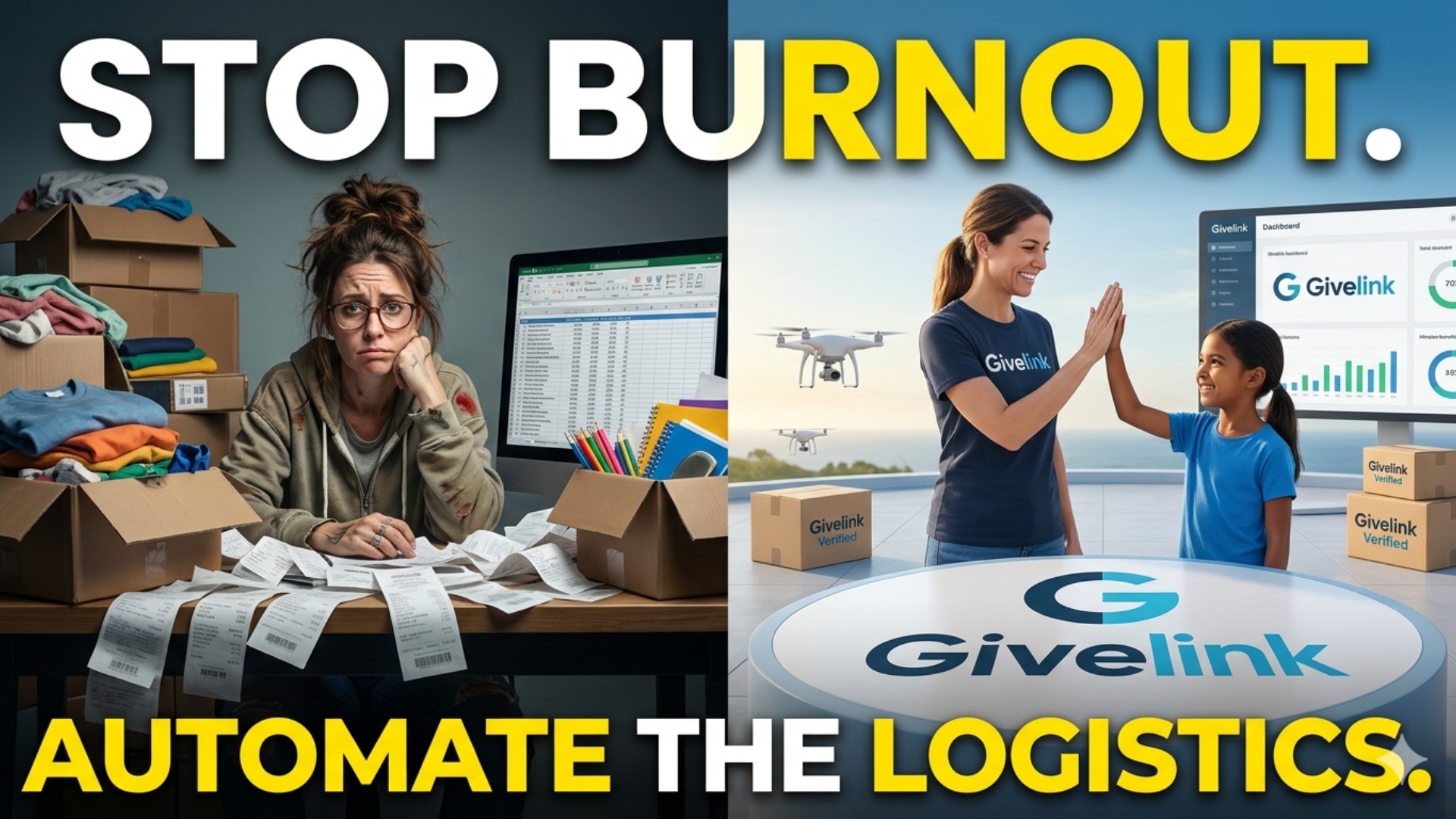
Nonprofit burnout is not new. What's new in 2026 is the scale: the Chronicle of Philanthropy's 2025 sector survey found that 67% of nonprofit leaders reported staff burnout as a top operational challenge, up from 51% in 2023. The causes are structural — underpay, under-resourcing, mission-heavy cultures that normalize overwork. But one operational cause is less discussed: the friction of sourcing and managing donated supplies. Every hour a program director spends ordering toothbrushes is an hour not spent on direct service. Givelink, a Transparent Giving Platform, was partly built to remove this friction. Here's why it matters — and what operational simplification actually looks like for stretched nonprofit teams.
Key Takeaways
- 67% of nonprofit leaders report staff burnout as a top operational challenge (Chronicle of Philanthropy, 2025).
- Sourcing friction — ordering, receiving, and managing donated supplies — is an underrecognized burnout contributor.
- Givelink's biweekly batched delivery removes the sourcing burden from nonprofit staff entirely.
- Wishlists let nonprofits define needs once and let donors fill them continuously.
- Operational simplicity is a form of respect for teams doing hard work.
The sourcing burden nobody talks about
Ask a nonprofit program director what takes the most unexpected time in their week. Many will say: managing donations and supplies.
This includes:
- Researching what supplies are needed and where to source them
- Placing orders or coordinating drive drop-offs
- Receiving and sorting deliveries (often at unpredictable times)
- Storing inventory and tracking what's running low
- Following up with donors who gave the wrong items or wrong quantities
- Returning or redistributing items that don't fit the organization's needs
None of this is program delivery. All of it is operational overhead — and for organizations with two or three program staff doubling as administrators, it's a real burnout contributor.
How transparent giving removes sourcing friction
Givelink's model shifts the sourcing burden from the nonprofit to the platform:
| Task | Traditional model | Givelink model |
|---|---|---|
| Identifying what's needed | Staff research and compile | Nonprofit updates wishlist (5 min/month) |
| Finding suppliers | Staff source individually | Givelink's verified U.S. supplier network |
| Placing orders | Staff or volunteers place orders | Donors choose and purchase |
| Coordinating delivery | Staff schedule and manage | Biweekly batched delivery on known schedule |
| Receiving donations | Unpredictable, labor-intensive | Scheduled, organized, single delivery event |
| Sorting and intake | Time-consuming | Items arrive organized by category |
| Donor communication | Manual follow-up | Automated dashboard updates |
| Tax documentation | Manual receipt generation | Auto-issued by the platform |
The operational time savings vary by organization size, but most nonprofits report reducing supply-related staff time by 60–80% after transitioning to Givelink's model.
What that time actually buys
When a program director gets back the hours previously spent on sourcing and receiving, those hours go somewhere:
- More client-facing service time
- More program development
- More staff supervision and support
- More grant writing and funder relations
- More rest — the most underrated operational asset in a burnout crisis
This is not abstract. For an organization where a single program coordinator handles both case management and supply procurement, removing sourcing friction is a real quality-of-life change.
Wishlists as operational clarity
A second burnout-reducing mechanism in Givelink's model is less obvious: the wishlist forces operational clarity.
When a nonprofit sits down to build a Givelink wishlist, they have to answer: what do we actually need, in what quantities, with what priority? This exercise — which takes about 30 minutes the first time — produces an operational snapshot that many organizations don't otherwise make explicit.
Nonprofits that maintain current, specific wishlists report better internal inventory management, clearer communication with volunteers and staff about supply levels, and reduced last-minute scrambles.
The wishlist is the operational plan made visible.
Why this matters in 2026
The burnout crisis in nonprofits is accelerating. Federal funding cuts have increased service demand without increasing staff. Donor retention struggles have increased fundraising pressure. The organizations most at risk are the small and mid-sized nonprofits with thin management layers and minimal administrative capacity.
For these organizations, operational friction is not a minor inconvenience. It's a staff retention issue, a program quality issue, and a long-term sustainability issue. Any tool that removes friction without adding cost is meaningful.
"Empathy — not charging nonprofits anything for getting help, striving to cover as many needs as possible."
Removing operational burden from nonprofit staff is what empathy looks like in platform design.
Givelink in action
A two-person team running a transitional housing program in Sacramento spent an estimated 8–10 hours per month sourcing, ordering, and receiving donated supplies through a combination of Amazon wishlists, individual donor pickups, and occasional drive events. After transitioning to Givelink, that time dropped to roughly 90 minutes per month — updating the wishlist and photographing biweekly deliveries. The program director used the recovered time to add a weekly group session for residents. Set up your free Givelink wishlist and reclaim your team's time.
Frequently Asked Questions
How much time does managing Givelink actually take for nonprofits?
Roughly 20–30 minutes per month: 5–10 minutes to update the wishlist and 2–3 minutes to photograph each biweekly delivery. Everything else — supplier coordination, delivery logistics, donor communication, tax receipt generation — is handled by the platform.
Does Givelink require dedicated staff to manage?
No. Most nonprofits assign wishlist management and delivery photography to a program coordinator or administrative staff member as a minor task. No dedicated platform manager is needed.
What happens if a nonprofit doesn't update their wishlist for a while?
A stale wishlist (unchanged for 60+ days) signals to donors that the organization may not be actively engaging. We recommend a monthly wishlist review, which takes about 5 minutes.
Can Givelink help reduce volunteer coordination burden too?
Partially — by removing the need for supply-drive coordination and individual donor logistics, Givelink reduces the volunteer burden associated with supply management. Direct service volunteers are unaffected.
Give your team back their time.
Apply to Givelink — free, 5 minutes, and the operational relief starts with the first delivery.
Stay Human.
Antonis Politis is CEO and Co-Founder of Givelink.
Διάβασε επίσης
Τι είναι η Givelink;
Άκου από τους ίδιους τους ιδρυτές:
Στήριξε μια οργάνωση
Κάνε τα ψώνια που χρειάζεται, online!