
blog
How Transparent Giving Frees Up Nonprofit Volunteer Hours
The operational math behind removing supply-drive coordination from your volunteer program — and what your volunteers can do with the time.
Antonis Politis |
How Transparent Giving Frees Up Nonprofit Volunteer Hours
The operational math behind removing supply-drive coordination from your volunteer program — and what your volunteers can do with the time.
Volunteers are one of the most valuable and most limited resources a nonprofit has. Independent Sector's 2025 survey valued volunteer time at $31.80 per hour nationally. For nonprofits that spend significant volunteer hours coordinating supply drives, organizing in-kind donation intake, and managing irregular deliveries, every hour redirected from logistics to direct service is $31.80 of mission capacity recovered. Givelink, a Transparent Giving Platform, removes supply-drive logistics from the nonprofit's operational stack entirely. Here's the operational math — and what the freed hours actually do for teams and volunteers.
Key Takeaways
- Volunteer time is valued at $31.80/hour (Independent Sector, 2025).
- Supply drive coordination typically consumes 8–15 volunteer hours per drive.
- Givelink's biweekly batched delivery removes this coordination burden entirely.
- Freed volunteer hours go to direct service — the work volunteers actually want to do.
- Volunteer satisfaction improves when volunteers do mission work, not logistics.
The supply drive volunteer burden
A standard nonprofit supply drive involves:
Pre-drive:
- Planning and timeline coordination (2–3 hours)
- Promotion and communication (1–2 hours)
- Collection site setup (1 hour)
During the drive:
- Collection site staffing (variable, often 4–8 hours across multiple staff/volunteers)
- Donor communication for questions and coordination (1–2 hours)
Post-drive:
- Collection, transport, and intake (2–4 hours)
- Sorting and inventory (2–3 hours)
- Donor thank-you communications (1 hour)
- Disposing of unusable items (variable)
Total per drive: 14–24 volunteer/staff hours
For a nonprofit running 4 drives per year, that's 56–96 hours annually — equivalent to one or two full-time equivalent weeks of volunteer capacity.
What Givelink replaces — and what it costs
Givelink's biweekly batched delivery model replaces all of the above with:
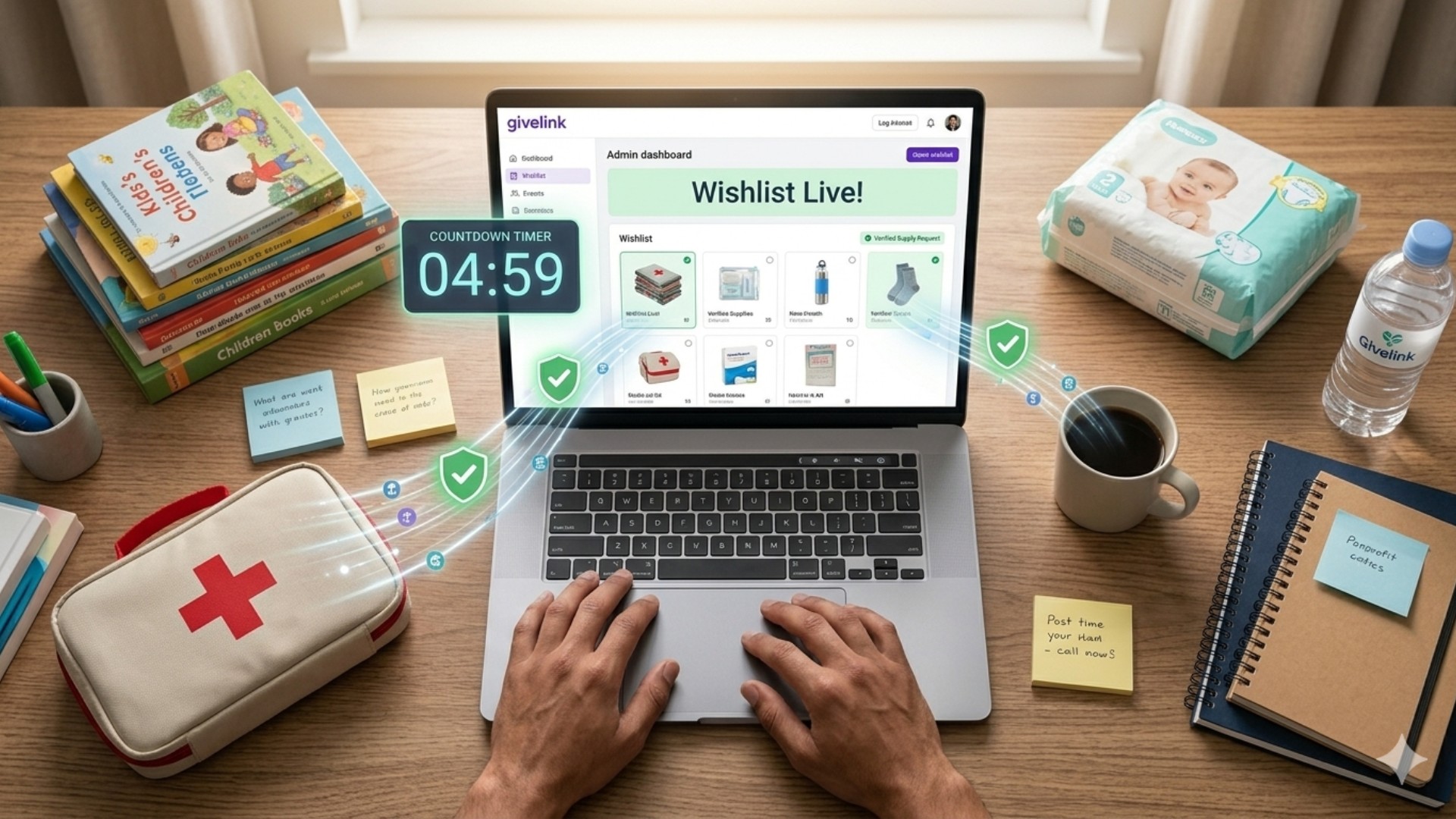
Monthly wishlist update: 5–10 minutes (staff, not volunteers) Delivery photography: 2–3 minutes per biweekly delivery Photo upload: 2 minutes per delivery
Total per month: approximately 20–30 minutes
The reduction from 14–24 hours per drive to 20–30 minutes per month is not a rounding error. For a nonprofit with a meaningful volunteer program, this recovery is structurally significant.
What volunteers actually want to do
Volunteer retention research consistently shows that volunteers who do direct service work — working with clients, leading programs, providing skilled support — report significantly higher satisfaction than volunteers assigned to administrative and logistics tasks.
Supply drive coordination falls squarely in the logistics category. It's important work, but it's not why most volunteers show up. When that work is removed from the volunteer stack, volunteers can be redirected to:
- Direct client interaction (tutoring, mentoring, companionship visits)
- Program facilitation (leading workshops, running events)
- Skilled volunteering (legal aid, pro bono professional services)
- Outreach and community engagement
- Content creation and storytelling (delivery photo captions, social media)
The mission work volunteers came to do is waiting. Logistics coordination is the barrier. Transparent giving removes the barrier.
The $31.80 calculation
Independent Sector's 2025 volunteer value estimate: $31.80/hour.
A nonprofit that removes 60 volunteer hours/year of supply logistics and redirects them to direct service produces:
- 60 hours × $31.80 = $1,908 in recovered volunteer mission capacity
For a small nonprofit, this is equivalent to a part-time program support position — gained not through fundraising, but through operational efficiency.
Why this matters in 2026
The volunteer sector is under its own version of the burnout crisis. Volunteer recruitment is harder than pre-pandemic. Volunteer retention requires more attention to role quality and meaningful engagement. Organizations that assign volunteers to satisfying direct service work retain them. Organizations that use volunteers for logistics lose them.
Removing supply logistics from the volunteer stack is a volunteer retention strategy. It's also a mission amplification strategy. And it's a free one — Givelink charges nonprofits zero.
Givelink in action
A senior services nonprofit in Sacramento was running two supply drives per year, each requiring approximately 15 volunteer hours for coordination, intake, and sorting. After transitioning to Givelink, those 30 volunteer hours were reallocated to a new weekly companion visitor program — one-hour visits to isolated senior residents. The program now has 8 regular volunteers and serves 12 residents weekly. The volunteers report it as the most meaningful work they've done with the organization. Set up your free Givelink wishlist and reclaim your volunteer hours.
Frequently Asked Questions
How much volunteer time does a typical supply drive require?
Approximately 14–24 staff and volunteer hours per drive, including pre-drive coordination, collection, intake, sorting, and thank-you communications.
How much time does managing Givelink deliveries require?
About 20–30 minutes per month total — wishlist updates and biweekly delivery photography. All coordination, logistics, and donor communication is handled by the platform.
Will removing supply drives affect donor relationships?
No — Givelink's wishlist model replaces drive-based giving with a more frequent, more verifiable giving experience. Donors who gave during drives can give from the wishlist instead, with delivery photos providing stronger engagement than drive participation.
Can volunteers help with Givelink delivery photography?
Yes — delivery photography is a simple task that can be assigned to any volunteer or staff member. It requires a phone camera and approximately 2–3 minutes per delivery.
Free your volunteers for the work they came to do.
Apply to Givelink — free, 5 minutes, and the first step toward a logistics-free volunteer program.
Stay Human.
Antonis Politis is CEO and Co-Founder of Givelink.
Διάβασε επίσης
Τι είναι η Givelink;
Άκου από τους ίδιους τους ιδρυτές:
Στήριξε μια οργάνωση
Κάνε τα ψώνια που χρειάζεται, online!