
blog
How to Verify a Charity Before You Donate (2026 Checklist)
Five checks that catch fraud, identify great organizations, and ensure your donation reaches verified people doing real work.

Panos Kokmotos |
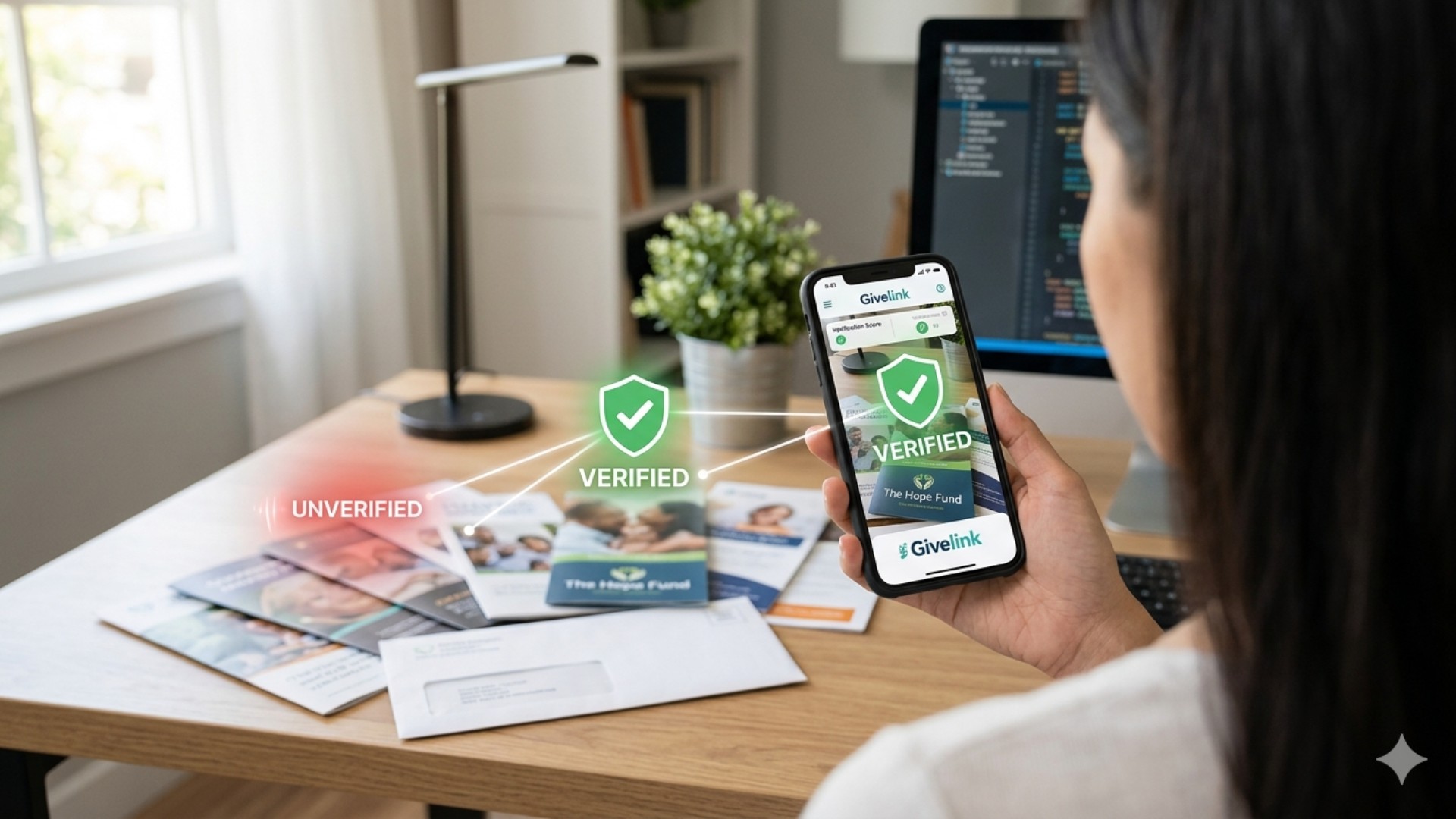
How to Verify a Charity Before You Donate (2026 Checklist)
Five checks that catch fraud, identify great organizations, and ensure your donation reaches verified people doing real work.
Charity fraud costs American donors an estimated $500 million per year — from sham solicitation organizations that route donations to professional fundraisers, to lookalike names designed to redirect gifts intended for legitimate nonprofits. Verifying a charity before donating is the single most effective thing you can do to ensure your gift reaches the people you intend. Givelink, a Transparent Giving Platform that connects donors to verified U.S. 501(c)(3) nonprofits with Charity Navigator data on every profile, builds verification into the giving experience. This guide gives you the five-check process that catches fraud and identifies great organizations — wherever you choose to give.
Key Takeaways
- Charity fraud costs U.S. donors ~$500 million per year — verification is the protection.
- Five checks catch 95% of fraudulent or low-quality organizations.
- Charity Navigator and IRS search are the two non-negotiable tools.
- Givelink integrates CN data directly — verification happens on the same screen as giving.
- Verified 501(c)(3) status is the legal floor — it's the beginning, not the end, of due diligence.
Why charity verification matters more in 2026
Three factors have made charity fraud and low-quality fundraising more prevalent.
1. Surge-giving moments attract bad actors. Giving Tuesday, disaster relief events, and social media fundraising peaks are the highest-fraud moments in the giving calendar. Urgency lowers donor scrutiny.
2. Lookalike names are rampant. Organizations with names like "Veterans Aid Fund" or "Children's Cancer Support" often have nothing to do with legitimate organizations bearing similar names. A quick IRS search catches most.
3. Professional fundraisers take the majority. The FTC has documented cases where "charities" route 80–90% of donations to professional telemarketing and direct mail firms, with less than 10% reaching programs. Charity Navigator's program expense ratio identifies this pattern.
The five-check process below catches all three.
The 5-check charity verification process
Check 1: IRS Tax Exempt Organization Search
Go to apps.irs.gov/app/eos/ and search the organization's exact legal name or EIN. Confirm:
- The organization is listed as a 501(c)(3) (not a different tax-exempt category)
- The status is current (not revoked)
- The address matches what the organization publishes
This is the legal floor. Any legitimate charity should pass this in 30 seconds.
Check 2: Charity Navigator rating
Go to charitynavigator.org and search the organization. Look for:
- Star rating: 3 or 4 stars is the target range
- Program expense ratio: Aim for 75% or higher going to programs
- Fundraising efficiency: Lower is better (below $0.10 to raise $1 is strong)
- Advisory flags: Any listed concern warrants more research
On Givelink, Charity Navigator data is displayed directly on every nonprofit profile — no separate search required.
Check 3: Form 990 review
Form 990 is the annual financial disclosure every 501(c)(3) must file with the IRS. Find it at:
- Charity Navigator (most profiles include it)
- ProPublica Nonprofit Explorer (free)
- Candid (formerly GuideStar)
Look for:
- Revenue and expense trend — is the organization stable?
- Executive compensation — is it proportionate to organizational size?
- Program descriptions — do they match what the organization claims to do?
Check 4: Active web presence and recent activity
A legitimate operating nonprofit has:
- A functional website with current contact information
- Recent activity (social media posts, newsletter, events in the last 90 days)
- Named leadership with verifiable identities
No website, no recent activity, or leadership who can't be independently verified are yellow flags.
Check 5: Physical address verification
Confirm the organization has a real physical address — not just a PO box — and that it matches IRS filings. On Givelink, physical address verification is part of the onboarding process for every nonprofit.
The 2026 red flag checklist
These are the signals that warrant stopping.
- High-pressure phone solicitation with no time to verify
- Organization name nearly identical to a well-known charity
- Refuses to provide EIN when asked
- Cannot explain what programs donations fund
- No Form 990 available (for organizations over $50K in revenue)
- IRS status revoked or not found
- Less than 50% of spending on programs (Charity Navigator data)
How the Givelink × Charity Navigator partnership removes friction
The most common reason donors skip verification is that it feels like a task that disrupts the giving moment. You're ready to give and then you have to open three new tabs.
Givelink removes this friction. Every nonprofit profile on the platform displays:
- IRS-confirmed 501(c)(3) status (verified during onboarding)
- Charity Navigator evaluation data (pulled automatically)
- Physical address verified during onboarding
- Active wishlist confirming current operations
The five-check process is built into the platform. Donors don't need to verify separately.
Why this matters in 2026
The FTC reported in 2025 that charitable solicitation fraud remains one of the top complaint categories from U.S. consumers. High-pressure phone solicitation for veterans causes, disaster relief, and children's charities accounts for a disproportionate share.
Transparent giving platforms that build verification into the giving experience protect donors from the decisions they're least equipped to make under urgency pressure. That's a structural improvement over any amount of consumer education.
"Ensuring that every nonprofit indeed does the work they say they do."
That's the Givelink standard. Not a checkbox — a commitment to every donor who uses the platform.
Givelink in action
A donor who had previously given to a solicitation organization that routed most donations to a professional fundraiser found Givelink through a Charity Navigator search. She browsed verified nonprofits, saw CN data on every profile, and gave with confidence for the first time in two years. The delivery photo arrived two weeks later. She's now a monthly donor at two verified nonprofits. Browse verified nonprofits on Givelink — the verification is already done.
Frequently Asked Questions
How do I verify a charity before donating?
Five checks: IRS Tax Exempt Organization Search (501(c)(3) confirmation), Charity Navigator rating (program expense ratio and transparency), Form 990 review (financial stability), active web presence (recent activity and named leadership), and physical address verification. Givelink integrates all five into every nonprofit profile.
How can I tell if a charity is legitimate?
Start with IRS confirmation of 501(c)(3) status and a Charity Navigator rating. Program expense ratios above 75%, no advisory flags, and a physical address that matches IRS filings are strong positive indicators.
Are phone solicitors for charities legitimate?
Sometimes — but aggressive phone solicitation is the highest-fraud category in charitable giving. Always verify independently before giving. Ask for the organization's EIN and check it in the IRS search before providing payment information.
What is Charity Navigator?
Charity Navigator is the world's largest independent charity evaluator, analyzing 230,000+ U.S. nonprofits across financial health, accountability, and results. Ratings and data are publicly available at charitynavigator.org, and Givelink integrates CN data on every nonprofit profile.
Does Givelink verify all nonprofits on the platform?
Yes — every nonprofit undergoes 501(c)(3) status confirmation, physical address verification, and operations review during onboarding. Charity Navigator data is added to the profile automatically. No unverified nonprofit appears on the platform.
Give to verified nonprofits — skip the fraud
Browse Charity Navigator–verified nonprofits on Givelink. The verification is already done. The proof comes after.
Stay Human.
Panos Kokmotos is Co-Founder and COO of Givelink.
Διάβασε επίσης
Τι είναι η Givelink;
Άκου από τους ίδιους τους ιδρυτές:
Στήριξε μια οργάνωση
Κάνε τα ψώνια που χρειάζεται, online!