
blog
How to Turn a One-Time Donor Into a Monthly Supporter
The exact moment, the exact message, and the exact experience that converts a first gift into a recurring relationship — with and without transparent giving.
Antonis Politis |
How to Turn a One-Time Donor Into a Monthly Supporter
The exact moment, the exact message, and the exact experience that converts a first gift into a recurring relationship — with and without transparent giving.
The most valuable thing a nonprofit can do for its long-term sustainability is convert one-time donors into monthly supporters. Not because monthly giving produces more money immediately, but because retained donors have dramatically higher lifetime value — and cost almost nothing to re-acquire. The Fundraising Effectiveness Project's 2025 data showed that two-plus-year donors account for 62% of individual giving dollars. The math on retention is unambiguous. Here's the specific conversion playbook — and why Givelink's transparent giving model changes the mechanism entirely.
Key Takeaways
- Two-plus-year donors produce 62% of individual giving dollars (FEP, 2025) — retention is the highest-leverage variable.
- The conversion window is 2–7 days after the first gift — when emotional connection peaks.
- Proof is the conversion mechanism on transparent platforms — not a better ask.
- Monthly ask timing changes when delivery photos provide the trigger.
- Givelink donors convert to recurring giving at higher rates because the proof loop does the conversion work.
The traditional conversion playbook
On a standard donation platform, the one-time-to-monthly conversion follows a well-documented pattern:
Day 1 (gift made): Thank-you email with receipt. Day 2–3: Follow-up email reinforcing impact (usually generic). Day 5–7: Soft monthly giving ask ("want to make your support recurring?"). Day 30: Check-in or impact update (often skipped). Month 6: Re-engagement campaign if the donor hasn't given again.
This sequence works — incrementally. Average first-to-recurring conversion rates hover around 10–15% using this approach.
The limitation is structural: the conversion ask comes before the donor has seen any proof of impact. You're asking someone to commit monthly to a relationship that hasn't yet proven itself.
The transparent giving conversion mechanism
On Givelink, the conversion mechanism is fundamentally different — because proof arrives before the ask.
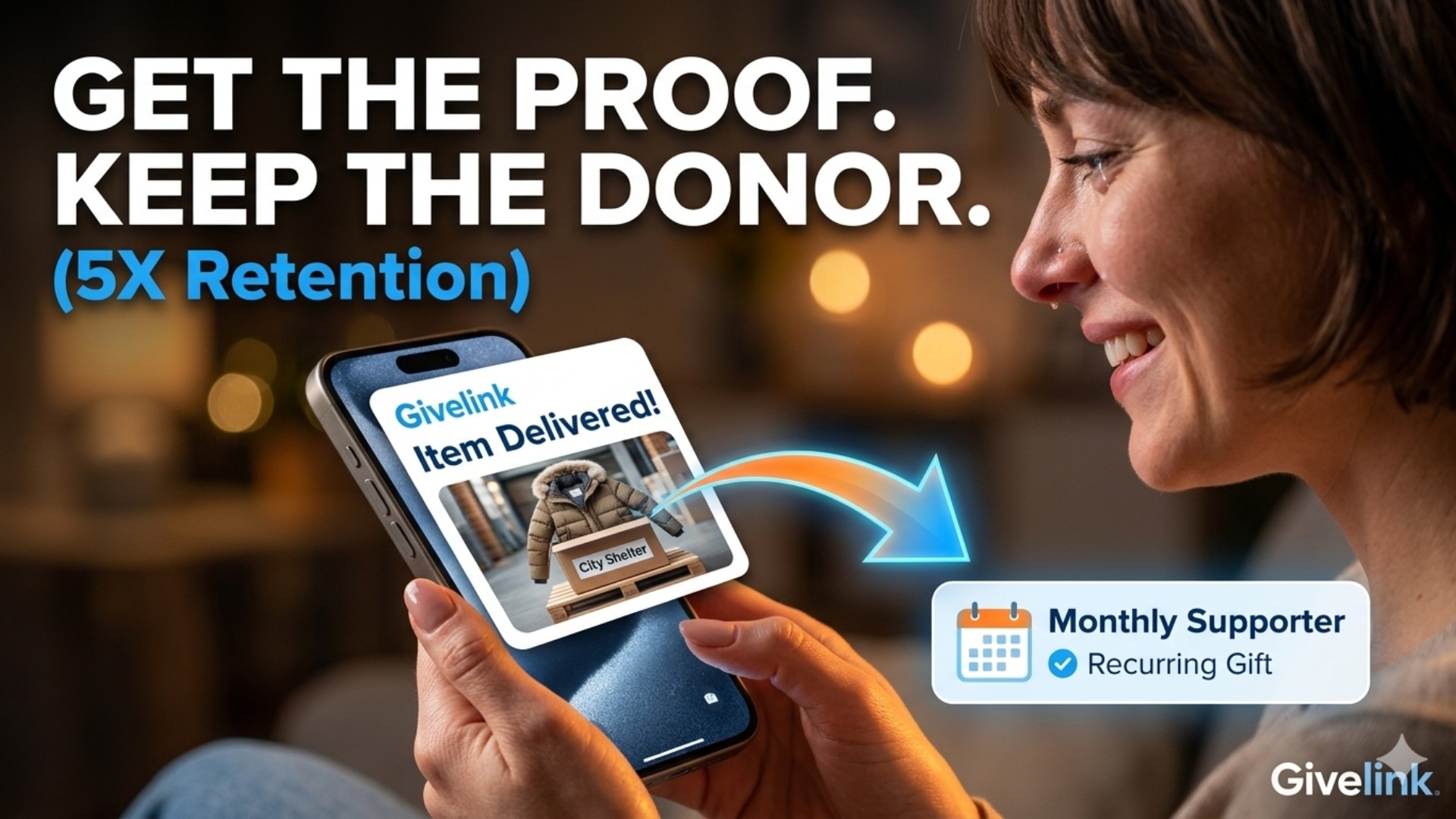
Day 1 (gift made): Order confirmation with specific items listed. Day 3–5: Shipping notification. Day 10–14: Delivery photo notification. This is the conversion moment. Day 14–16: Soft monthly giving ask — triggered by the delivery photo, not a calendar.
The delivery photo is the conversion trigger. The donor sees what their gift became. Efficacy belief is confirmed. The ask to continue giving arrives when motivation is highest — not 7 days after the transaction, but 14 days after the proof.
According to Givelink data (2026), donors who receive delivery photos give 60% more times per year than traditional donors. A significant share of that frequency comes from self-initiated return giving — donors who didn't need to be asked, who just came back because they saw what happened.
The monthly ask — timing and language
For nonprofits using Givelink, the monthly giving ask is most effective when sent within 24–48 hours of the delivery photo notification.
Language that works: "The [items] you gave arrived at [organization name] last week — you saw the photo. This is what monthly giving looks like: specific items, real proof, every two weeks. Would you like to make your giving monthly?"
Language that doesn't: "Your generous gift means so much to us. Please consider becoming a monthly supporter and help us continue our mission."
The first version connects the ask to the specific proof the donor just received. The second version is generic and disconnected.
The connection between proof and ask is the conversion mechanism. Name what they saw. Ask them to see it again.
The dashboard as a retention tool
For recurring donors on Givelink, the dashboard creates a retention loop that doesn't require active stewardship from the nonprofit:
- Recurring donor gives
- Items ship biweekly
- Nonprofit uploads delivery photo
- Photo notification goes to donor's dashboard
- Donor checks dashboard
- Donor sees updated wishlist for next month
- Donor gives again
Steps 4–7 happen without the nonprofit sending a single email. The dashboard is the stewardship system.
This is why transparent giving produces structurally higher recurring donor retention than traditional giving — the retention mechanism is in the product, not in the email sequences.
What nonprofits can do to accelerate conversion
1. Send the monthly ask within 48 hours of delivery photo upload. Timing is everything.
2. Reference the specific delivery. Name the items. Reference the photo. Connect the ask to what just happened.
3. Make the recurring option easy. A single-click "make this monthly" option in the dashboard or email converts better than a multi-step recurring gift form.
4. Show what monthly giving looks like over time. "Monthly giving produces a delivery photo every two weeks — 26 proof moments per year" is a compelling recurring giving pitch.
5. Thank recurring donors differently. A recurring donor who has given 6 times deserves a different acknowledgment than a first-time donor. Personalize the thank-you to reflect the relationship's tenure.
Why this matters in 2026
Recurring revenue is the most resilient line item in nonprofit finance. Donorbox's 2025 analysis showed monthly giving grew 5% in 2024 even as total giving grew only 3.5%. In a funding environment where federal cuts and donor count declines are squeezing community nonprofits, monthly recurring donors are the difference between organizational stability and constant crisis fundraising.
Transparent giving platforms build the conversion mechanism into the product. The proof does the selling.
Givelink in action
A youth education nonprofit tracked first-to-recurring conversion rates before and after implementing Givelink. Traditional email-based monthly ask: 12% conversion rate. Post-delivery photo monthly ask (sent within 48 hours of photo notification): 34% conversion rate. Same organization, same donors, same ask — different timing and trigger. The photo did the conversion work. Set up your free Givelink profile and build the conversion mechanism into your giving experience.
Frequently Asked Questions
When is the best time to ask a one-time donor to give monthly?
On Givelink, within 24–48 hours of the delivery photo notification — when the donor's emotional connection to the impact is highest. On traditional platforms, within 5–7 days of the first gift.
What language converts one-time donors to monthly supporters?
Language that references the specific proof the donor received: "The [items] you gave arrived — you saw the photo. This is what monthly giving looks like." Generic impact language performs significantly worse.
Does Givelink have a built-in monthly giving option?
Yes — donors can give recurring contributions through the platform. Nonprofits can also send monthly giving asks that link directly to their Givelink profile.
What's a realistic first-to-recurring conversion rate?
Traditional email-based approaches achieve 10–15%. Proof-triggered asks (tied to delivery photos) achieve significantly higher rates — 30%+ in Givelink nonprofit data.
Build the conversion into the proof.
Set up your free Givelink profile and let the delivery photo do the conversion work.
Stay Human.
Antonis Politis is CEO and Co-Founder of Givelink.
Διάβασε επίσης
Τι είναι η Givelink;
Άκου από τους ίδιους τους ιδρυτές:
Στήριξε μια οργάνωση
Κάνε τα ψώνια που χρειάζεται, online!