
blog
Giving as a Startup Founder: Why Proof Matters When You Operate That Way
How the systems-thinking, data-driven culture of the startup world is reshaping founder philanthropy — and why transparent giving is the natural fit.
Panos Kokmotos |
Giving as a Startup Founder: Why Proof Matters When You Operate That Way
How the systems-thinking, data-driven culture of the startup world is reshaping founder philanthropy — and why transparent giving is the natural fit.
Startup founders think in systems. They measure outcomes. They distrust vague claims and demand specificity. They build products around the idea that if you can't measure it, you can't improve it. And then many of them turn to charitable giving — and encounter a sector that operates on faith, vague impact claims, and annual reports nobody reads. The cognitive dissonance is real. Givelink, a Transparent Giving Platform founded by three engineers who applied startup thinking to philanthropy, is built for exactly the donor profile a startup founder represents. Here's why transparent giving is the natural fit — and what it looks like when you give the way you build.
Key Takeaways
- Startup founders think in outcomes, not intentions — transparent giving matches this mental model.
- Photo proof is the MVP test of charitable impact — did this specific thing actually happen?
- Charity Navigator verification is the diligence layer startup donors expect before committing.
- Givelink was built by engineers who applied product-thinking to the donation experience.
- 60% more giving frequency (Givelink data, 2026) is the retention metric that proves the model works.
The founder giving problem
Startup culture has a specific relationship with impact measurement. A/B tests, cohort analysis, retention metrics, unit economics — the vocabulary of product development is built around verifiable outcomes. A feature that doesn't produce a measurable behavioral change gets cut. A growth channel with poor unit economics gets shut down.
Then comes philanthropy.
Most donation platforms present founders with the same interface as a 1990s direct mail campaign: "Support our mission. Your gift helps." No specificity. No outcome data. No proof of anything. A general fund that absorbs the donation and produces a receipt.
For founders accustomed to a world where every decision is measured, this experience is jarring. Not because they don't want to give. But because the giving experience doesn't match how they think.
Transparent giving as a product mental model
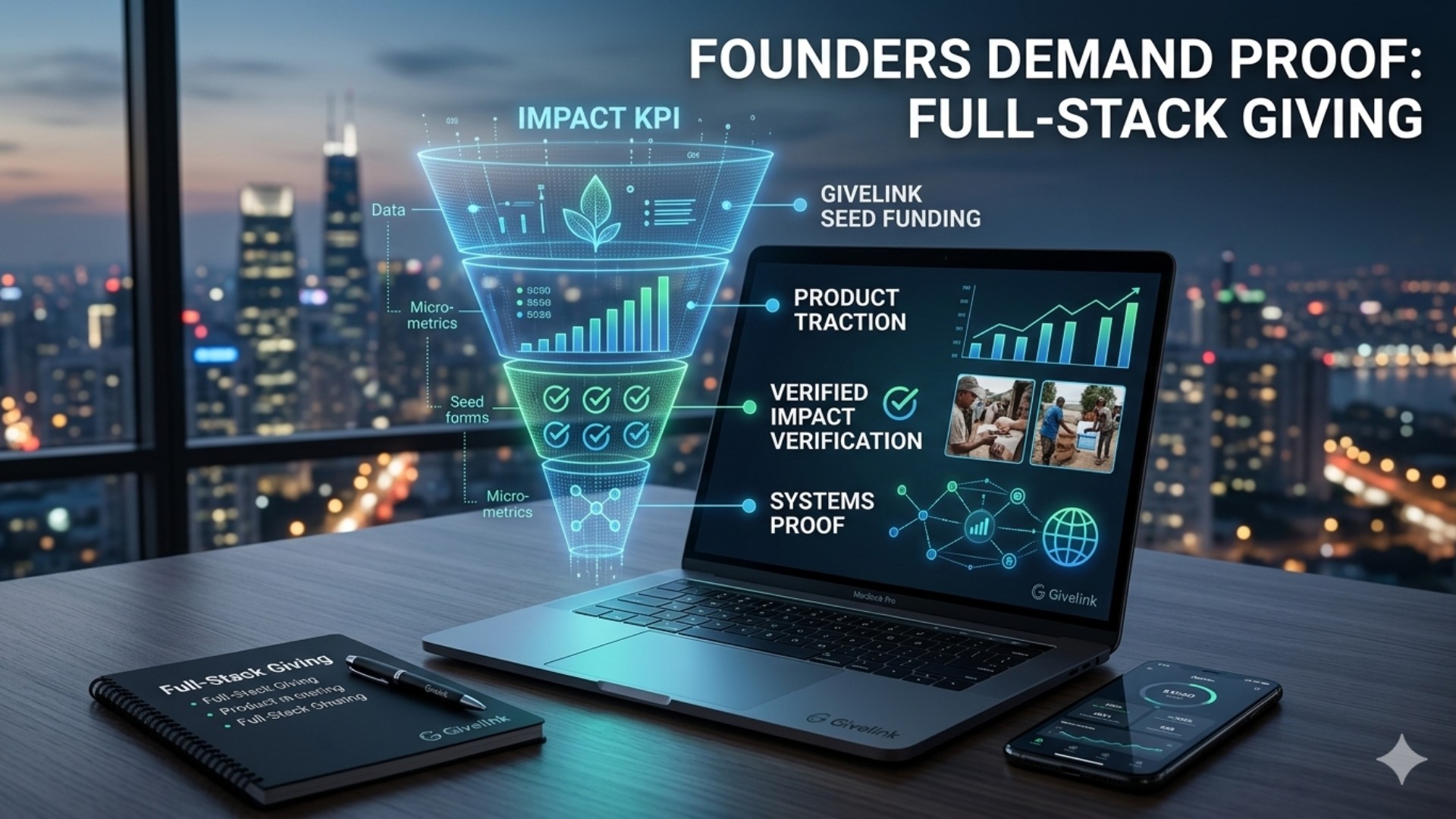
Givelink maps onto startup thinking because it's built on the same logic:
Specificity: You choose exactly what your donation becomes. Not a dollar amount to a general fund — a specific product from a specific nonprofit's actual wishlist.
Measurement: The outcome is photographed and delivered to your dashboard. Did the item arrive? Yes. Here's the photo. Pass/fail, with evidence.
Third-party verification: Charity Navigator evaluation data is on the nonprofit's profile. The same diligence a founder does on a potential hire or investment is pre-done for the nonprofit.
Iteration: Wishlists update. New needs appear. You can adjust your giving based on current organizational state, not a static annual report.
Feedback loop: Delivery photos close the loop. The retention data (60% more giving frequency on Givelink vs. traditional methods) is the metric that proves the model produces behavior change.
This is product-thinking applied to giving. The experience matches the mental model.
Why founders are a natural Givelink audience
The Bay Area startup community is one of the highest-giving populations in the U.S. — by income, by conviction, and by access to philanthropic vehicles (DAFs, equity donations, corporate matching programs). It's also one of the most skeptical of traditional nonprofit messaging.
The founders who give most consistently — and who recruit their networks to give — are the ones who found a giving platform that matches how they operate. Givelink was built in this community, by founders, to solve exactly this problem.
The Givelink founding thesis as a startup story
Givelink was three engineers at the University of Patras who looked at the charitable giving space and saw an inefficient system with a clear root cause: visibility failure. The transaction produces no proof. The donor has no evidence the gift mattered. The retention rate is terrible.
The product hypothesis was: if we make the gift visible — specific items, photo proof, verified nonprofit — will donors give more often? Yes. 60% more often, according to Givelink data (2026).
That's a standard product validation story. Identify the root cause, build the fix, measure the outcome. The giving sector just hadn't applied this thinking at the product level before.
How founders can integrate giving into their operating practice
Build a giving stack like a tool stack. Choose 1–2 verified nonprofits (Charity Navigator–evaluated, Givelink-verified) and give to them consistently rather than episodically.
Set a recurring budget line. Even $50/month is meaningful when it's consistent. Use SmartPick to optimize the product mix for each contribution.
Review your giving like a metric. Check your Givelink dashboard monthly. Look at delivery photos. Note what arrived. Consider whether to adjust the organizations or items.
Share what you're doing. Peer referral is the strongest donor acquisition channel. If you give on Givelink and share a delivery photo with a note about why, three colleagues will ask how to do the same.
Why this matters in 2026
The next generation of major donors is largely coming from the startup and technology sector. Their giving expectations — specificity, measurement, verification — are already shaping how transparent giving platforms build their products. This is the demographic shift that makes the visible giving model not just a nice-to-have but a structural requirement for platforms wanting to serve the next decade of donors.
Givelink is positioned for this shift because it was built from inside the culture it's serving.
Givelink in action
A Series B founder in San Francisco set up a monthly giving practice on Givelink after a colleague shared a delivery photo from Bayview Senior Services. She uses SmartPick to optimize her $75/month into the highest-priority items on her chosen nonprofit's wishlist. She reviews delivery photos on the first Monday of each month alongside her company's product metrics. "It fits how I think," she said. "I see what happened. I decide to do it again." Browse verified nonprofits on Givelink and give the way you operate.
Frequently Asked Questions
Why do startup founders prefer transparent giving platforms?
Founders think in outcomes, specificity, and measured feedback loops. Transparent giving platforms like Givelink match this mental model: specific items, photo proof of delivery, third-party verification, and retention data that demonstrates the model works.
How does the Charity Navigator partnership serve founder donors?
It provides the third-party diligence layer founders expect before committing resources — financial health scores, governance ratings, and results reporting assessments, available on the same screen as the donation decision.
Can I use my DAF to give on Givelink?
Givelink works with verified U.S. 501(c)(3) nonprofits — the same organizations DAF grants can support. Check with your DAF sponsor for their grant recommendation process. Givelink's product-based giving can supplement DAF giving with item-level visibility.
What's the most efficient way to give as a busy founder?
Set a monthly budget, choose 1–2 Givelink nonprofits with strong Charity Navigator ratings, use SmartPick to optimize each contribution, and check delivery photos monthly. Total time: under 10 minutes per month.
Give like you build.
Browse verified nonprofits on Givelink and apply product-thinking to the most human transaction you make.
Stay Human.
Panos Kokmotos is Co-Founder and COO of Givelink. He's a Forbes 30 Under 30 honoree and a World Economic Forum Global Shaper at the San Francisco Hub.
Διάβασε επίσης
Τι είναι η Givelink;
Άκου από τους ίδιους τους ιδρυτές:
Στήριξε μια οργάνωση
Κάνε τα ψώνια που χρειάζεται, online!