
blog
How to Give to Domestic Violence Organizations in 2026
What survivors and the organizations serving them actually need — how to give with privacy, dignity, and photo proof.

Panos Kokmotos |
How to Give to Domestic Violence Organizations in 2027
What survivors and the organizations serving them actually need — how to give with privacy, dignity, and photo proof.
Domestic violence organizations — emergency shelters, transitional housing programs, legal aid services, and advocacy nonprofits — serve some of the most vulnerable people in the United States, in conditions that require exceptional privacy protection. They also need specific, practical supplies continuously — and they receive them inconsistently because most donors default to cash or generic drive donations rather than the specific items survivors need. Givelink, a Transparent Giving Platform, serves verified domestic violence organizations with the same photo-proof model applied everywhere on the platform — with special attention to the dignity and privacy requirements unique to this cause. Here's how to give effectively and respectfully.
Key Takeaways
- DV organizations need specific supplies that generic drives consistently miss — and that survivors depend on.
- Privacy is paramount — Givelink's delivery photos show items, never people or identifiable locations.
- Domestic Violence Awareness Month (October) is the peak giving moment — wishlists update in August for advance preparation.
- Charity Navigator verification confirms organizational legitimacy before you give.
- Photo proof shows operational evidence without compromising anyone's safety.
What domestic violence organizations actually need
The supply profile reflects the specific situations of residents — often arriving with nothing, transitioning out of violence, rebuilding with children.
Emergency intake (day one for residents):
- Hygiene basics — toothbrush, toothpaste, soap, shampoo, deodorant
- New socks and underwear (adults and children)
- Feminine hygiene products
- Phone charger (critical for maintaining contact with support services)
Children in shelter:
- Diapers (sizes 3, 4, 5 — these are the sizes most consistently needed)
- Baby wipes
- Baby food and formula for infants
- School supplies for school-age children
- Books and age-appropriate activities for children in shelter
Extended stay (residents in transitional housing):
- Laundry detergent (fragrance-free)
- Cleaning supplies
- Kitchen staples
- Comfort items — journal, blanket, small personal items
Employment and court support:
- Professional clothing for job interviews and court appearances
- Transportation gift cards
- Backpacks and organizational supplies for employment support programs
The privacy requirement — and how Givelink addresses it
Domestic violence shelters operate with strict confidentiality requirements. Addresses are often confidential. Clients are never identified publicly. Photography of shelter environments requires careful management.
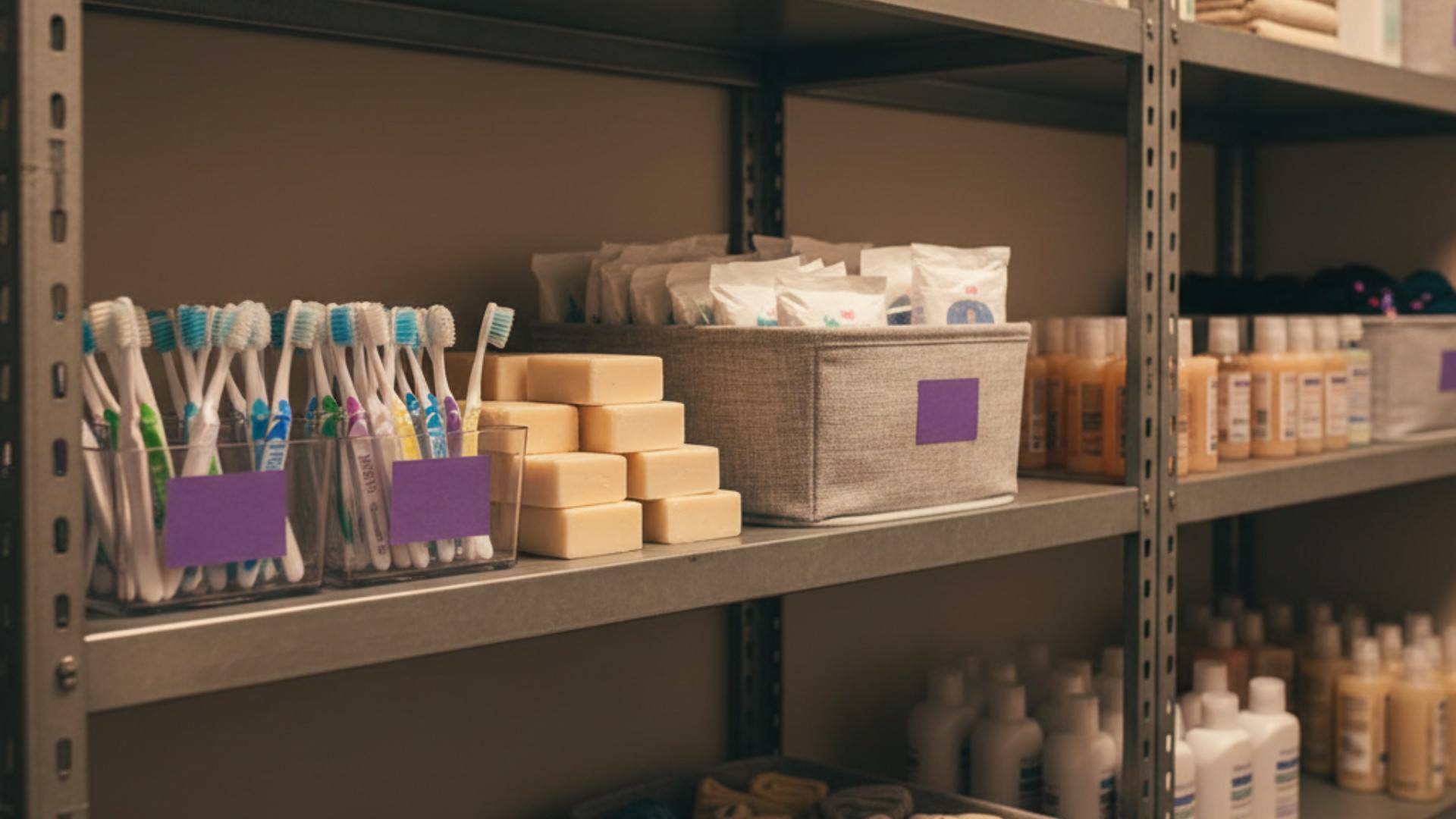
Givelink's delivery photos from DV organizations show:
- Supply room shelves with organized items
- Intake areas with supplies ready for distribution
- Storage systems, labeled bins, pantry shelves
Givelink's delivery photos from DV organizations never show:
- Client faces, names, or identifying information
- Shelter addresses or exterior locations that could identify the facility
- Any image that could compromise client safety
This is not a constraint on the photo — it's a design that produces the most honest proof available: operational evidence that supplies arrived and are ready for use, without compromising anyone's safety.
Donors who give to DV organizations on Givelink should expect these operationally-specific, people-free photos — and understand that this is the dignity standard, not an absence of proof.
October: Domestic Violence Awareness Month
October is Domestic Violence Awareness Month — the annual moment of greatest public attention to DV causes and the highest-giving period for DV nonprofits.
Givelink-onboarded DV organizations typically update their wishlists in August with October-specific items: higher quantities of intake hygiene basics, children's items for the fall school year, and warm clothing as temperatures drop.
Donors who give in October should expect delivery photos in October and November — in time to see what the awareness month giving produced. This timing makes October giving through Givelink particularly effective for retention: the photo arrives close to the giving moment, and the connection is recent.
How to verify a DV organization before giving
On Givelink: Every DV organization is pre-verified for 501(c)(3) status, address-confirmed (through a protocol that honors shelter confidentiality while confirming operational reality), and displays Charity Navigator data where available.
Red flags for DV organizations:
- No IRS database listing
- No evidence of physical operations (confirmed address process)
- Charity Navigator concerns
- Generic appeals with no program specificity
The confidential address requirement for DV shelters makes the Givelink verification protocol particularly important — our address confirmation process is designed to verify operational presence without publicly exposing shelter locations.
Why this matters in October and beyond
Domestic violence rates in the U.S. have remained persistently high despite decades of advocacy and program investment. The organizations doing the daily work of safety, recovery, and rebuilding are chronically underfunded — not because donors don't care, but because the giving experience hasn't been specific, verified, or proof-based enough to retain donors year-round.
October gives these organizations peak attention. Transparent giving gives their donors a reason to come back in November, December, and every month after.
Givelink in action
A donor who had personal experience with domestic violence in her family gave hygiene basics and children's diapers to a Bay Area DV shelter through Givelink in October. The delivery photo arrived November 5 — a supply room shelf, organized, labeled. No faces. No names. Just the evidence that the supplies were there. She wrote in her dashboard: "This is for every person who's walked into a shelter with nothing. I can't see their faces in this photo, and that's right. But I know they're there." She gives monthly. Browse verified domestic violence nonprofits on Givelink.
Frequently Asked Questions
Why do DV shelter delivery photos not show people?
Client privacy and safety are paramount for organizations serving domestic violence survivors. Photos showing items in supply rooms provide operational proof without compromising anyone's identity or safety.
Can I give to a DV shelter without knowing their address?
Yes — Givelink confirms operational addresses through a confidential verification process without publicly exposing shelter locations. Your donation is delivered to a verified address; the address itself is not shared with donors.
What size diapers should I give for DV shelters?
Sizes 3, 4, and 5 are the most consistently needed — they fit children aged 1–4, who represent a significant proportion of children in DV shelter. Always check the specific organization's wishlist for current size needs.
Is Domestic Violence Awareness Month the best time to give to DV organizations?
October is the peak awareness and giving moment. But DV organizations need supplies year-round — recurring monthly giving provides more operational stability than a single October donation.
Give what survivors need. See it arrive.
Browse verified domestic violence nonprofits on Givelink.
Stay Human.
Panos Kokmotos is Co-Founder and COO of Givelink.
Διάβασε επίσης
Τι είναι η Givelink;
Άκου από τους ίδιους τους ιδρυτές:
Στήριξε μια οργάνωση
Κάνε τα ψώνια που χρειάζεται, online!