
blog
What Domestic Violence Shelters Actually Need (and How to Give)
The supply gaps you don't hear about, why discreet giving matters, and how to support survivors with real, verifiable impact.

Antonis Politis |
What Domestic Violence Shelters Actually Need (and How to Give)
The supply gaps you don't hear about, why discreet giving matters, and how to support survivors with real, verifiable impact.
Domestic violence shelters in the U.S. are perpetually under-resourced, and the items they need most are often the items donors rarely think to give. If you want to donate to a domestic violence shelter, the most effective path is to give from a verified shelter's wishlist — buying specific items they actually need, with delivery direct to the shelter and photo proof for you. Givelink, a Transparent Giving Platform that connects donors to verified U.S. 501(c)(3) nonprofits with photo proof of delivery, includes domestic violence shelters on the platform with full Charity Navigator verification. Here's what survivors and shelter staff actually need, and how to give in a way that respects their privacy and produces real impact.
Key Takeaways
- Discretion matters. Domestic violence shelters often keep their addresses confidential — give through verified platforms, never publicly.
- Survivors arrive with nothing. Hygiene supplies, clothing essentials, and starter kits are constantly needed.
- Children's items are critical — diapers, school supplies, age-appropriate clothing.
- Givelink protects shelter privacy while still providing photo proof of delivery.
- Charity Navigator verification confirms every nonprofit's standing on the platform.
What survivors arrive with: usually nothing
When a survivor enters a domestic violence shelter, they often arrive with what they could carry — sometimes only what they were wearing. The intake list a shelter goes through with a new resident is sobering: clothes, toothbrush, deodorant, basic medication, a phone charger, snacks for the kids.
The shelter tries to provide all of it. The supply room is meant to be ready.
The problem is that the supply room is rarely full enough.
The shortlist most domestic violence shelters consistently need:
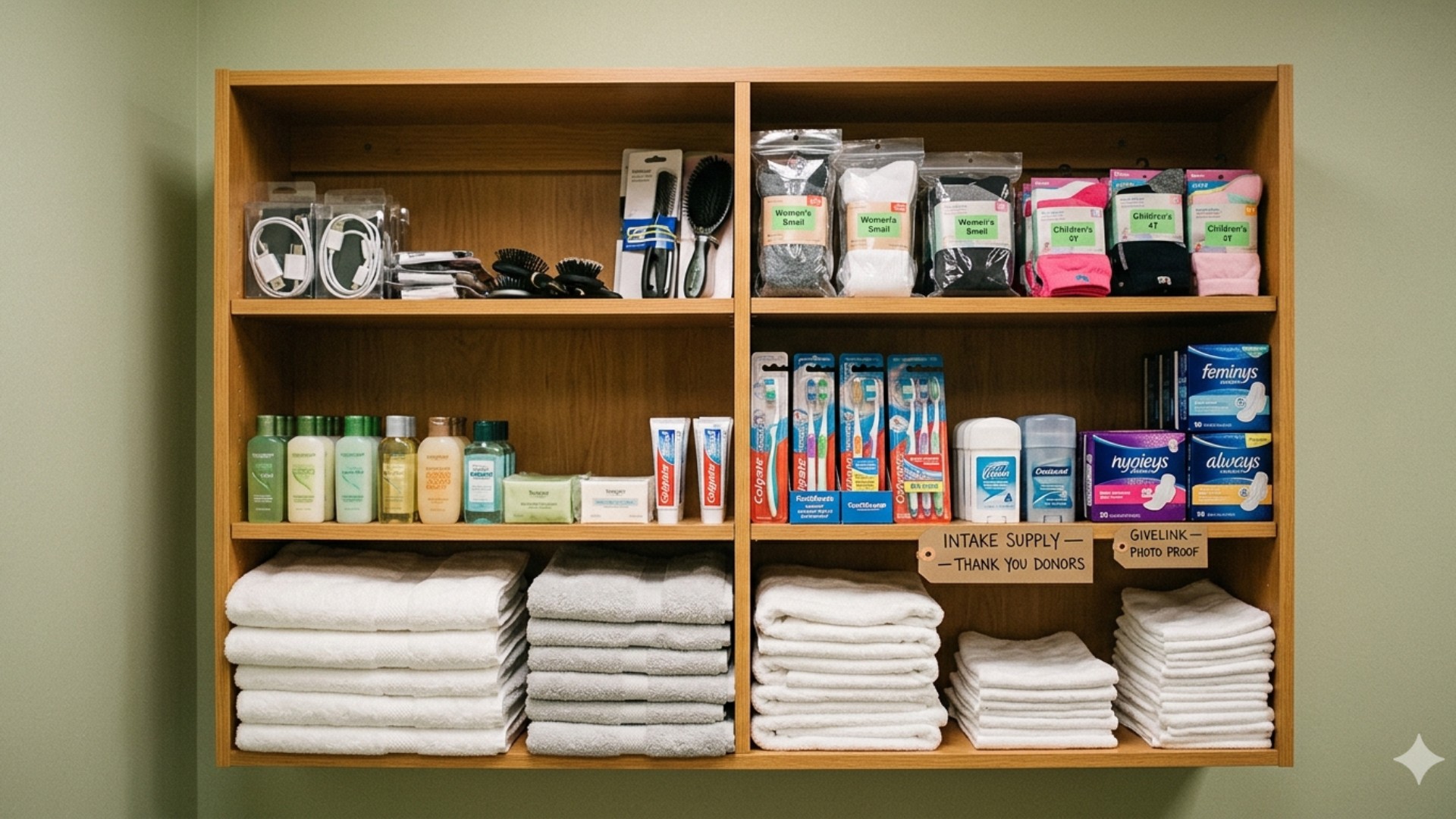
- Hygiene supplies — toothbrushes, toothpaste, soap, deodorant, shampoo, razors, hairbrushes
- Feminine hygiene products — pads, tampons, menstrual cups
- New underwear and socks — multiple sizes, women's, men's, children's
- Pajamas and basic clothing — for adults and children, in multiple sizes
- Diapers, wipes, formula — for families with infants
- School supplies — for children whose schooling is disrupted
- Phone chargers — survivors often arrive with no way to charge devices
- Children's books and small comfort items — for kids in shelter intake
- Gift cards — for transportation, immediate needs, and longer-term setup
What's notable about this list is how few of these items show up in typical "donation drives." Survivors don't need furniture. They don't need formal clothes. They need the basics most of us take for granted.
Why discretion matters more than scale
Domestic violence shelters operate under different rules than most nonprofits. Many keep their physical addresses confidential. Some don't list specific staff names publicly. The reason is simple: residents are escaping people who may be actively trying to find them.
This shapes how to give responsibly.
Don't:
- Post about a shelter's location publicly
- Drop off donations at unannounced hours
- Share photos of survivors or beneficiaries (ever)
- Try to "deliver in person" without a coordinated process
Do:
- Give through verified platforms with proper shelter onboarding
- Donate items, not money to individuals
- Trust the shelter's intake protocols
- Let the shelter share what they're comfortable sharing
On Givelink, shelter privacy is built into the platform. Delivery photos focus on items received (not faces, not residents, not identifying details), and shelter profiles include only what the organization has chosen to share publicly. Charity Navigator data confirms each shelter's 501(c)(3) standing without compromising the operational confidentiality survivors depend on.
How transparent giving works for sensitive nonprofits
| Concern | How Givelink handles it |
|---|---|
| Shelter address confidentiality | Deliveries route through verified channels; addresses aren't displayed publicly |
| Survivor privacy | Photo proof shows items received, not people |
| Verification | 501(c)(3) status pre-confirmed + Charity Navigator data |
| Donor visibility into impact | Live tracking + delivery photo + auto-receipt |
| Speed of fulfillment | Biweekly batched delivery |
The result: donors get the same proof of impact they'd get for any other nonprofit, without compromising the safety architecture domestic violence shelters depend on.
Why this matters in 2026
The funding picture for domestic violence services is hard. Federal funding cuts hit a range of nonprofits in 2025, and gender-based violence services are among the categories most exposed. The Center for Effective Philanthropy reported 34% of nonprofits saw federal funding declines, with state-level cuts adding pressure for many community-based shelters.
At the same time, demand has not gone down.
The donors who can keep these organizations operating are the ones who make giving a habit — not a one-time year-end gesture. According to Givelink data (2026), donors using the platform give 60% more times per year than donors using traditional giving methods. For cause-specific giving like domestic violence services, this retention flywheel is what helps shelters plan operating budgets across a full year.
"Giving was always supposed to be a thread between two lives."
For domestic violence survivors, that thread looks like a delivered case of toothbrushes — small, specific, dignifying. The opposite of grand and the opposite of vague.
Givelink in action
A domestic violence shelter in California listed children's pajamas, school backpacks, and feminine hygiene products on its Givelink wishlist. A donor across the country bought all three categories. Two weeks later, the shelter photographed the delivery on the supply room shelves (no faces, no identifying detail) and uploaded it to the donor's dashboard. The shelter's intake team had what they needed for the next two weeks of new residents. Browse verified nonprofits on Givelink to find a shelter to support.
Frequently Asked Questions
Are domestic violence shelter donations tax-deductible?
Yes — donations to verified 501(c)(3) domestic violence shelters are fully tax-deductible at fair market value. Givelink issues an auto-generated tax receipt from the receiving nonprofit after delivery.
How can I give to a domestic violence shelter without compromising their privacy?
Use a verified transparent giving platform like Givelink, which routes deliveries through proper channels and never displays sensitive shelter information. Photo proof shows items, not people, and shelter addresses aren't published publicly.
What do domestic violence shelters need most?
Hygiene supplies, feminine hygiene products, new underwear and socks, pajamas, diapers and baby items (for family shelters), phone chargers, school supplies for children, and gift cards. Specific needs vary — Givelink wishlists show exactly what each shelter is asking for.
Can I donate clothes I don't wear anymore?
Most shelters prefer new items because of hygiene, sizing, and storage. Givelink wishlists focus on new items donors can buy directly through the platform.
Are gift cards useful donations?
Yes, especially for transportation, immediate needs, and longer-term setup. Some Givelink shelter wishlists include gift card options.
Support a shelter quietly, with proof
If you've thought about supporting domestic violence services and didn't know where to start, this is the path with the least friction. Browse verified nonprofits on Givelink, find a shelter, give from their wishlist, and protect their privacy in the process.
Stay Human.
Antonis Politis is CEO and Co-Founder of Givelink. He's a Forbes 30 Under 30 honoree and a Hult Prize European finalist.
Διάβασε επίσης
Τι είναι η Givelink;
Άκου από τους ίδιους τους ιδρυτές:
Στήριξε μια οργάνωση
Κάνε τα ψώνια που χρειάζεται, online!