
blog
How to Use Delivery Photos to Tell Your Nonprofit's Story
Every box that arrives at your organization is a story. Here's how to turn proof-of-delivery photos into your most powerful content.
Panos Kokmotos |
How to Use Delivery Photos to Tell Your Nonprofit's Story
Every box that arrives at your organization is a story. Here's how to turn proof-of-delivery photos into your most powerful content.
Most nonprofits spend hours writing appeal letters and annual reports. They spend almost no time capturing the moment a donation arrives — the box on the table, the staff member sorting items, the resident's face when they see what donors gave them. This is backwards. The arrival moment is the most powerful proof point in the entire giving cycle, and it takes thirty seconds to photograph. Givelink, a Transparent Giving Platform that connects donors to verified U.S. 501(c)(3) nonprofits with photo proof of delivery, built delivery confirmation into the product because a single photo does more for donor relationships than a year of email newsletters. Here is how to use it.
Key Takeaways
- Delivery photos are the single most effective retention touchpoint — they close the loop that every other giving experience leaves open.
- Nonprofits upload photos through Givelink's dashboard — they go directly to the donor's account with no extra effort.
- The same photo serves multiple purposes — donor retention, social media, grant reporting, email newsletters.
- Givelink donors give 60% more times per year than traditional donors (Givelink data, 2026) — proof is the driver.
- Authenticity beats production value — a real photo on a real shelf outperforms a polished campaign image.
Why a photo outperforms a thank-you email
The standard post-donation communication sequence: automated thank-you email, donation receipt, occasional newsletter, maybe an annual impact report. This sequence is better than silence. It is not proof.
A donor who receives a photo of the exact items they chose — sitting on a shelf at the exact organization they gave to, timestamped within two weeks of their gift — experiences something fundamentally different.
The photo answers three questions simultaneously: Did it arrive? What did it become? Was it real?
No thank-you email answers all three. The photo does. And when the answer is "yes, yes, and yes," the donor gives again. That is the retention mechanism — not more communication, but better proof.
The Fundraising Effectiveness Project's 2025 report found that nonprofits with visual, specific impact confirmation retain first-year donors at nearly double the national average. One photo, handled consistently, is the highest-leverage retention action available to a nonprofit of any size.
How the Givelink photo workflow works
For nonprofits on Givelink, the delivery photo process is built into the platform:
- Givelink delivers batched donations to your organization on a biweekly cycle, coordinated with your team.
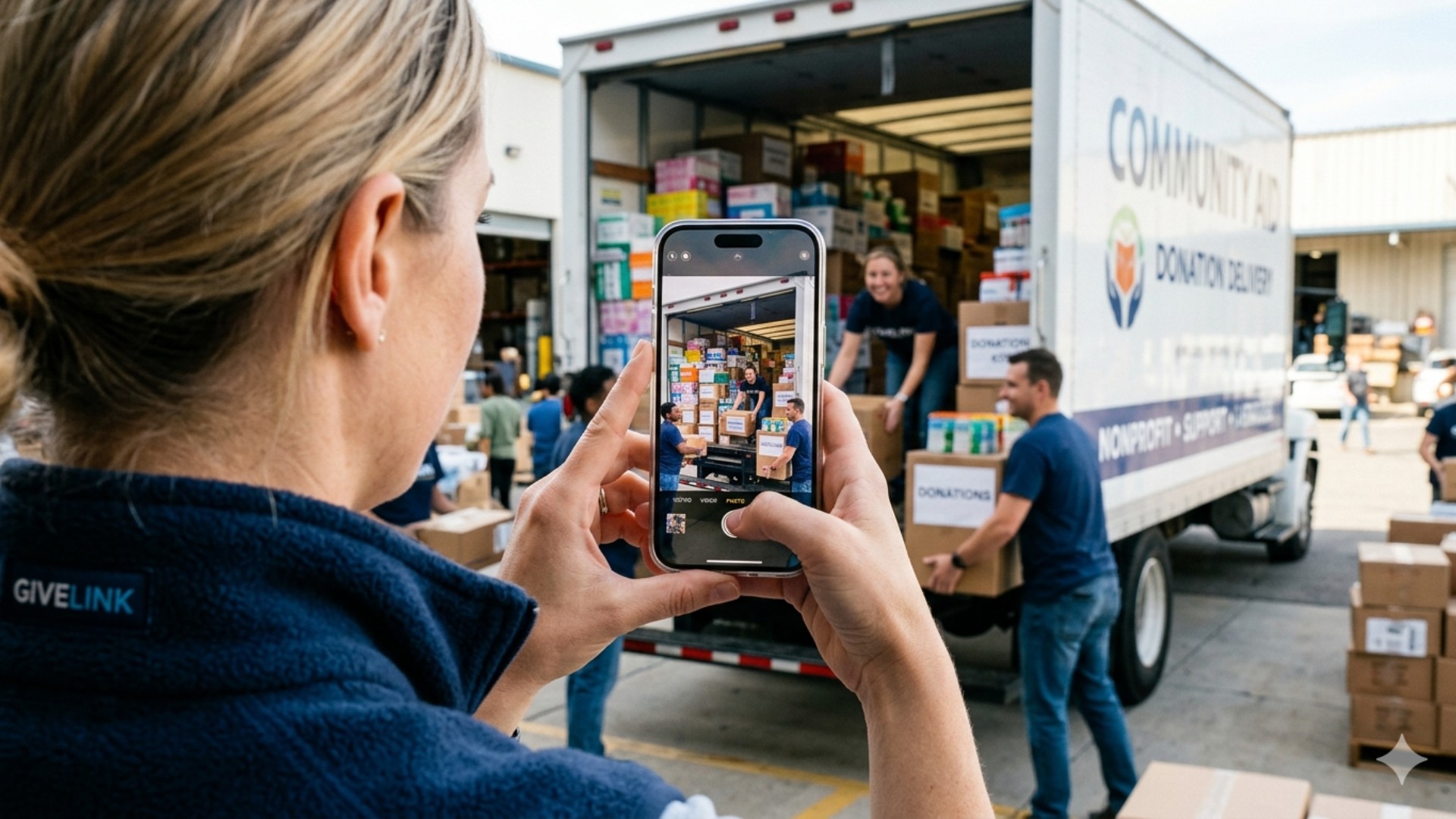
- When items arrive, your staff photographs them — a simple shelf photo showing the received goods is sufficient. No professional equipment needed.
- You upload the photo through your Givelink dashboard. It takes about sixty seconds.
- The photo automatically routes to the dashboards of every donor whose items were in that delivery.
- Each donor receives a notification — "Your donation arrived. Here's the proof."
The entire process requires no design work, no copywriting, and no email campaign. The platform handles delivery routing. Your staff handles the photograph.
"Giving was always supposed to be a thread between two lives."
The photo is the thread made visible.
Taking a photo that does the work
Production value is not the point. Authenticity is.
A photo that shows a real shelf, real items, a real team member — even with a phone camera in average lighting — is more powerful than a stock-photo-quality image that looks constructed. Donors are sophisticated. They can see when something is staged.
Three principles for a high-impact delivery photo:
Show the items, not just a box. The donor gave specific things. Unbox them. Lay them out on a table or organize them on a shelf. The visual specificity confirms their specific gift landed.
Include a person where you can. A staff member's hands unpacking items, or a team member with the received goods, adds humanity without requiring any client face. The donor gave to people — let them feel that.
Don't over-edit. A quick crop and brightness adjustment is fine. Filters, overlays, and heavy branding dilute the authenticity that makes the photo work.
Extending the photo beyond donor delivery
The same photo that goes to donors through Givelink has at least four more uses:
Social media. Post it with a simple caption: "This week's deliveries from our Givelink donors. Here's what arrived." Tag donors if they've shared their giving publicly. The photo is the content — no campaign copy needed.
Email newsletter. A monthly or quarterly roundup of delivery photos from the period is more compelling than any program narrative. "Here's what your community gave us this quarter" with four photos is a newsletter that donors read.
Grant reports. Foundations increasingly ask for evidence of donor engagement and operational activity. A library of delivery photos with timestamps is primary-source documentation that no written report replaces.
Board presentations. A slide deck with delivery photos from the year, matched to the nonprofit's wishlist items, is the most vivid way to communicate program vitality to a board. It shows the mission working, not described.
Building a photo habit on your team
One person. One phone. Sixty seconds per delivery.
Designate who is responsible for the delivery photo on each Givelink cycle. It should be a staff member who is present when shipments arrive — a program coordinator, an operations lead, or an office manager. Add "photograph delivery and upload to Givelink" to the standard receiving checklist alongside signing the delivery confirmation.
The habit takes three weeks to establish and produces a content library and a retention tool simultaneously. For a nonprofit with minimal staff capacity, this is the highest return-per-minute content activity available.
Why this matters in 2026
Donor trust in charitable institutions continues to face headwinds. The 2025 Edelman Trust Barometer found nonprofit trust lower than in any year prior to 2020. In this environment, assertion — "we use donations well" — is insufficient. Evidence — "here is the photo of what your donation became" — is what moves skeptical donors from one-time givers to repeat supporters.
Givelink in action
A domestic violence services organization in Southern California adopted the delivery photo workflow after joining Givelink. Their staff designated a five-minute "photo window" on every delivery day. Within four months, their repeat donor rate had climbed from 21% to 38%. The delivery photos became their most shared social content. Three major donors cited the photos as the reason they increased their giving. Set up your free Givelink profile and build the proof library your donors are waiting for.
Frequently Asked Questions
How do nonprofits share proof of delivery with donors?
Through Givelink's dashboard, delivery photos upload directly to the platform and route automatically to the dashboards of donors whose items were in that delivery. Donors receive a notification when their photo arrives.
What makes a good nonprofit delivery photo?
Authenticity over production value. Show the specific items received, include a staff member where possible, and avoid heavy editing. A real phone photo in natural light outperforms a staged campaign image.
Can delivery photos help with grant reporting?
Yes. A library of timestamped delivery photos is primary-source documentation of donor engagement and program activity — increasingly requested by foundations as evidence of operational transparency.
Does taking delivery photos require special equipment?
No. A phone camera and a tidy shelf are sufficient. The point is proof and authenticity, not production quality.
Your next delivery is a story waiting to happen
Set up your free Givelink profile and turn every arrival into a moment donors will remember.
Stay Human.
Panos Kokmotos is Co-Founder and COO of Givelink. He has worked alongside nonprofit teams across two continents and believes that visibility — not volume — is what builds lasting donor relationships.
Διάβασε επίσης
Τι είναι η Givelink;
Άκου από τους ίδιους τους ιδρυτές:
Στήριξε μια οργάνωση
Κάνε τα ψώνια που χρειάζεται, online!