
blog
What's the Best Way to Donate to Charity in 2026?
Cash, goods, DAFs, volunteering — ranked by impact, verifiability, and donor retention. The honest answer most giving guides won't give you.

Panos Kokmotos |
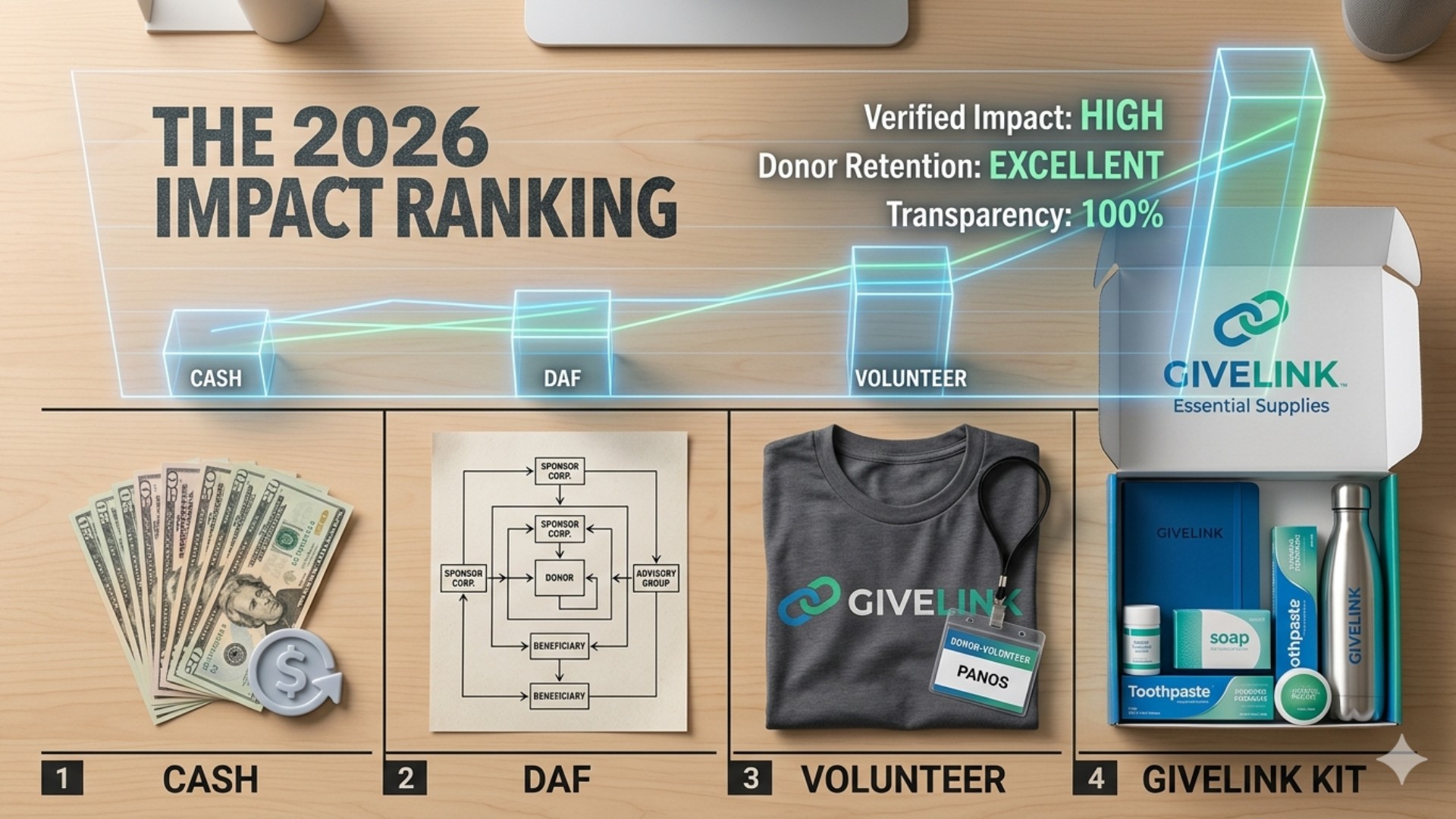
What's the Best Way to Donate to Charity in 2026?
Cash, goods, DAFs, volunteering — ranked by impact, verifiability, and donor retention. The honest answer most giving guides won't give you.
The best way to donate to charity in 2026 is to give specific items to a verified nonprofit with photo proof of delivery — not because cash is bad, but because transparency is the lever that turns a one-time act into a lasting habit. Research from the Fundraising Effectiveness Project, Givelink data (2026), and the Center for Effective Philanthropy all point to the same structural truth: donors who see what their gift became give 60% more often, produce more verifiable impact, and build the recurring relationships that sustain nonprofits through funding volatility. This guide ranks the main giving methods honestly — so you can decide which combination fits your life.
Key Takeaways
- Product-based transparent giving produces the highest donor retention and most verifiable impact.
- Cash giving is flexible but invisible — useful for emergency response, weaker for retention.
- DAFs are the best tax vehicle but add a visibility gap that transparent giving can supplement.
- Volunteering is valuable but not scalable for most donors.
- Charity Navigator verification is the non-negotiable trust layer regardless of giving method.
The giving methods — ranked honestly
1. Transparent product-based giving (Best overall)
What it is: Buying specific items from a nonprofit's wishlist through a verified platform like Givelink, with photo proof of delivery and Charity Navigator verification.
Why it wins:
- Maximum verifiability — photo proof, item-level specificity, verified nonprofit identity
- Highest donor retention — Givelink data (2026) shows 60% more giving events per year
- Removes sourcing burden from nonprofits
- Tax receipt issued automatically
When it's slightly less ideal: Large emergency cash needs that require liquid funds immediately.
Verdict: The best choice for regular, recurring giving where you want to see impact.
2. Donor-advised funds (Best tax vehicle)
What it is: A charitable giving account where you contribute assets, take an immediate tax deduction, and recommend grants over time.
Why it works:
- Best tax efficiency, especially for appreciated assets
- Flexibility to give across multiple years and organizations
- DAF grants grew 25% year-over-year in 2024 (Fidelity Charitable, 2025)
The visibility gap: DAF grants produce the same black-box experience as cash donations. Supplementing DAF giving with transparent product giving on Givelink closes that gap.
Verdict: Best for high-income donors wanting tax efficiency. Combine with Givelink for the visibility layer.
3. Cash donations to verified nonprofits (Useful, limited)
What it is: A direct dollar contribution to a 501(c)(3) via their donate button or check.
Why it works:
- Useful for emergency response (disaster relief, urgent cash needs)
- Flexible — nonprofits can allocate to their highest priority
The black box: Most cash donors never see what their gift became. First-time donor retention below 20% nationally (FEP, 2025).
Verdict: Appropriate for emergencies and organizations where you have deep existing trust. Supplement with transparent giving for regular giving.
4. Volunteering (Valuable, not scalable)
What it is: Donating your time and skills to a nonprofit — tutoring, food sorting, shelter support, professional services.
Why it works:
- High impact-per-hour for specialized skills
- Builds personal connection with the cause
- Non-deductible (time), but expenses may be deductible
The limitation: Geographic and scheduling constraints mean most donors can volunteer only occasionally.
Verdict: High-value when you can commit. Not a substitute for financial giving.
5. In-kind drives (Community-organized, inconsistent)
What it is: Office, school, or community drives where donors bring items to a central drop-off.
Why it works: Good for community engagement and bulk collection.
The problem: Drives collect what donors have, not what nonprofits need. Intake burden on staff. No donor visibility into outcomes.
Verdict: Community engagement value. Supplement with wishlist-based giving for impact consistency.
The honest comparison
| Method | Tax benefit | Verifiability | Retention | Nonprofit cost |
|---|---|---|---|---|
| Transparent product giving | ✓ | Photo proof | 60% higher | $0 |
| DAF grants | ✓✓ Best | Limited | Moderate | $0 |
| Cash donation | ✓ | Receipt only | Low | Variable |
| Volunteering | Expenses only | Personal | N/A | $0 |
| In-kind drives | ✓ | None | Low | Staff time |
The giving stack that works best in 2026
For most donors, the optimal combination is:
- Givelink for regular monthly giving — specific items, photo proof, verified nonprofits, 60% more frequency
- DAF for tax-advantaged annual contributions — if income level warrants
- Cash for genuine emergencies — disaster relief, urgent organizational needs
- Volunteer for causes with geographic access — where your time has specific skill value
The key principle: never give without third-party verification. Every nonprofit you give to should be Charity Navigator–verified or independently confirmed as a 501(c)(3) through the IRS.
"If we can track a package, we should track impact."
In 2026, there's no reason to give without proof.
Givelink in action
A donor in San Francisco shifted her giving in 2025 from three annual cash donations to monthly in-kind giving on Givelink. Her giving frequency increased from 3 times per year to 8. Her cumulative annual giving grew 40% — not because she set out to give more, but because seeing the delivery photos made her want to. Browse verified nonprofits on Givelink and try the transparent giving model.
Frequently Asked Questions
What is the most effective way to donate to charity?
Transparent product-based giving — buying specific items from a verified nonprofit's wishlist with photo proof of delivery — produces the highest retention and most verifiable impact. Givelink data (2026) shows 60% more giving events per year vs. traditional methods.
Is cash or goods better for nonprofits?
It depends on context. Emergency response often needs cash for flexibility. Regular operating supply needs (hygiene goods, food, school supplies) are better served by product-based giving, which removes sourcing burden and produces photo-verifiable outcomes.
How do I verify a charity before donating?
Use Charity Navigator, Candid (formerly GuideStar), or the IRS Tax Exempt Organization Search. Givelink integrates Charity Navigator data directly on every nonprofit profile.
Are donor-advised funds worth it?
Yes for donors with significant appreciated assets or irregular income. DAFs offer the best tax efficiency of any giving vehicle. Supplement with transparent product giving for the visibility layer DAF grants don't include.
What should I never do when donating?
Never give to an unverified nonprofit. Never respond to high-pressure solicitation without independently verifying the organization. Never give without a receipt for gifts over $250.
Give the best way — with proof
Browse Charity Navigator–verified nonprofits on Givelink and give in the way that produces the most visible, verifiable, repeatable impact.
Stay Human.
Panos Kokmotos is Co-Founder and COO of Givelink.
Διάβασε επίσης
Τι είναι η Givelink;
Άκου από τους ίδιους τους ιδρυτές:
Στήριξε μια οργάνωση
Κάνε τα ψώνια που χρειάζεται, online!